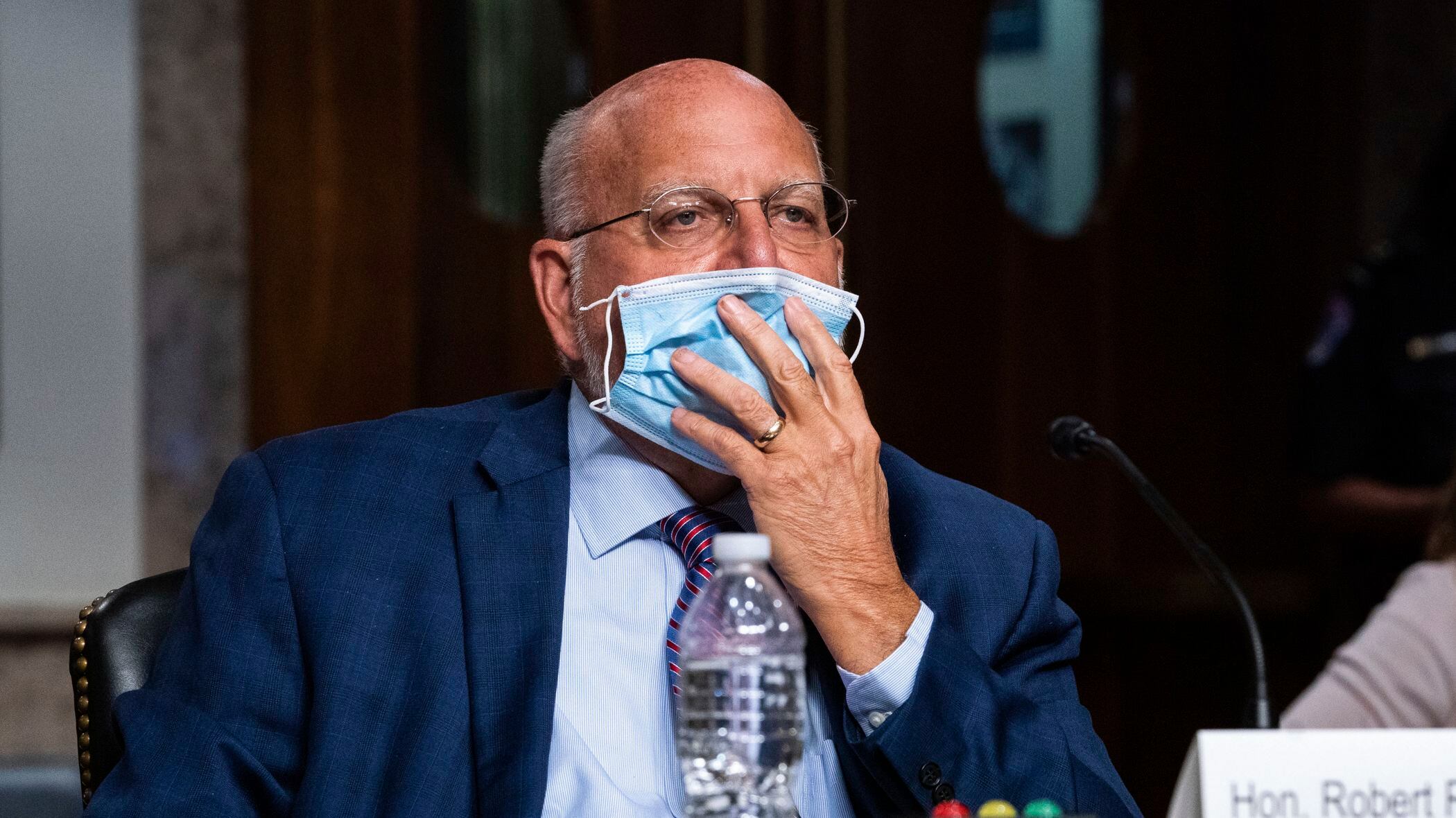
Dr. Robert Redfield, director of the Centers for Disease Control and Prevention testifies at a hearing with the Senate Appropriations Subcommittee on Labor, Health and Human Services, Education, and Related Agencies, on Capitol Hill in Washington, Wednesday, Sept. 16, 2020. (Anna Moneymaker/New York Times, Pool via AP)
By Mike Stobbe
U.S. health officials on Friday dropped a controversial piece of coronavirus guidance and said anyone who has been in close contact with an infected person should get tested.
The Centers for Disease Control and Prevention essentially returned to its previous testing guidance, getting rid of language posted last month that said people didn't need to get tested if they didn't feel sick. That change had set off a rash of criticism from health experts who couldn't fathom why the nation's top public health agency would say such a thing amid the pandemic.
It was "not consistent with the basic principles of controlling an epidemic," said Dr. Silvia Chiang, a pediatric infectious diseases expert at Brown University who applauded the change announced Friday.
The CDC now says anyone who has been within 6 feet of an infected person for at least 15 minutes should get a test. In a statement, the agency called the changes a "clarification" that was needed "due to the significance of asymptomatic and pre-symptomatic transmission."
Agency officials declined additional comment.
Health officials were evasive about why they had made the change in August, and some outside observers speculated it was forced on the CDC by political appointees within the Trump administration.
At the time, administration officials said the language originated at the CDC but the decision came out of meetings of the White House coronavirus task force. Dr. Brett Giroir, an assistant secretary at the Department of Health and Human Services, said many federal leaders outside the agency were involved in "lots of editing, lots of input." He said it was difficult to attribute the final language to any one source.
The New York Times, citing internal federal documents and unnamed sources, on Thursday reported that the guidance was placed on the CDC's website over the objections of agency scientists.
Public health experts have noted that testing the contacts of infected people is a core element of efforts to keep outbreaks in check and that a large percentage of those infected with the coronavirus exhibit no COVID-19 symptoms.
The CDC's chief, Dr. Robert Redfield, issued a statement shortly after the controversy erupted that did little to clarify why the change was deemed necessary. The main intent seemed to be to assure state health officials that they could continue to recommend that all close contacts be tested if they felt that was wisest, despite the website language that said it was not necessary.
During a U.S. Senate hearing on Wednesday, Redfield continued to defend the language that was dropped Friday. He said the August changes had been "misinterpreted" and were part of an effort to increase engagement by doctors and local health officials in the handling of potential illness clusters.
___
The Associated Press Health and Science Department receives support from the Howard Hughes Medical Institute's Department of Science Education. The AP is solely responsible for all content.
Liana Guzmán, CEO of FOLX Health, joins Cheddar News to discuss the company launching billboards across the country in response to anti-LGBTQ+ legislation.
President Biden has announced an additional $800 million in military assistance to Ukraine, including artillery, armored personnel carriers, and helicopters. It comes as Russian forces appear to be preparing for a new, aggressive offensive in the eastern part of Ukraine. Paul McLeary, defense reporter for Politico, joined Cheddar to discuss this new round of aid and what it means for the U.S. commitment to arming the embattled country.
Catching you up on what you need to know on April 18, 2022, with Russian missile attacks on the Ukrainian city of Lviv killing seven, mass shootings in South Carolina and Pittsburgh, Lucky Charms cereal under official investigation by the FDA, and more.
Activism is growing around the country in response to school boards banning books from shelves that focus on sexuality, gender, identity, or race. Jen Cousins, co-founder of The Florida Freedom to Read Project, joins Cheddar News to discuss.
As the Russian invasion of Ukraine intensifies, President Biden has announced a ban on importing Russian oil, gas, and energy. To discuss how this ban will impact the war and Americans, Amir Handjani, non-resident fellow at Quincy Institute, joins Cheddar News.
Thousands of protesters around the world are expressing their solidarity with Ukraine against Russia's invasion.
Jason Beardsley, national executive director of the Association of the U.S. Navy and national security expert, joins Cheddar News to discuss.
As gas prices surge amid the Russian invasion of Ukraine, other nations could potentially transition faster to using clean energy than previously expected. Philip K. Verleger, a senior fellow at the Niskanen Center, joined Cheddar News to explain how this could be a possibility in the near future. "Part of the reason I think we have this invasion and the tantrum that's being thrown by Russia, terrible tantrum, is because the Russians were trying to slow down the transition," he said. "Ironically they speeded it up."
Following the invasion of Ukraine, a multitude of Western companies have paused doing business with Russia. PepsiCo, Coca-Cola, McDonald's, and Starbucks are the most recent companies to temporarily cease operations in Russia. Dean of Miami Herbert Business School at the University of Miami, John Quelch, joined Cheddar News to discuss what message this sends to Russia and the Russian consumer. “I would not underestimate the collective strength of all of these multinational companies, essentially coming together to make their collective statement in support of the political statements that have come out of Washington," he said.
The war in Ukraine continues to reveal heartbreaking gut-wrenching stories. The war in itself is not only devastating but also expensive. Experts estimate that Russia is draining nearly $20 million dollars each day to continue occupying and invading Ukraine. All this could force the country to turn to cryptocurrencies. It's a major turn for the country that briefly considered outlined digital assets entirely, but it could also have serious implications for cryptos. Managing Director at Quantum Fintech Group, Harry Yeh, joined Cheddar to discuss more.