President Joe Biden is hoping to get the bipartisan infrastructure deal on track by highlighting its expected economic benefits, stressing its $973 billion would include the largest investment in transportation in nearly a century and millions of jobs would be created.
White House officials issued an internal memo highlighting the impact on jobs and growth ahead of Biden leaving Tuesday for Wisconsin to make his case directly to voters. The memo, obtained by The Associated Press, notes that the total is four times the size of the infrastructure investment made a dozen years ago in response to the Great Recession and the biggest infrastructure package since Franklin Roosevelt's New Deal.
It also emphasizes an analysis suggesting that 90% of the jobs generated by the spending could go to workers without college degrees, a key shift as a majority of net job gains before the pandemic went to college graduates.
“This is a blue-collar blueprint to rebuild America,” the memo says.
Potential economic gains were a shared incentive for the group of Democratic and Republican senators who agreed to the deal on Thursday. But the process briefly fell into disarray as Biden suggested the deal would be held up until he also received a separate package for infrastructure, jobs and education that would be determined solely by Democrats through the budget reconciliation process.
Biden said Saturday that this was not a veto threat and by Monday the package appeared back on track.
White House Press Secretary Jen Psaki said Monday that Biden is “eager” for both bills to be approved by Congress and is going to “work his heart out” to make it happen.
“The president intends to sign both pieces of legislation into law,” Psaki said at her daily briefing.
Approval of both bills by Congress remains a long haul with this summer's initial votes expected in July. Senate Republican Leader Mitch McConnell questioned the legislative process ahead and mounted fresh obstacles speaking Monday in Kentucky.
McConnell said he has not yet decided if he will support the bipartisan package, but he wants Biden to pressure House Speaker Nancy Pelosi and Senate Democratic leader Chuck Schumer to say they will allow the bipartisan arrangement to pass without mandating that the much larger and broader follow-up bill be in place.
“I appreciate the president saying that he’s willing to deal with infrastructure separately, But he doesn’t control the Congress,” McConnell said at a press conference in Louisville.
The two bills had always been expected to move in tandem, and that is likely to continue as Biden drops his veto threat but reaches across the aisle for the nearly $1 trillion bipartisan package and as well as his own broader package. The Democratic leaders are pressing ahead on the broader bill, which includes Biden's families and climate change proposals as well as their own investments in Medicare, swelling to some $6 trillion.
The Democratic leaders did not immediately respond to McConnell's remarks.
The prospect of additional economic gains might be a way to garner public support and soothe partisan tensions. Biden also faces pressure from Democrats such as New York Rep. Alexandria Ocasio-Cortez, who told NBC's “Meet the Press” that the spending isn't as huge as it might seem because the sums are spread out over multiple years.
The eight-page White House memo comes from Brian Deese, director of the National Economic Council, and senior adviser Anita Dunn. It indicates that the $110 billion for roads and bridges would help relieve traffic and congestion that costs the economy over $160 billion annually. The memo justifies the $48.5 billion planned for public transit by citing studies that link light rail and buses to increased earnings and employment for workers. It defends the $66 billion for repairs and upgrades for rail lines by saying that current delays and disruptions weigh on growth.
The bipartisan agreement also would help nurture the market for electric vehicles, improve broadband access, repair water lines and create resilience against damage from extreme weather events.
Associated Press writer Lisa Mascaro in Washington and Bruce Schreiner in Louisville, Ky. contributed to this report.
California's new composting law will affect what residents do in their kitchens. As of this week, Californians will have to recycle excess food in an effort to reduce emissions caused by food waste. Cities and counties will turn recycled food into compost or use it as a renewable energy source. California's new law is the largest mandatory residential food waste recycling program in the country. Rachel Wagoner, Director of the California Department of Resources, Recycling and Recovery called the law 'the biggest change to trash' since recycling started in the 1980s. She joined Cheddar Climate to discuss.
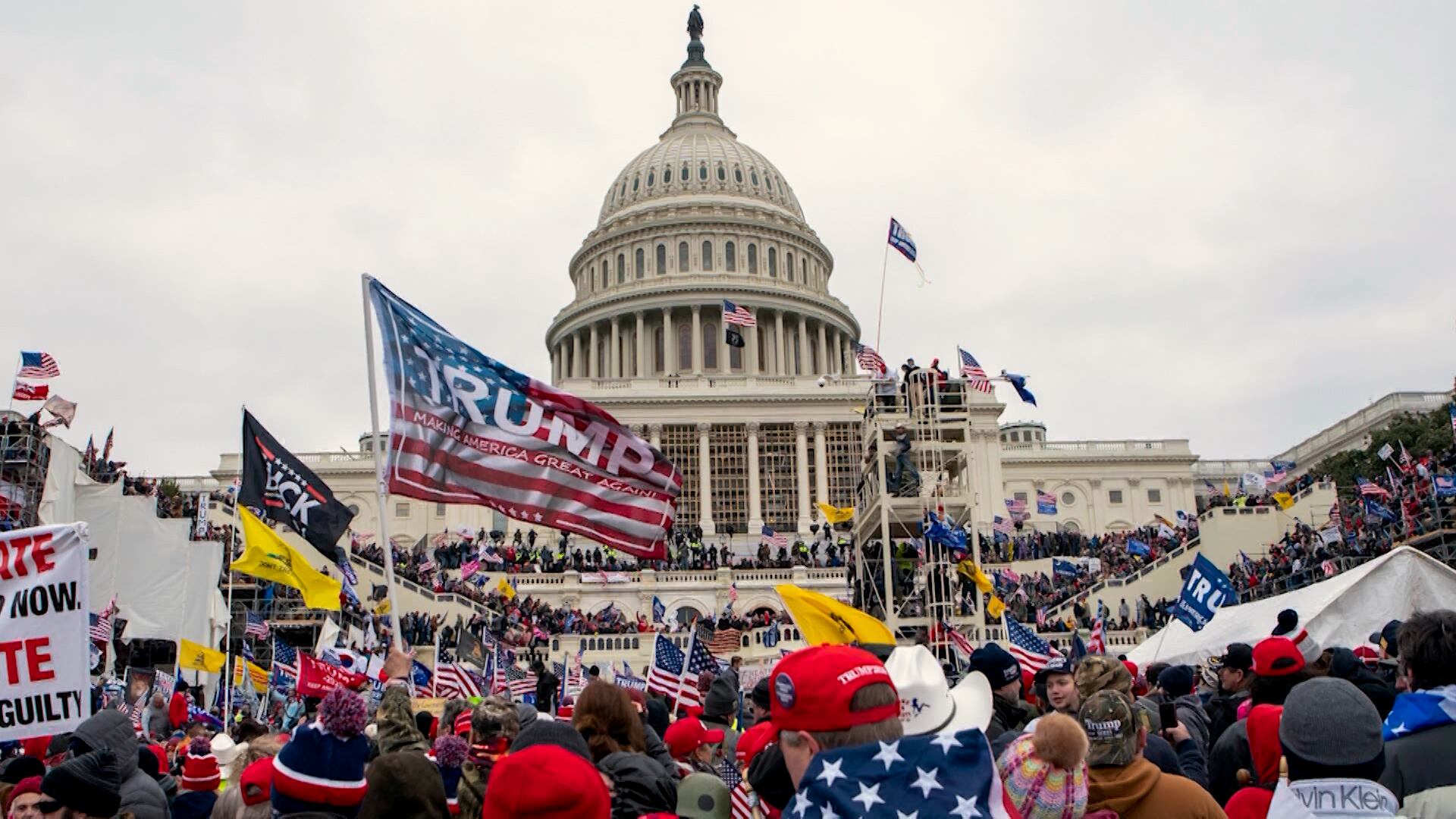
As the U.S. comes up on the first anniversary of the January 6 insurrection.,A.C. Thompson, investigative reporter at ProPublica, joined Cheddar's Baker Machado to discuss updates to American Insurrection by FRONTLINE, ProPublica and Berkeley Journalism’s Investigative Reporting Program. The documentary investigates the attack on the Capitol touched off by the lie that the presidential election was stolen from Donald Trump but with new information gleaned since the event including interviews with lawmakers and law enforcement and the evolution of groups like the Boogaloo Boys and the Proud Boys behind the attack. "In some ways those groups that were kind of the vanguard of January 6 are maybe no longer relevant because their message is everywhere," he said.
A new report from ProPublica and the Washington Post found that Facebook Groups played a major role in the spread of misinformation linked to the January 6 insurrection with more than 650,000 posts claiming that Joe Biden's election victory was illegitimate.
Millions of Americans with young children have relied on the child tax credit since the federal government began issuing checks in July 2021. The last round of payments was sent out just before the Christmas holiday — at the same time as the omicron variant surged. Leah Hamilton, associate professor of social work at Appalachian State University, joined Cheddar to discuss what the end to the tax credit means as the U.S. sees the end of many relief programs and its highest number of COVID cases since the start of the pandemic. "It'll become harder for families to meet their basic needs, increasing national childhood poverty rates and the proportion of families who have difficulty putting food on the table, maintaining stable housing, and paying their bills," Hamilton said. She also pointed to research that the credit as a long-term investment in children offsets claims that it contributes to macroeconomic impacts like inflation.
U.S. President Joe Biden spoke with Ukrainian President Volodymyr Zelensky over the week-end, just days after he spoke with Russian President Vladimir Putin. The call comes as Washington prepares to meet with Moscow on January 10, as tensions mount over Russia's military build up near its border with Ukraine. Cheddar News speaks with Mustafa Tameez, a former advisor to the U.S. Department of Homeland Security, about the issue.
Several Silicon Valley insiders are being accused of contorting a 1990s-era tax break to avoid taxes on millions of dollars of investment profits. The tax break is known as the qualified small business stock exemption, and it allows early investors in certain companies to avoid half of the taxes on up to $10 million in capital gains. A piece recently published in the New York Times says venture capital firms like Andreessen Horowitz replicated the tax exemption by giving shares of companies to friends and family, who would otherwise face a 23.8% capital gains bill. The CEO of Roblox is also accused of replicating the tax break for his family members at least 12 times. Although the loophole known as 'stacking' is considered to be legal, the Times piece implies that the exemption has been manipulated for the ultra-wealthy to become more wealthy. Greycroft co-founder and Chairman Emeritus Alan Patricof joins Cheddar News' Closing Bell to discuss.
Chris Sommerfeldt, City Hall reporter for the New York Daily News, joins Cheddar News' Closing Bell, where he discusses both the wins and losses of Bill de Blasio's eight years as New York City Mayor.