By Jonathan Lemire, Aamer Madhani, Zeke Miller, Jill Colvin, and Alexandra Jaffe
Joe Biden has won Michigan and Wisconsin, pushing him closer to 270 Electoral College votes and narrowing President Donald Trump’s possible path to reelection.
Only a handful of battleground states remain uncalled including Georgia, North Carolina and Pennsylvania.
Both Michigan and Wisconsin represent parts of the “blue wall” that slipped away from Democrats four years ago, paving the way for Trump’s election. Biden’s campaign had counted on winning back at least some of them.
THIS IS A BREAKING NEWS UPDATE. AP’s earlier story follows below.
WASHINGTON (AP) — On a day of electoral uncertainty and legal action, Joe Biden won Wisconsin on Wednesday, reclaiming a key part of the “blue wall” that slipped away from Democrats four years ago and narrowing President Donald Trump’s pathway to reelection.
A full day after Election Day, neither candidate had cleared the 270 Electoral College votes needed to win the White House. Margins remained tight in several fiercely contested states including the Great Lakes battlegrounds of Michigan and Pennsylvania. But Biden’s victory in Wisconsin loomed as an important step to the presidency.
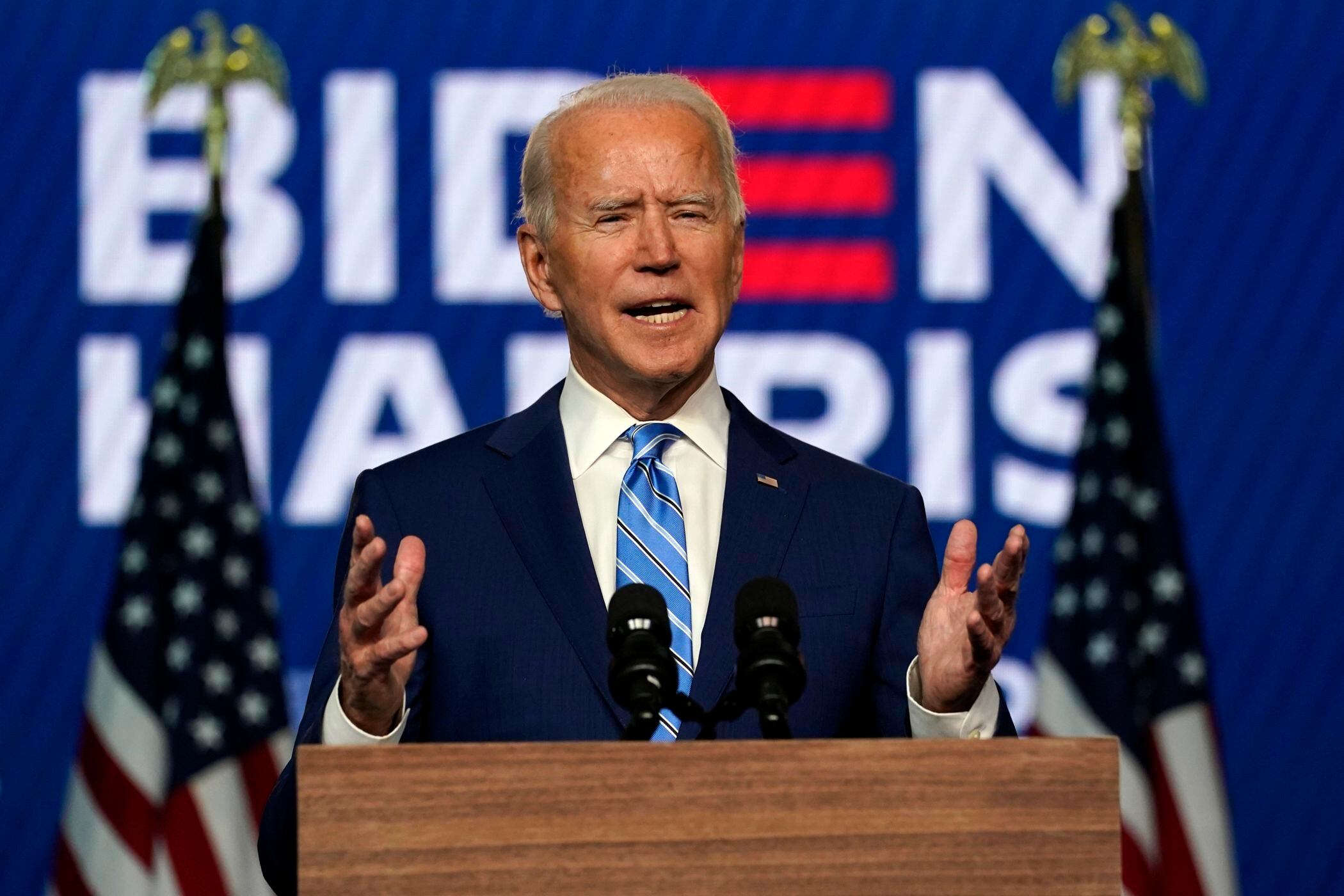
Speaking at an afternoon news conference, Biden, joined by his running mate Kamala Harris, said he now expected to win the presidency, though he stopped short of outright declaring victory.
“I will govern as an American president,” Biden said. ”There will be no red states and blue states when we win. Just the United States of America.”
It was a stark contrast to Trump, who early Wednesday morning falsely proclaimed that he had won the election, even though millions of votes remained uncounted and the race was far from over.
The Associated Press called Wisconsin for Biden after election officials in the state said all outstanding ballots had been counted, save for a few hundred in one township and an expected small number of provisional votes.
Trump’s campaign requested a recount, in addition to filing lawsuits in Pennsylvania and Michigan. Statewide recounts in Wisconsin have historically changed the vote tally by only a few hundred votes; Biden led by 0.624 percentage point out of nearly 3.3 million ballots counted.
It was unclear when or how quickly a national winner could be determined after a long, bitter campaign dominated by the coronavirus and its effects on Americans and the national economy. But Biden’s possible pathways to the White House were expanding rapidly.
After the victory in Wisconsin, he held 248 Electoral College votes, 22 shy of the 270 needed to win the presidency. The former vice president had several possible combinations of outstanding states to win the White House. For example, combining Nevada with either Michigan or Georgia would land him at precisely 270.
Trump campaign manager Bill Stepien said the president would formally request a Wisconsin recount, citing “irregularities” in several counties. And the campaign said it was filing suit in Michigan and Pennsylvania to halt ballot counting on grounds that it wasn’t given proper access to observe.
At the same time, hundreds of thousands of votes were still to be counted in Pennsylvania, and Trump’s campaign said it was moving to intervene in the existing Supreme Court litigation over counting mail-in ballots there.
In other closely watched races, Trump picked up Florida, the largest of the swing states, while Biden flipped Arizona, a state that had reliably voted Republican in recent elections.
The Trump campaign questioned the results in Arizona, with aides having come to the conclusion that, without Wisconsin, their best, if still unlikely, path to victory was winning that state and Pennsylvania. A legal challenge in Arizona was possible.
The unsettled nature of the presidential race was reflective of a somewhat disappointing night for Democrats, who had hoped to deliver a thorough repudiation of Trump’s four years in office while also reclaiming the Senate to have a firm grasp on all of Washington. But the GOP held on to several Senate seats that had been considered vulnerable, including in Iowa, Texas, Maine, and Kansas. Democrats lost House seats but were expected to retain control there.
The high-stakes election was held against the backdrop of a historic pandemic that has killed more than 232,000 Americans and wiped away millions of jobs. The candidates spent months pressing dramatically different visions for the nation’s future, including on racial justice, and voters responded in huge numbers, with more than 100 million people casting votes ahead of Election Day.
Trump, in an extraordinary move from the White House, issued premature claims of victory — which he continued on Twitter Wednesday — and said he would take the election to the Supreme Court to stop the counting. It was unclear exactly what legal action he could try to pursue.
Senate Majority Leader Mitch McConnell discounted the president’s quick claim of victory, saying it would take a while for states to conduct their vote counts. The Kentucky Republican said Wednesday that “claiming you’ve won the election is different from finishing the counting.”
The president stayed out of the public eye but took to Twitter to suggest, without basis, that the election was being tainted by late-counted ballots. Twitter flagged a number of Trump’s tweets, noting some of the information shared was “disputed and might be misleading about an election or other civic process.”
Biden, briefly appearing in front of supporters in Delaware early Wednesday, urged patience, saying the election “ain’t over until every vote is counted, every ballot is counted.”
“It’s not my place or Donald Trump’s place to declare who’s won this election,” Biden said. “That’s the decision of the American people.”
Vote tabulations routinely continue beyond Election Day and states largely set the rules for when the count has to end. In presidential elections, a key point is the date in December when presidential electors met. That’s set by federal law.
Several states allow mailed-in votes to be accepted as long as they were postmarked by Tuesday. That includes Pennsylvania, where ballots postmarked by Nov. 3 can be accepted if they arrive up to three days later.
Trump appeared to suggest those ballots should not be counted, and that he would fight for that outcome at the high court. But legal experts were dubious of Trump’s declaration. Trump has appointed three of the high court’s nine justices including, most recently, Amy Coney Barrett.
The Trump campaign on Wednesday pushed Republican donors to dig deeper into their pockets to help finance legal challenges. Republican National Committee Chairwoman Ronna McDaniel, during a donor call, spoke plainly: “The fight’s not over. We’re in it.” Biden’s running mate, Sen. Kamala Harris, made a pitch on Twitter to supporters to pitch in $5 to help pay for a fight that could “stretch on for weeks.”
Democrats typically outperform Republicans in mail voting, while the GOP looks to make up ground in Election Day turnout. That means the early margins between the candidates could be influenced by which type of votes — early or Election Day — were being reported by the states.
Trump won several states, including Texas, Iowa, and Ohio, where Biden had made a strong play in the final stages of the campaign. But Biden picked off states where Trump sought to compete, including New Hampshire and Minnesota. But Florida was the biggest, fiercely contested battleground on the map, with both campaigns battling over the 29 Electoral College votes that went to Trump.
The momentum from early voting carried into Election Day, as an energized electorate produced long lines at polling sites throughout the country. Turnout was higher than in 2016 in numerous counties, including all of Florida, nearly every county in North Carolina, and more than 100 counties in both Georgia and Texas. That tally seemed sure to increase as more counties reported their turnout figures.
Voters braved worries of the coronavirus, threats of polling place intimidation, and expectations of long lines caused by changes to voting systems, but appeared undeterred as turnout appeared it would easily surpass the 139 million ballots cast four years ago.
___
Jaffe reported from Wilmington, Delaware. Associated Press writers Andrew Taylor in Washington and Sophia Tulp in Atlanta contributed reporting.
Updated November 4, 2020, at 6:15 p.m. ET with the latest information.