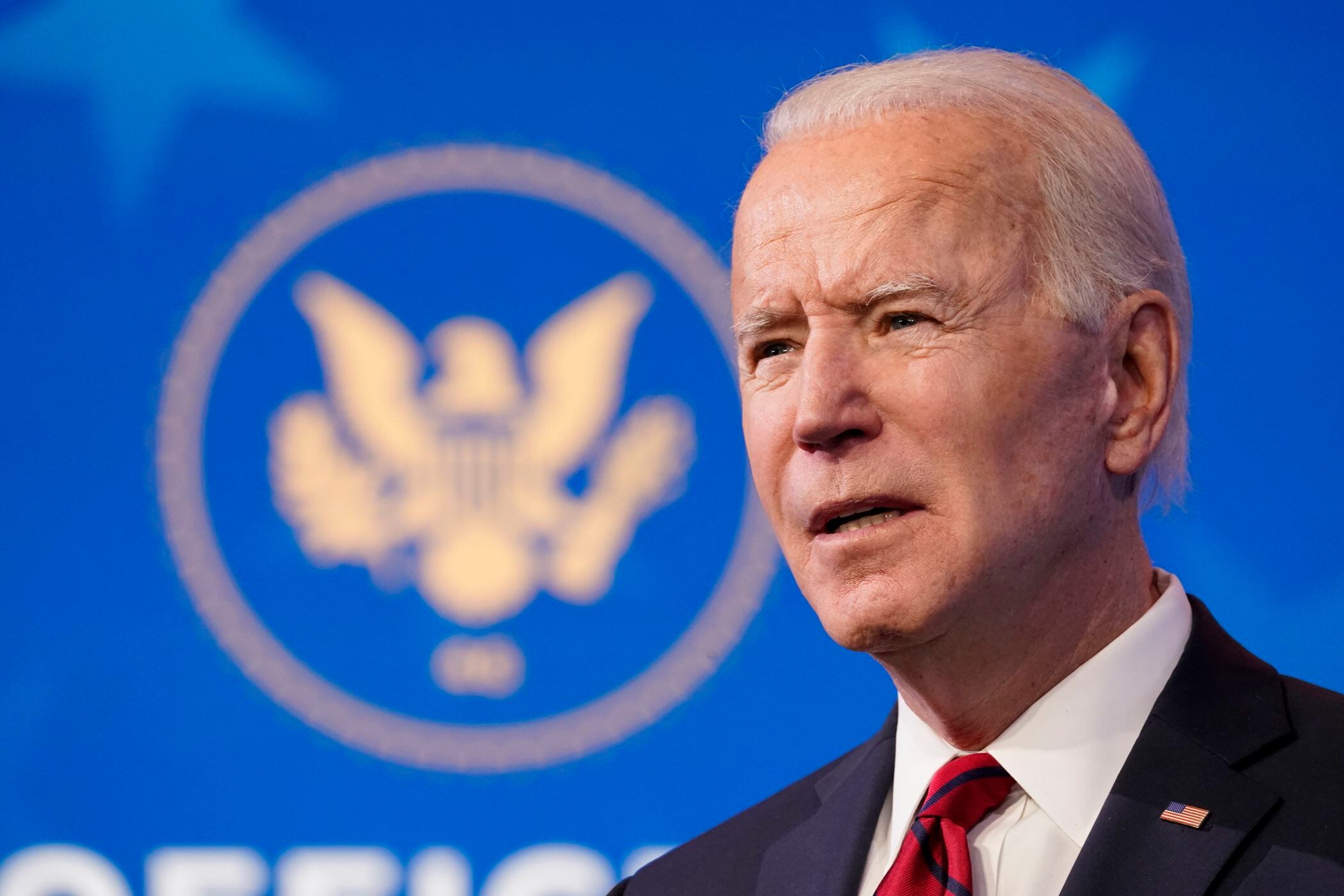
In this Jan. 15, 2021 file photo, President-elect Joe Biden speaks during an event at The Queen theater in Wilmington, Del. (AP Photo/Matt Slocum)
By Will Weissert
President-elect Joe Biden has tapped Pennsylvania Health Secretary Rachel Levine to be his assistant secretary of health, leaving her poised to become the first openly transgender federal official to be confirmed by the U.S. Senate.
A pediatrician and former Pennsylvania physician general, Levine was appointed to her current post by Democratic Gov. Tom Wolf in 2017, making her one of the few transgender people serving in elected or appointed positions nationwide. She won past confirmation by the Republican-majority Pennsylvania Senate and has emerged as the public face of the state's response to the coronavirus pandemic.
“Dr. Rachel Levine will bring the steady leadership and essential expertise we need to get people through this pandemic — no matter their zip code, race, religion, sexual orientation, gender identity, or disability — and meet the public health needs of our country in this critical moment and beyond," Biden said in a statement. "She is a historic and deeply qualified choice to help lead our administration’s health efforts.”
A graduate of Harvard and of Tulane Medical School, Levine is president of the Association of State and Territorial Health Officials. She's written in the past on the opioid crisis, medical marijuana, adolescent medicine, eating disorders, and LGBTQ medicine.
Biden and his transition team have already begun negotiating with members of Congress, promoting speedy passage of the president-elect's $1.9 trillion plan to bring the coronavirus, which has killed nearly 400,000 people in the United States, under control. It seeks to enlist federal emergency personnel to run mass vaccination centers and provide 100 million immunization shots in his administration’s first 100 days while using government spending to stimulate the pandemic-hammered economy.
Biden also says that, in one of his first acts as president, he'll ask Americans to wear masks for 100 days to slow the virus' spread.
Vice President-elect Kamala Harris called Levine “a remarkable public servant with the knowledge and experience to help us contain this pandemic, and protect and improve the health and well-being of the American people.”
Levine joins Biden's Health and Human Services secretary nominee Xavier Becerra, a Latino politician who rose from humble beginnings to serve in Congress and as California’s attorney general.
Businessman Jeff Zients is Biden's coronavirus response coordinator, while Biden picked infectious-disease specialist Rochelle Walensky to run the Centers for Disease Control and Prevention, Vivek Murthy as surgeon general, and Yale epidemiologist Marcella Nunez-Smith to head a working group to ensure fair and equitable distribution of vaccines and treatments.
The government's top infectious disease expert, Dr. Anthony Fauci, will also work closely with the Biden administration.
A transition spokesperson also said Tuesday that Dawn O’Connell will serve as senior counselor for coronavirus response to the health and human services secretary. O'Connell most recently served as director of the Coalition for Epidemic Preparedness Innovations and was the senior counselor and deputy chief of staff to Health and Human Services Secretary Sylvia Burwell during the Obama administration.
Liana Guzmán, CEO of FOLX Health, joins Cheddar News to discuss the company launching billboards across the country in response to anti-LGBTQ+ legislation.
President Biden has announced an additional $800 million in military assistance to Ukraine, including artillery, armored personnel carriers, and helicopters. It comes as Russian forces appear to be preparing for a new, aggressive offensive in the eastern part of Ukraine. Paul McLeary, defense reporter for Politico, joined Cheddar to discuss this new round of aid and what it means for the U.S. commitment to arming the embattled country.
Catching you up on what you need to know on April 18, 2022, with Russian missile attacks on the Ukrainian city of Lviv killing seven, mass shootings in South Carolina and Pittsburgh, Lucky Charms cereal under official investigation by the FDA, and more.
Activism is growing around the country in response to school boards banning books from shelves that focus on sexuality, gender, identity, or race. Jen Cousins, co-founder of The Florida Freedom to Read Project, joins Cheddar News to discuss.
As the Russian invasion of Ukraine intensifies, President Biden has announced a ban on importing Russian oil, gas, and energy. To discuss how this ban will impact the war and Americans, Amir Handjani, non-resident fellow at Quincy Institute, joins Cheddar News.
Thousands of protesters around the world are expressing their solidarity with Ukraine against Russia's invasion.
Jason Beardsley, national executive director of the Association of the U.S. Navy and national security expert, joins Cheddar News to discuss.
As gas prices surge amid the Russian invasion of Ukraine, other nations could potentially transition faster to using clean energy than previously expected. Philip K. Verleger, a senior fellow at the Niskanen Center, joined Cheddar News to explain how this could be a possibility in the near future. "Part of the reason I think we have this invasion and the tantrum that's being thrown by Russia, terrible tantrum, is because the Russians were trying to slow down the transition," he said. "Ironically they speeded it up."
Following the invasion of Ukraine, a multitude of Western companies have paused doing business with Russia. PepsiCo, Coca-Cola, McDonald's, and Starbucks are the most recent companies to temporarily cease operations in Russia. Dean of Miami Herbert Business School at the University of Miami, John Quelch, joined Cheddar News to discuss what message this sends to Russia and the Russian consumer. “I would not underestimate the collective strength of all of these multinational companies, essentially coming together to make their collective statement in support of the political statements that have come out of Washington," he said.
The war in Ukraine continues to reveal heartbreaking gut-wrenching stories. The war in itself is not only devastating but also expensive. Experts estimate that Russia is draining nearly $20 million dollars each day to continue occupying and invading Ukraine. All this could force the country to turn to cryptocurrencies. It's a major turn for the country that briefly considered outlined digital assets entirely, but it could also have serious implications for cryptos. Managing Director at Quantum Fintech Group, Harry Yeh, joined Cheddar to discuss more.