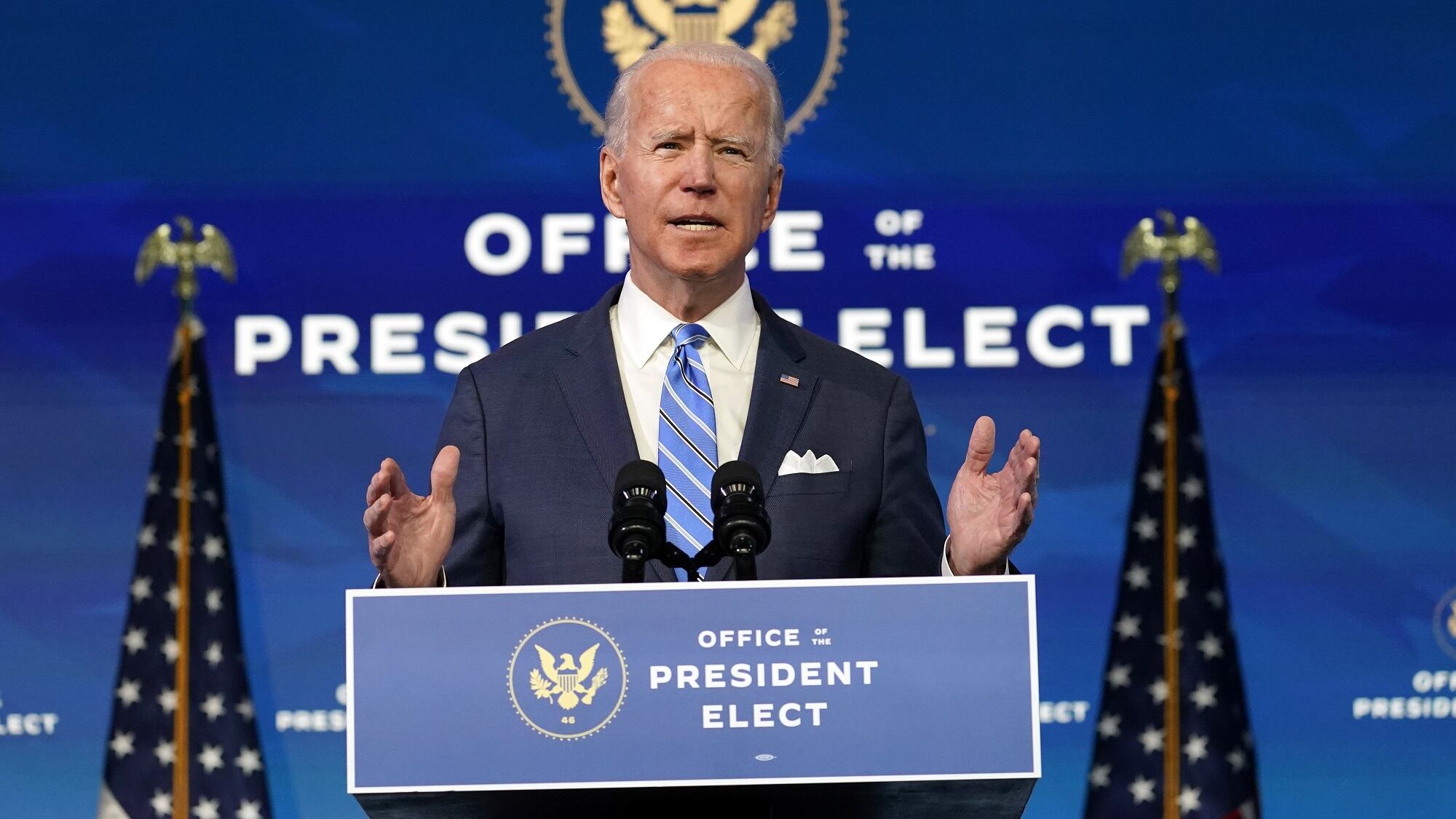
President-elect Joe Biden Thursday night outlined his "two-step" plan to spend $1.9 trillion on a combination of "rescue and recovery" with measures such as more direct payments, an expansion of jobless benefits, and funding for cash-strapped state and local governments.
The speech struck a populist tone, highlighting the plight of regular Americans whose fortunes during the pandemic have diverged from a stubbornly exuberant stock market.
As the coronavirus pandemic spikes again in the U.S., Biden said "there is real pain overwhelming the real economy, one where people rely on paychecks, not their investments, to pay for their bills, and their meals, and their children's needs. You won't see this pain if your scorecard is how things are going on Wall Street, but you will see it very clearly if you examine what the twin crises of a pandemic and this sinking economy have laid bare: the growing divide between those few people at the very top who are doing quite well in this economy and the rest of America."
At times during the speech, Biden sounded like his former primary challenger, Sen. Bernie Sanders, as he listed off stark economic statistics such as the total wealth gained by the top one percent as compared to the bottom 50 percent.
Most of the measures in the plan were included in past relief bills proposed by Democrats since the beginning of the pandemic. With the Senate about to enter Democratic control, Biden said the package will be a top legislative priority once he enters office on January 20.
The "rescue" step of the plan will include $400 billion new spending toward combatting the coronavirus pandemic. That includes $50 billion to expand testing and $20 billion for the national vaccination program. The money will also support the hiring of 100,000 public health workers who will focus on contact tracing and spreading the word about vaccination.
The "recovery" step of the plan will include new $1,400 direct checks for individuals earning less than $75,000 per year, supplementing the $600 provided in the recent bipartisan relief bill, and an extension of an extra $400 per week in emergency unemployment benefits until September.
The plan would also extend the moratorium on evictions and foreclosures until September.
In addition, the plan includes a $350 billion cash infusion for state and local governments — a measure Republicans lawmakers have resisted mightily in negotiating past deals — and $130 billion to speed up school reopenings.
The president-elect doubled down on earlier comments that he was committed to deficit spending to combat the virus and fuel the economic recovery.
Putting aside his former reputation as a budget hawk, Biden echoed a growing number of economists who claim the overall debt should be ignored in favor of boosting the economy.
"I know what I just described does not come cheaply, but failure to do so will cost us dearly," he said. "The consensus among leading economists is we simply cannot afford not to do what I'm proposing. Independent, respected institutions around the world from the Federal Reserve to the International Monetary Fund have underscored the urgency."
In outlining his approach to helping small businesses, Biden emphasized inclusion and fairness, promising to distribute $50 billion in grants "swiftly and equitably, unlike the first time around."
Also he noted low-cost funds to help "entrepreneurs of all backgrounds create and maintain jobs plus provide the essential goods and services that communities depend upon," he said. "We'll focus on minority-owned small businesses, women-owned businesses, and finally having equal access to the resources they need to reopen and to rebuild."
Though it's unclear where it would fit into his plan, Biden also took time to champion a national $15 per hour minimum wage, and committed to reducing inequality in the economy.
"We not only have an economic imperative to act now, I believe we have a moral obligation."