By Eric Tucker, Michael Balsamo, and Darlene Superville
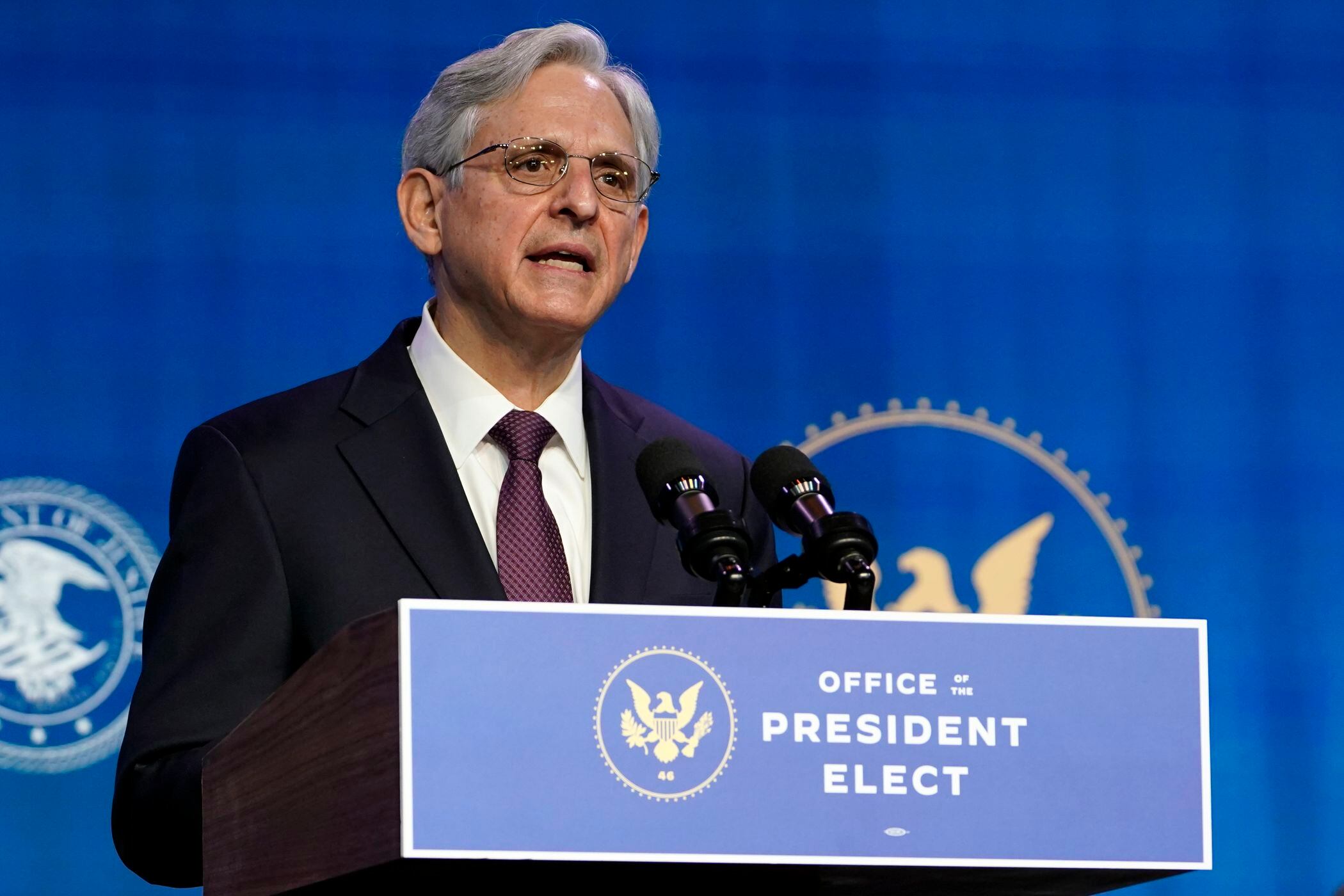
President-elect Joe Biden introduced Merrick Garland as his pick for attorney general on Thursday, turning to an experienced judge to help de-politicize the Justice Department and restore the rule of law after what he described as four years of lawlessness under President Donald Trump.
Biden also described the pro-Trump mob that stormed the Capitol on Wednesday as “domestic terrorists” and assailed the Republican president for inciting the siege.
“The past four years we’ve had a president who’s made his contempt for our democracy, our Constitution, the rule of law, clear in everything he has done,” Biden declared, vowing a dramatic change of course in his administration. “More than anything, we need to restore the honor, the integrity, the independence of the Department of Justice that’s been so badly damaged."
If confirmed by the Senate, which is likely, Garland would take over as the nation's top law enforcement official at a critical moment for the country and the agency. He would inherit immediate challenges related to civil rights, an ongoing criminal tax investigation into Biden’s son Hunter and calls from many Democrats to pursue criminal inquiries into Trump after he leaves office.
Beyond the specific issues, he will be tasked with repairing the American people's broad distrust in the Justice Department, among other institutions of democracy undermined by Trump's turbulent presidency.
Biden vowed that Garland's loyalty would rest not with the president, but with the law and Constitution.
“You don't work for me,” Biden charged as he introduced Garland.
Facing the public for the first time at Biden's side, Garland promised to restore independence and integrity to the Justice Department, pointing to Wednesday's assault on the Capitol as a consequence of failing to do so.
“As everyone who watched yesterday's events in Washington now understands, if they did not understand before, the rule of law is not just some lawyers' turn of phrase, it is the very foundation of our democracy,” Garland said.
Senate Republicans spurned Garland four years ago, refusing even to hold hearings when President Barack Obama nominated him for the Supreme Court. But now, his confirmation prospects were all but ensured when Democrats scored control of the Senate majority by winning both Georgia Senate seats.
Biden also introduced three others for senior Justice Department leadership posts, including Obama administration homeland security adviser Lisa Monaco as deputy attorney general and former Justice Department civil rights chief Vanita Gupta as associate attorney general, the No. 3 official. He also named an assistant attorney general for civil rights, Kristen Clarke, now the president of Lawyers’ Committee for Civil Rights Under Law, an advocacy group.
Garland was selected over other finalists including former Sen. Doug Jones, D-Ala., and former Deputy Attorney General Sally Yates.
Garland would inherit a Justice Department that has endured a tumultuous four years and abundant criticism from Democrats over what they see as the over-politicization of law enforcement. The department is expected to dramatically change course under new leadership, including through a different approach to civil rights issues and national policing policies, especially after months of mass protests over the deaths of Black Americans at the hand of law enforcement.
Black and Latino advocates had wanted a Black attorney general or someone with a background in civil rights causes and criminal justice reform. Groups including the NAACP Legal Defense and Educational Fund had championed Garland’s Supreme Court nomination, but the extent of support from minority groups for the attorney general job was not immediately clear.
Though Garland is a white man, the selection of Gupta and Clarke, two women with significant experience in civil rights, appeared designed to blunt any concerns and served as a signal that progressive causes would be prioritized in the new administration.
Garland would also inherit the special counsel investigation into the origins of the Russia probe, which remains open.
Having worked for the Justice Department decades ago, he would return to an agency radically different from the one he left. The Sept. 11 attacks were years in the future and the department’s national security division had not yet been created. A proliferation of aggressive cyber and counterintelligence threats from foreign adversaries have made countries like China, Russia, and North Korea top priorities for federal law enforcement.
Monaco in particular brings to the department significant national security experience, including in cybersecurity — an especially urgent issue as the U.S. government confronts a devastating hack of federal agencies that officials have linked to Russia.
Some of the issues from Garland’s first stint at the department persist. Tensions between police and minorities, an issue that flared following the 1992 beating of Rodney King in Los Angeles, remain a major concern, particularly following a summer of racial unrest that roiled American cities after the May killing of George Floyd in Minneapolis.
And the FBI has confronted a surge in violence from antigovernment and racially motivated extremists. That is a familiar threat to Garland, who as a senior Justice Department official helped manage the federal government’s response to the 1995 bombing of a government building in Oklahoma City that killed 168 people. The bomber, Timothy McVeigh, was later executed.
Garland has called the work the “most important thing I have done” and was known for keeping a framed photo of Oklahoma City’s Alfred P. Murrah Federal Building in his courthouse office in Washington.
Garland was put forward by Obama for a seat on the Supreme Court in 2016 following the death of Justice Antonin Scalia, but Republicans refused to hold confirmation hearings in the final year of Obama’s term, arguing that the person elected president that fall should make the selection.
Garland has been on the federal appeals court in Washington since 1997. Before that, he had worked in private practice, as well as a federal prosecutor, a senior official in the Justice Department’s criminal division, and as the principal associate deputy attorney general.
___
AP writer Steve Peoples in New York contributed.
Updated on January 7, 2021, at 2:53 p.m. ET with the latest details.