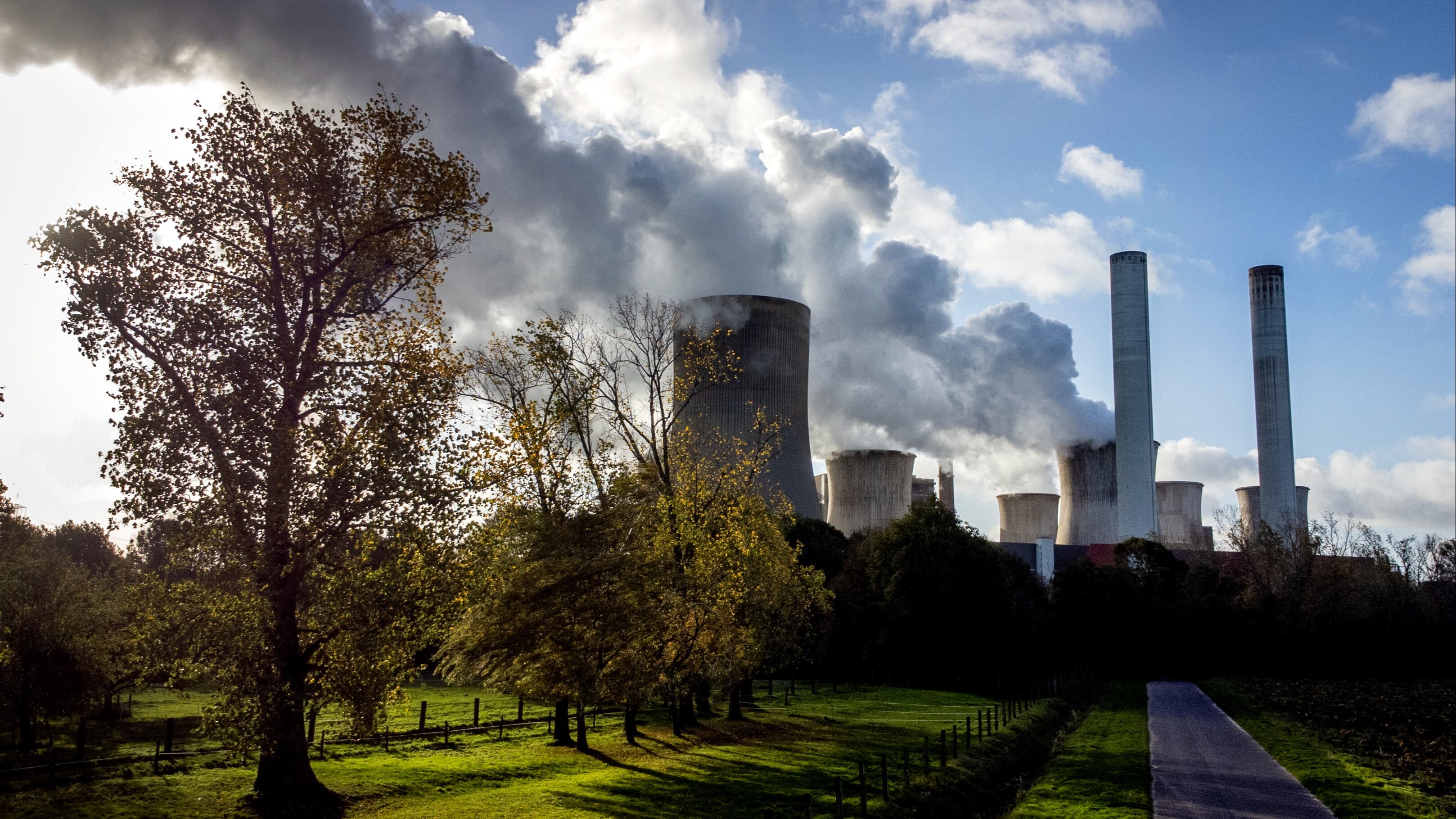
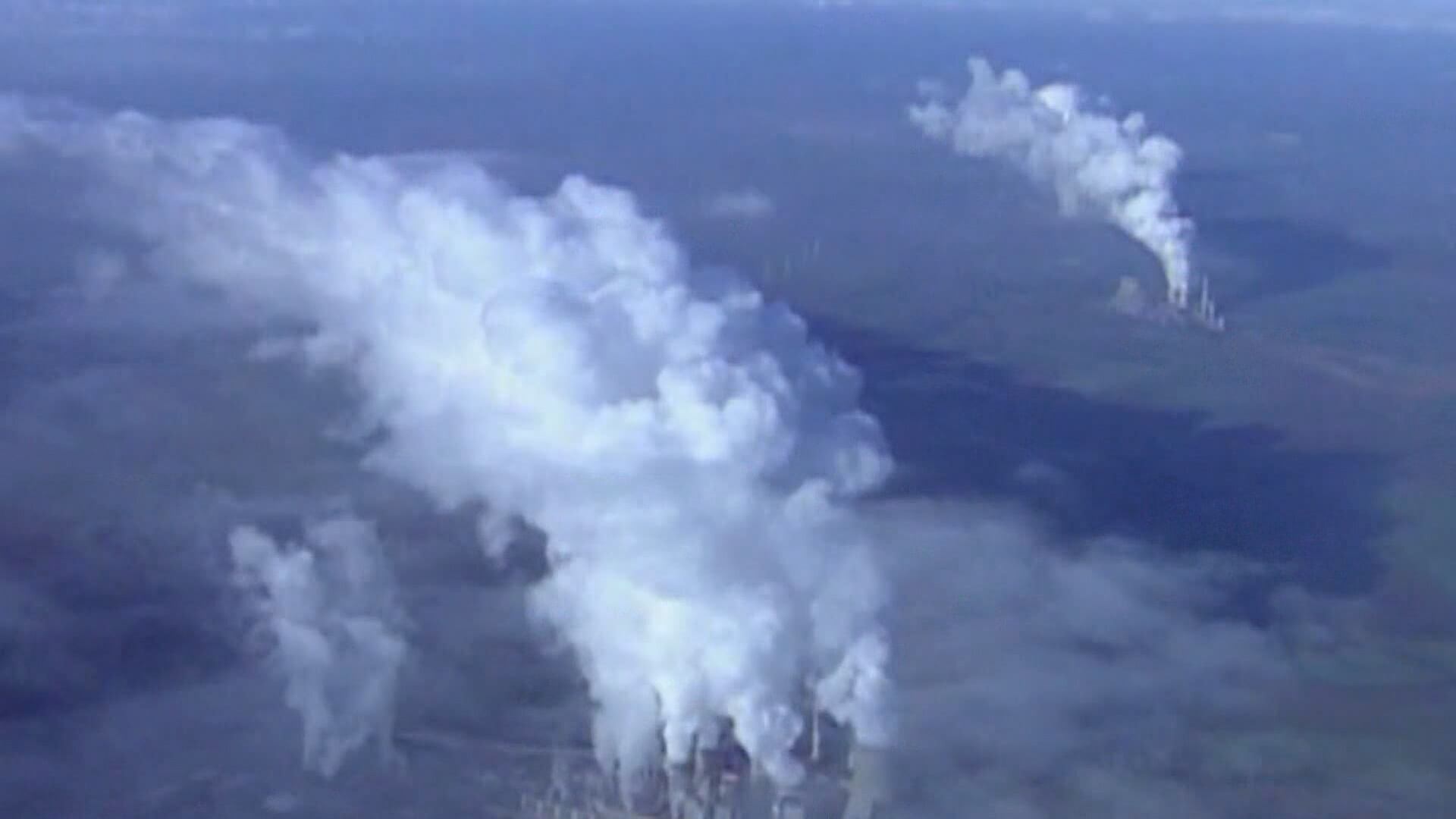
Steam rises from the coal-fired power plant Niederaussem, Germany, on Nov. 2, 2022. The cause of global warming is showing no signs of slowing as heat-trapping carbon dioxide in Earth’s atmosphere increased to record highs in its annual Spring peak, jumping at one of the fastest rates on record, officials announced Monday, June 5, 2023. (AP Photo/Michael Probst, File)
By Seth Borenstein
The cause of global warming is showing no signs of slowing as heat-trapping carbon dioxide in Earth’s atmosphere increased to record highs in its annual Spring peak, jumping at one of the fastest rates on record, officials announced Monday.
Carbon dioxide levels in the air are now the highest they’ve been in more than 4 million years because of the burning of oil coal and gas. The last time the air had similar amounts was during a less hospitable hothouse Earth before human civilization took root, scientists said.
The National Oceanic Atmospheric Administration announced that the carbon dioxide level measured in May in Hawaii averaged 424 parts per million. That’s 3 parts per million more than last year’s May average and 51% higher than pre-industrial levels of 280 ppm. It is one of the largest annual May-to-May increases in carbon dioxide levels on record, behind only 2016 and 2019, which had jumps of 3.7 and 3.4 parts per million.
“To me as an atmospheric scientist, that trend is very concerning,” said NOAA greenhouse gas monitoring group leader Arlyn Andrews. “Not only is CO2 continuing to increase despite efforts to start reducing emissions, but it’s increasing faster than it was 10 or 20 years ago.”
Emissions used to increase by maybe 1 part per million per year, but now they are increasing at twice and even three times that rate, depending on whether there is an El Nino, Andrews said.
“The relentless rise in atmospheric CO2 is incredibly worrying if not wholly predictable,” said Brown University climate scientist Kim Cobb, who was not part of the research.
Carbon dioxide levels are rising so that each year is higher than the last. However, there’s a seasonal cycle with carbon dioxide so that it reaches its highest saturation point in May. That’s because two-thirds of the globe’s land is in the northern hemisphere and plants suck carbon dioxide out of the air, so during late spring and summer carbon dioxide levels fall until they start rising again in November, Andrews said.
Carbon dioxide levels rise more during El Nino climate cycles because it is drier in the northern hemisphere. An El Nino is brewing. That 3.0 increase may be a sign of an El Nino bump, she said.
There are two main ways of tracking greenhouse gases. One is to monitor what’s coming out of smokestacks and exhaust pipes, but about half of that is absorbed by the oceans and lands, Andrews said.
The other way is to measure how much carbon dioxide is in the air. NOAA and partner agencies measure all around the world. Hawaii has the longest history of direct measurements and is the home of the Scripps Institution of Oceanography’s Keeling Curve, which has kept track of carbon in the air since 1958 when the May reading peaked at 317.5. Emissions have gone up about 33% since then.
“Current emissions are going to remain in the atmosphere for thousands of years and they’re going to continue to trap heat energy near Earth’s surface for thousands of years,” Andrews said.
Because of that “we are still dealing with CO2 in the atmosphere that was emitted in the early-to-mid 20th century,” University of Oklahoma meteorology professor Jason Furtado, who wasn't part of the monitoring teams, said in an email. “This is why we have to see emissions DROP in order to have a chance to reverse climate change. And even if/when we reverse the CO2 emissions rate, it will take some time before the climate system responds.”
This year NOAA had a complication in its reading.
NOAA and the Scripps Institution have two distinct monitors that have slightly different measurements. Scripps measured 423.8 parts per million and often runs a bit below NOAA. Both have been at the remote Mauna Loa volcano for decades but last November’s eruption cut off power to the NOAA monitor and it’s been unable to use it since. NOAA established another one at Mauna Kea Volcano, 21 miles away.
Scripps got their Mauna Loa site working and put one at Mauna Kea and their data shows that Mauna Kea is an accurate substation for Mauna Loa, Andrews said.
Many activists and scientists advocate for returning to 350 parts per million levels.
“CO2 now is higher than any time in the last 4 to 4.5 million years when the atmosphere was about 7 degrees Fahrenheit (3.9 degrees Celsius) warmer and sea levels were 5 to 25 meters (16 to 82 feet) higher,” Andrews said.
Temperatures were higher with similar amount of carbon dioxide in the air because carbon dioxide traps heat for so long and millions of years ago the build up of carbon dioxide was much more gradual, allowing heat to build and ice to melt to raise seas, scientists said.
“We are absolutely at levels unseen in human civilization,” Furtado said. “Humans are running a massive experiment on the Earth climate system via burning carbon, and the results are turning out not great for a lot of people on this planet.”
Associated Press climate and environmental coverage receives support from several private foundations. See more about AP’s climate initiative here. The AP is solely responsible for all content.
Ellen Fitzsimmons-Craft, assistant professor of psychiatry at Washington University School of Medicine, joins Cheddar News to discuss how chatbots can help prevent eating disorders and the research that uncovered these findings.
Shoulder injuries are one of the most common orthopedic injuries – and they're also one of the most commonly ignored. But chimpanzees, with whom we share nearly 99% of our DNA, don’t encounter the same issues we do. So why are human shoulders such a design disaster? Well, we can trace the answer back to a very particular moment in our evolution.
As the Omicron variant continues to sweep across the country. The US Supreme Court is expected to hear arguments at the end of this week on whether or not the Biden administration can force private companies to vaccinate or test millions of their employees. In addition, the National Nurses United has spearheaded legal action to protect nurses and health care workers, patients, and the public while on the job. President of the National Nurses Union, Zenei Cortez, joined Cheddar to discuss more.
Digital medical care provider Pear Therapeutics rang the closing bell on the Nasdaq Friday and President and CEO Dr. Corey McCann, joined Cheddar to talk about how the company plans to grow the business of software-based therapeutics and how the first FDA authorized prescription digital therapeutics company will go about treating illnesses like insomnia and addiction. "These really are pieces of software. In many cases, they're apps and in the cases of our addiction products, these are based on something called cognitive behavioral therapy or CBT," he said. "These products change the patient's brain circuitry to help them be abstinent, to help them stay in treatment, and that's exactly what we see in randomized clinical trials and that's what we see in the real world." He also addressed the ongoing mental health crises brought on by the pandemic. **copy updated to remove IPO information as Pear Therapeutics went public in December**
Jake Carbone, senior data analyst at InfluenceMap joins Cheddar News to talk about a new report by The Guardian and InfluenceMap that reveals how companies are creating fossil fuel ads designed to look like Google search results.
Satellite launch service Virgin Orbit has gone public on the Nasdaq via a SPAC merger with NextGen Acquisitions with a valuation of about $3.2 billion. CEO Dan Hart joined Cheddar's "Between Bells" from in front of his LauncherOne rocket in New York City's Times Square to talk about what's next after the IPO, an upcoming "Above the Clouds" mission to deliver commercial and national security payloads, and the benefits of their rockets being launched from commercial 747 aircraft. "We can launch anywhere in the world," he said. "There are almost 80 space agencies across the world, for instance, and about 10 of them have space launch. We can give them a space flight capability overnight by taking a runway and turning it into a spaceport."
The year 2021 saw numerous natural disasters around the world, including extreme heat and wildfires, rare deep freezes, and historic flooding. This year's United Nations COP26 conference was key for getting world leaders on board with emissions reductions and other climate-focused policies as the UN Secretary-General said the agency's report on global warming is a 'code red for humanity.' In the U.S., President Joe Biden has focused most of his domestic agenda on slashing emissions and building climate-focused infrastructure. Guests from The Economist, UNC-Chapel Hill, Global Rescue, and more join Cheddar Climate's year-end special to discuss how the climate changed in 2021, and what to expect in 2022.
Digital mental health company Little Otter recently announced it closed a $22 million Series A round. Little Otter was founded in 2020 by a mother-daughter team, which based the company on the idea that a child's mental health can only be addressed by treating the whole family through technology available to everyone. Little Otter CEO and co-founder Rebecca Egger and her mother, Little Otter Chief Medical and Scientific Officer and co-founder Dr. Helen Egger joined Cheddar News' Closing Bell to discuss.
Among all the other events of the last few years, you may have missed this one: Spermageddon. This is the fun name for the idea that sperm counts among mainly ‘Western’ men are in freefall. The Spermageddon hype began with the publication of a 2017 study showing a nearly 60% drop in overall sperm counts in men living in North America, Europe, Australia, and New Zealand.
But four years later, it seems that Spermageddon has been overblown. By a lot. And all that hype has obscured the real issue behind declining male fertility.
Covid-19 has changed the way we view wellness. Jillian Hughes, communications director of Mental Health America, joins Cheddar News to discuss breaking the stigma around mental health. Justin Davis, CEO and co-founder of Spectrum Labs, weighs in on how social media impacts our wellbeing. Lastly, Precision Nutrition CEO Timothy Jones advices us on what trends to watch in 2022.