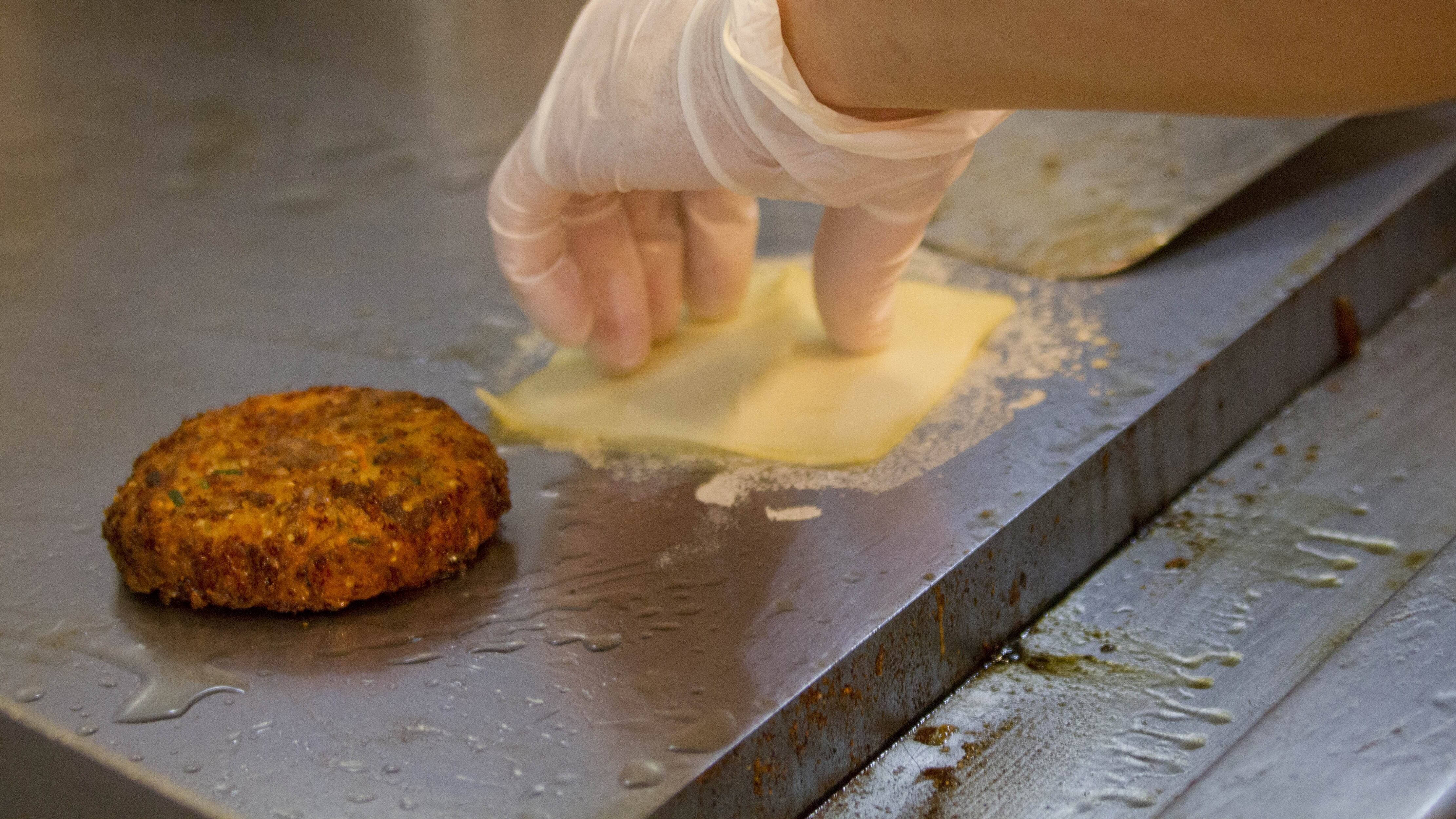
In this file photo from Tuesday, Jan. 27, 2015, a BurgerFi restaurant employee prepares to add cheese to a veggie burger as she grills an order at the Aventura, Fla., restaurant. (AP Photo/Wilfredo Lee)
Plant-based products that do not contain meat can continue to be labeled “sausages” or “burgers,” European lawmakers said Friday, when they rejected a proposal back by the meat industry to ban the terms.
In votes on issues relating to agricultural products, the European Parliament said that so-called veggie burgers, soy steaks and vegan sausages can continue to be sold as such in restaurants and shops across the union.
Europe’s largest farmers' association, Copa-Cogeca, had supported a ban, arguing that labeling vegetarian substitutes with designations bringing meat to mind was misleading for consumers.
On the opposite side of the debate, a group of 13 organizations including Greenpeace and WWF urged lawmakers to reject the proposed amendments, arguing that a ban would have not only exposed the EU “to ridicule," but also damaged its environmental credibility.
They said promoting a shift toward more plant-based diet is in line with the EU Commission's ambition to tackle global warming. Losing the ability to use the terms steak or sausage might make those plant-based products more obscure for consumers.
After the vote, the European Consumer Organization, an umbrella group bringing together consumers' associations, praised the MEPs for their “common sense."
“Consumers are in no way confused by a soy steak or chickpea-based sausage, so long as it is clearly labeled as vegetarian or vegan," the group said in a statement. “Terms such as ‘burger’ or ‘steak’ on plant-based items simply make it much easier for consumers to know how to integrate these products within a meal."
Together with Greenpeace, the group regretted that lawmakers accepted further restrictions on the naming of alternative products containing no dairy. Terms like ‘almond milk’ and ‘soy yogurt’ are already banned in Europe after the bloc's top court ruled in 2017 that purely plant-based products can't be marketed using terms such as milk, butter or cheese, which are reserved for animal products.
The Buy Now, Pay Later trend no longer has the luster it once had during the pandemic. Brandon Kreig, Stash CEO and co-founder, joins Cheddar News to give us insight on what happened and what's next for BNPL companies.
Join Cheddar News as we break down the top headlines this morning including updates on the Jan. 6 hears, the PGA suspension of 17 of the world's best golfers, and NASA's plans to study UFOs.
The national average for a gallon of gas is closing in on $5 dollars per gallon and it's putting pressure on already strained budgets. The summer travel season could stall out before it even gets started. Cheddar's Shannon Lanier has some great hacks to help you save a few bucks at the pump.
Lower Manhattan's iconic Stone Street is getting a bubbly makeover. Champagne Nicolas Feuillatte will be 'unleashing the bubbles' throughout the month of June in New York City, with themed events, bubble ball pits, and special menu and drink experiences. Anne-Laure Domenichini, director of communications for Champagne Nicholas Feuillatte, joins Cheddar News' Closing Bell to discuss.
Alex Gladstein, Chief Strategy Officer for the Human Rights Foundation, joins Closing Bell, where he explains where tech experts are getting it wrong when they call crypto risky and unproven. He also stresses the importance of crypto and points to how Ukraine was able to use Bitcoin during the onset of the Russian invasion.
API platform RapidAPI recently became a unicorn with a $1 billion valuation after raising $150 million in a Series D funding round led by Softbank Vision Two Fund. Microsoft's Venture Fund, M12, and Andreessen Horowitz also participated. RapidAPI says it provides the world's largest API hub which enables millions of developers and companies to build software faster. Iddo Gino, founder and CEO of RapidAPI, joins Cheddar News' Closing Bell to discuss.
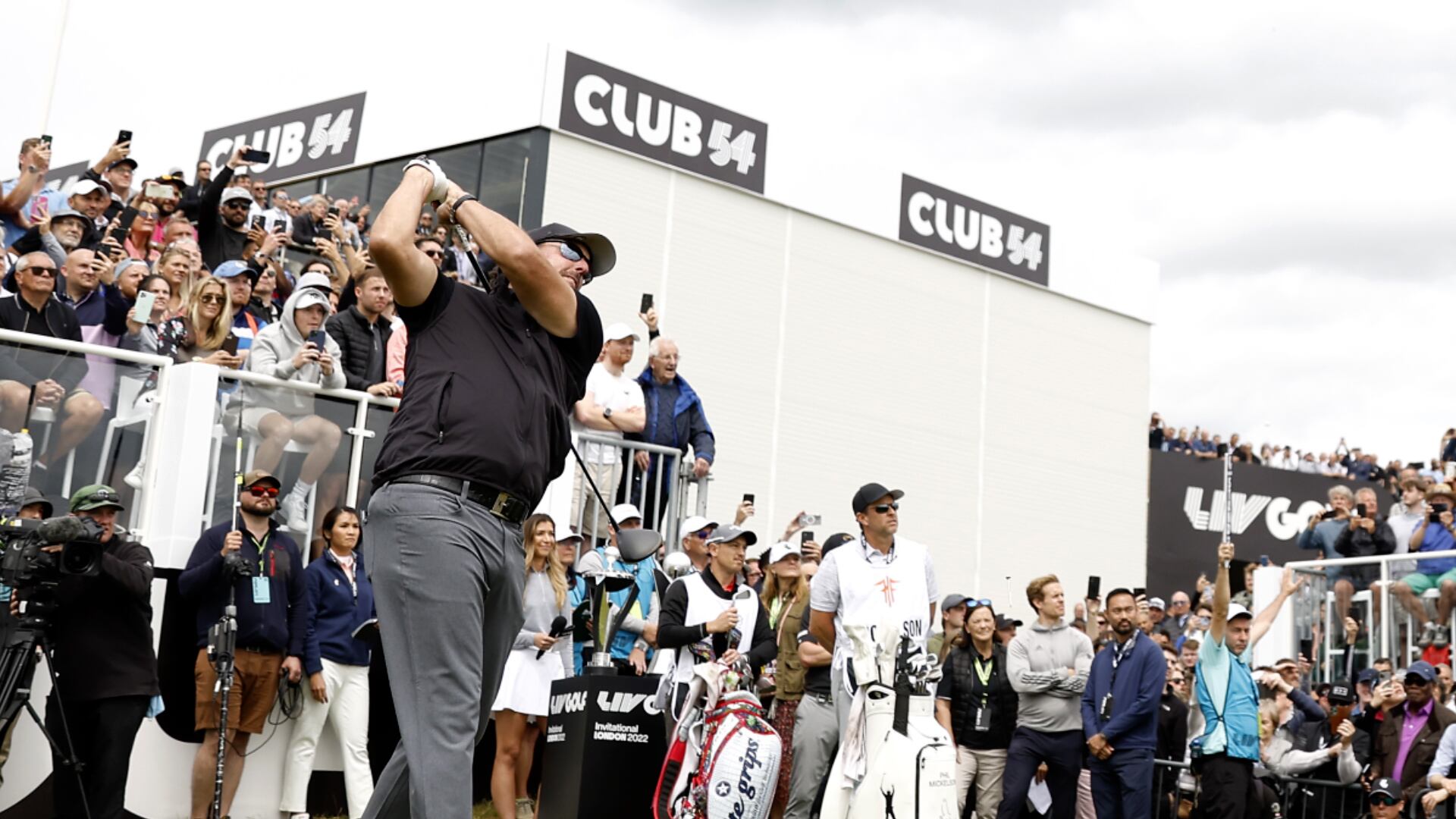
The PGA Tour has announced that it will suspend players that are competing in the LIV Golf event that teed off today. At least 17 players, including names like Phil Mickelson, Dustin Johnson, and Sergio Garcia are banned from the PGA Tour competition. Hilary Fordwich, a business analyst and golf expert, joined Cheddar News to discuss why the PGA had to go this route. This is a threat to the future of golf for them, and there's been many contentions about them not being fair and that this is vindictive," she said. "Don't forget, of course, they represent sort of a monopoly in the history of golf. So you've got two sides to this story. You've got those the purists, those that feel that golf should only be a certain way and that there are only these limited events that the PGA puts on. And then you've got other people who are saying … this is all about money"