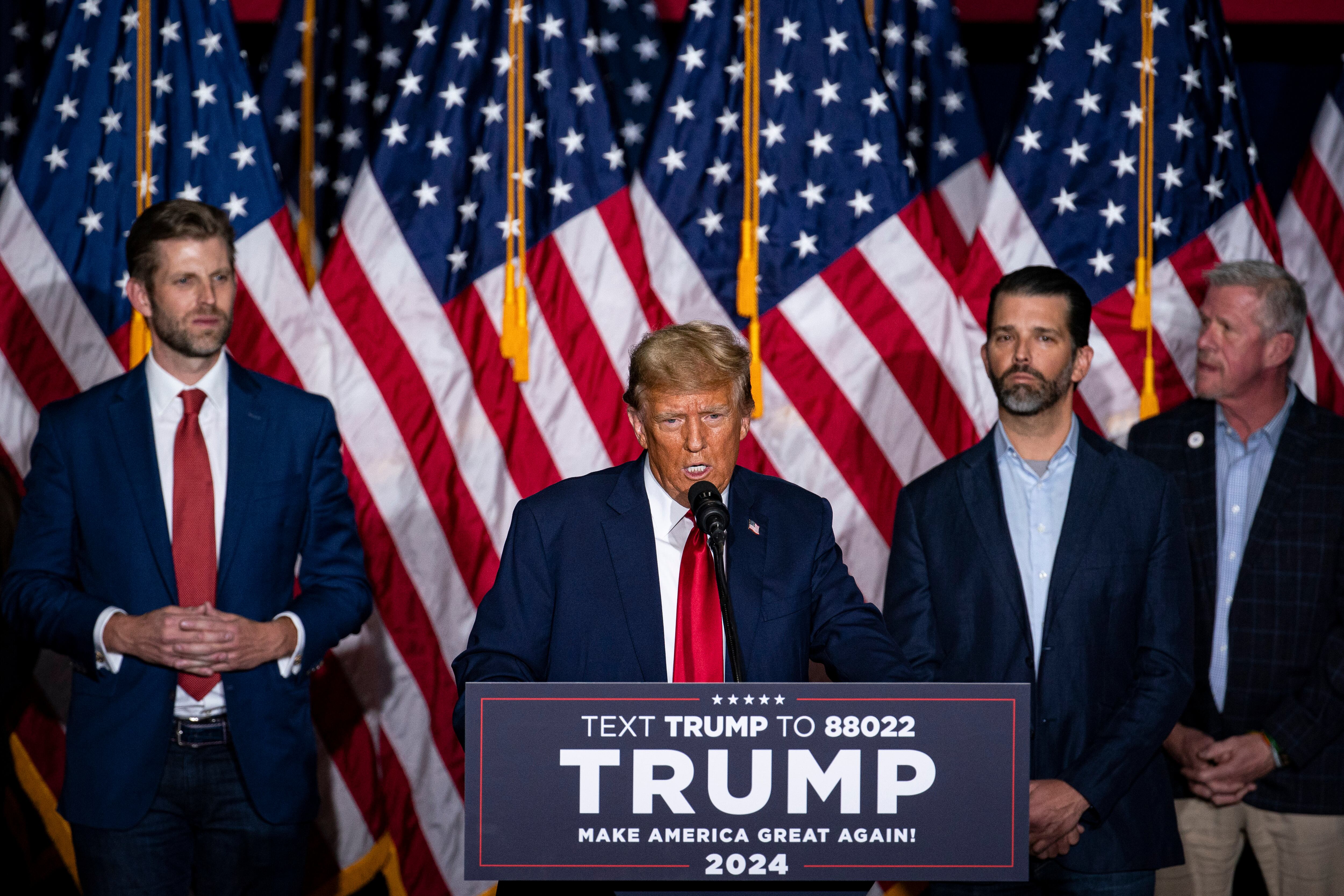
President Trump is facing sharp rebukes from many sides Friday, following the announcement that U.S. will impose tariffs on $300 billion worth of Chinese imports.
Stocks tumbled Friday, China has said it will retaliate against new tariffs, and trade groups across industries have come out in fierce opposition to the move, which is the latest escalation in the now years-long trade dispute between the U.S. and China.
"We're concerned these additional tariffs will further erode our reputation as a reliable supplier, and our farmers, workers, and consumers will suffer more," Craig Allen, the president of the US-China Business Council, said in a statement.
The announcement of additional tariffs came after two days of seemingly fruitless high-level trade talks in Shanghai. Negotiators included U.S. Trade Representative Robert Lighthizer, Treasury Secretary Steven Mnuchin, and China's Vice Premier Liu He.
"Unfortunately, it seems that when we take two steps forward, we then take two steps backward," Kip Eideberg, a vice president at the Association of Equipment Manufacturers, told Cheddar Friday.
The sudden escalation sent waves across markets. In the U.S., the Dow, the S&P 500, and the Nasdaq Composite all opened down on Friday. The FTSE 100 Index — better known as the "Footsie" — in London fell by roughly 2.2 percent, and both the Nikkei Index in Tokyo and the Hang Seng Index in Hong Kong closed the day down over 2 percent.
On Thursday, Trump said that a 10 percent tariff would be levied on $300 billion worth of Chinese goods. That would essentially blanket all Chinese imports, which totaled roughly $558 billion in 2018, with tariffs. Trump later told reporters that the established tariffs could be increased beyond 25 percent if progress is not made in negotiations.
"I can always do much more or I can do less, depending on what happens with respect to a deal," Trump said on the White House lawn Thursday after making the announcement. "It can be lifted up to well beyond 25 percent. But we're not looking to do that, necessarily."
In response, the Chinese Foreign Ministry said it "deplores and firmly opposes" the new tariffs, adding that China will take necessary countermeasures to defend its interests.
"We do not want a trade war, but we are not afraid of fighting one," Hua Chunying, a foreign ministry spokesperson, said on Friday. "China does not accept any maximum pressure, threat, or blackmail."
Several trade groups came out in strong opposition to Trump's tariff, arguing that such a strategy ultimately hurts U.S. businesses and consumers.
"These additional tariffs will only threaten U.S. jobs and raise costs for American families on everyday goods," David French, the senior vice president for government relations at the National Retail Federation, said in a statement. "The tariffs imposed over the past year haven't worked, and there's no evidence another tax increase on American businesses and consumers will yield new results."
The Consumer Technology Association (CTA) said that the new tariffs are essentially a tax on American's favorite technology products, stressing that tariffs are paid for by U.S. consumers and not China. "Retaliatory tariffs, whether 10% or 25%, are bad policy," Gary Shapiro, the president and CEO of CTA, said.
Trump, nonetheless, claimed on Thursday said that his strategy is working, claiming that "our people haven't paid … frankly, it hasn't cost our consumer anything; it costs China."
People's Daily, the official Chinese government's newspaper, said in an editorial on Friday that "some American politicians once again found ants in their pants and tried to destroy the potential for cooperation."