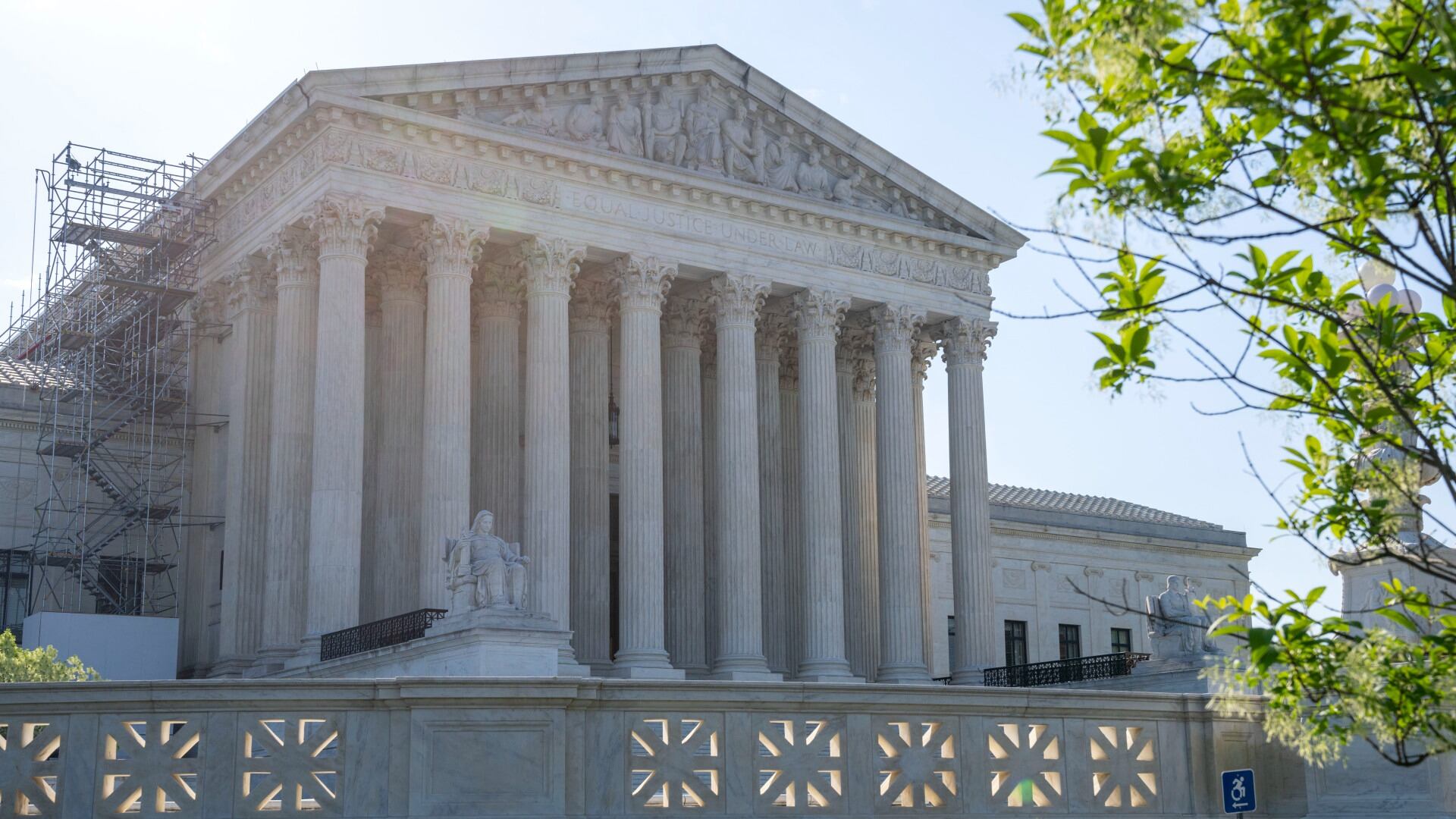
The Supreme Court is seen, Friday, April 21, 2023, ahead of an abortion pill decision in Washington. (AP Photo/Jacquelyn Martin)
By Jessica Gresko
The Supreme Court said Monday it won't review North Carolina's decision to stop issuing specialty license plates with the Confederate flag.
As is typical, the court did not comment in declining to hear the case, which challenged the state's decision. The dispute was one of many the court said Monday it would not hear. It was similar to a case originating in Texas that the court heard in 2015, when it ruled the license plates are state property.
The current dispute stems from North Carolina's 2021 decision to stop issuing specialty license plates bearing the insignia of the North Carolina chapter of the Sons of Confederate Veterans. The chapter sued, claiming that the state's decision violated state and federal law. A lower court dismissed the case, and a federal appeals court agreed with that decision.
North Carolina offers three standard license plates and more than 200 specialty plates. Civic clubs including the Sons of Confederate Veterans can create specialty plates by meeting specific requirements.
In 2021, however, the state Department of Transportation sent the group a letter saying it would "no longer issue or renew specialty license plates bearing the Confederate battle flag or any variation of that flag" because the plates "have the potential to offend those who view them."
The state said it would consider alternate artwork for the plates' design if it does not contain the Confederate flag.
The organization unsuccessfully argued that the state's decision violated its free speech rights under the Constitution's First Amendment and state law governing specialty license plates.
In 2015, the Sons of Confederate Veterans’ Texas chapter claimed Texas was wrong not to issue a specialty license plate with the group's insignia. But the Supreme Court ruled 5-4 that Texas could limit the content of license plates because they are state property.
The truck blockade at the U.S. border by Canadians protesting the country’s COVID-19 restrictions is tightening the screws on the auto industry, forcing Ford, Toyota and General Motors to shut down plants or otherwise curtail production.
Inflation was hotter than expected in January, but the debate over what this means for the economy is getting even hotter as markets brace for a flurry of Fed rate hikes in 2022.
Inflation soared over the past year at its highest rate in four decades, hammering America’s consumers, wiping out pay raises and reinforcing the Federal Reserve’s decision to begin raising borrowing rates.
A rapidly growing list of Canadian provinces moved to lift their COVID-19 restrictions as protesters decrying vaccine mandates and other precautions kept up the pressure with truck blockades.
The House has approved legislation financing federal agencies for another month. It's the latest emblem of Congress’ inability to finish its budget work on time.
The IRS said Monday it will suspend the use of facial recognition technology to authenticate people who create online accounts after the practice was criticized by privacy advocates and lawmakers.
The first lady says real people often are caught in the middle. She spoke Monday in Washington about a now-stalled proposal for tuition-free community college, which she's pushed for a long time as a community college professor.
In a flurry of diplomacy across two continents, President Joe Biden emerged from a meeting with Germany’s new leader to vow the crucial Nord Stream 2 gas pipeline in Europe would be blocked if Russia further invades Ukraine.
Kristin Myers, Editor-in-Chief at The Balance, joined Cheddar News to preview the January jobs report, and to break down the racial disparity in employment numbers in the U.S.