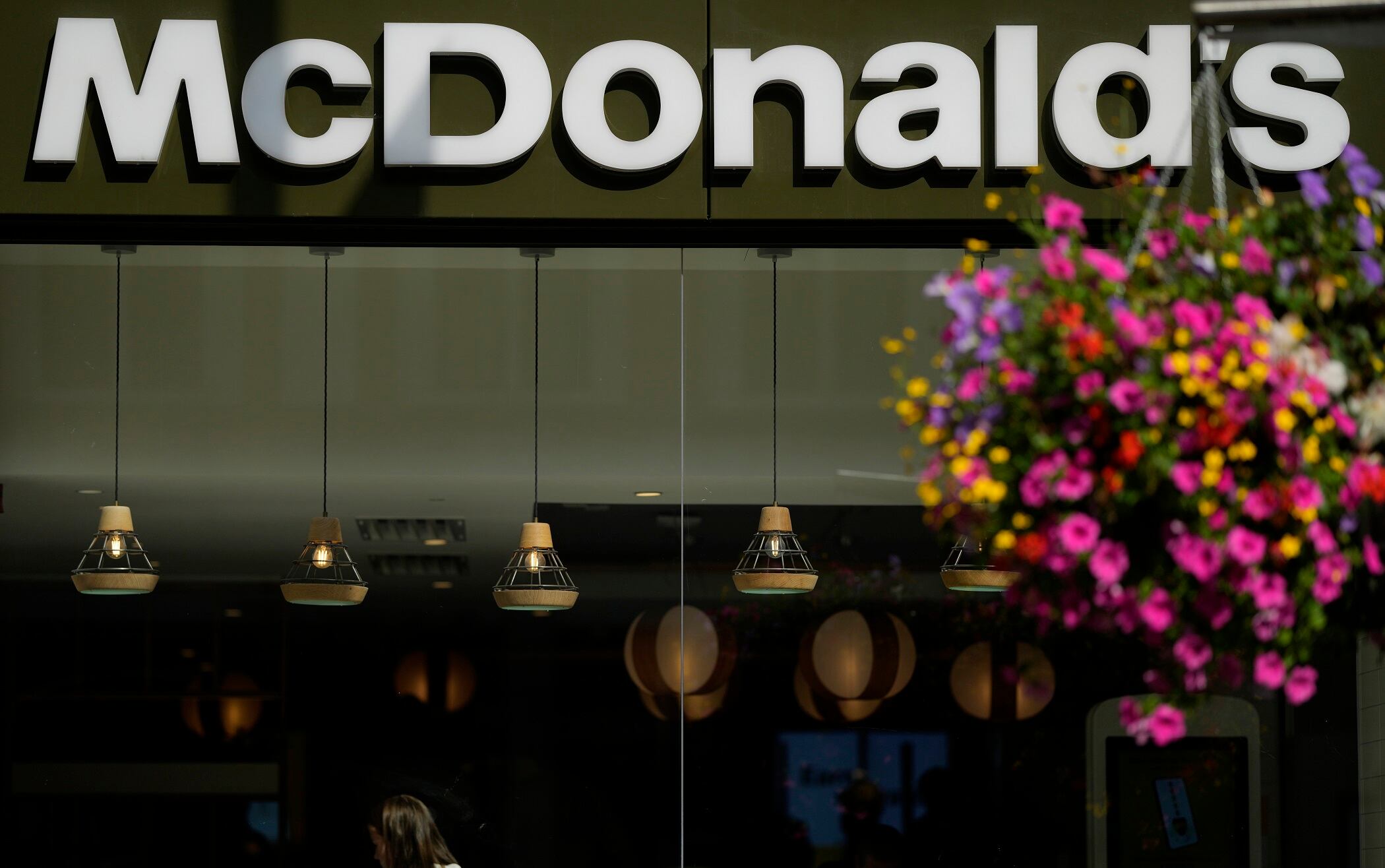
A customer walks in a McDonald's restaurant, in London, Tuesday, Aug. 24, 2021. McDonald’s says it has pulled milkshakes from the menu in all 1,250 of its British restaurants because of supply problems stemming from a shortage of truck drivers. The fast-food chain says it is also experiencing shortages of bottled drinks. (AP Photo/Alastair Grant)
McDonald’s says it has pulled milkshakes from the menu in all 1,250 of its British restaurants because of supply problems stemming from a shortage of truck drivers.
The fast-food chain says it is also experiencing shortages of bottled drinks.
“Like most retailers, we are currently experiencing some supply chain issues, impacting the availability of a small number of products,” McDonald’s said in a statement Tuesday. “Bottled drinks and milkshakes are temporarily unavailable in restaurants across England, Scotland and Wales.”
It said it was “working hard to return these items to the menu.”
It is the latest in a series of shortages to parts and products in Britain blamed on a combination of Brexit and the coronavirus pandemic. Britain’s exit from the European Union at the end of last year has made it harder for the bloc’s citizens to work in the U.K., and businesses have also been hit by large numbers of employees having to self-isolate because of possible exposure to the virus.
Industry body the Road Haulage Association says pandemic restrictions over the past 18 months have delayed many new recruits taking their driving tests. The group says Britain is short about 100,000 drivers, from a pre-pandemic total of 600,000.
Last week, chicken chain Nando’s temporarily shut about 50 outlets because of a shortage of poultry. KFC also warned recently that supply chain issues meant it was unable to stock some menu items.
Supermarkets have also reported problems getting some products onto shelves.
The U.K. government has temporarily eased restrictions on the number of hours drivers can work in an attempt to improve the situation.
Ahead of the Meta shareholder meeting, more than five hundred doctors have jointly sent a letter to investors to hold the Facebook parent accountable for the risks its platforms have posed to the public and mental health. Dr. Rob Davidson, a West Michigan ER physician and executive director of the Committee to Protect Health Care, joined Cheddar News to discuss how medical professionals are coming together to highlight the social media giant's spread of misinformation, especially during the pandemic. "We've seen the direct impacts of misinformation and disinformation that spreads like wildfire on the social media platforms," he said. "Our goal with this letter is to try to get the shareholders of Meta to convince leadership that they need to do a better job."
Snap downgraded its earnings and revenue expectations for the second quarter, saying the "macroeconomic environment" has deteriorated faster than the company anticipated. The warning sent shockwaves through the digital ad industry, dragging down a handful of other tech stocks, including Pinterest, Meta, and Twitter. Daniel Cobb, CEO and Chief Strategy Officer of Daniel Brian Advertising, joined Cheddar to discuss the reason behind this warning, and why it's bringing so many social media stocks down.
Pamela Rucker, CIO Advisor and Instructor for Harvard Professional Development, joins Cheddar to discuss how perceptions of Environmental, Social, and Governance–or ESG–changed over the past couple of years, and how using machine learning and artificial intelligence could pave the way to a more sustainable future.
Bob Lockett, Chief Diversity & Talent Officer, ADP, joins Cheddar to break down why offering more flexibility at work is a top way to retain talent at work, and how strong DEI policies help encourage employee loyalty.