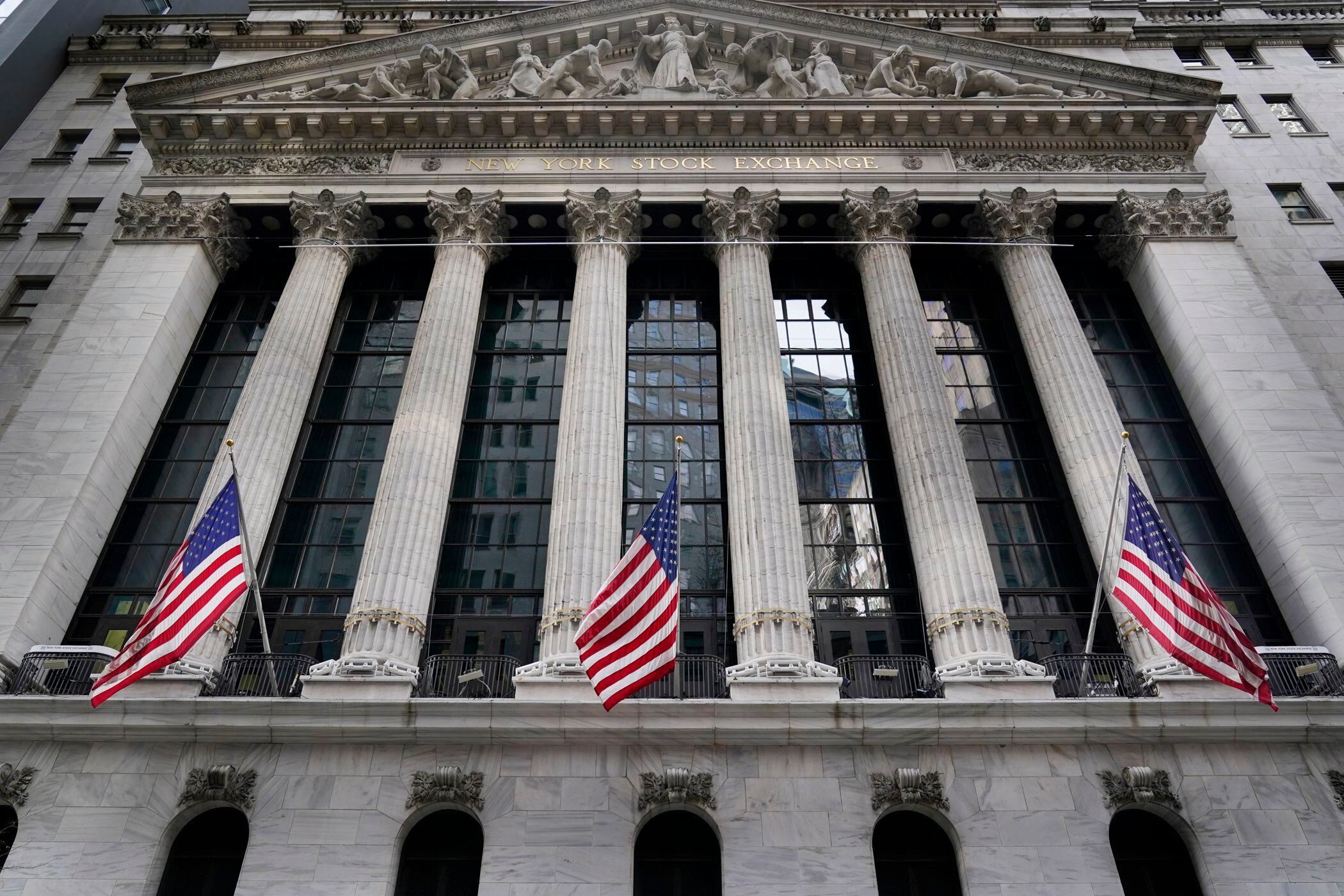
In this Nov. 23, 2020 file photo, the New York Stock Exchange is seen in New York. Stocks are opening lower, Wednesday, May 12, 2021, on Wall Street and bond yields are rising as investors reacted to a worse-than-expected increase in inflation last month. (AP Photo/Seth Wenig)
By Damian J. Troise and Alex Veiga
Inflation worries rattled Wall Street Wednesday, pulling the Dow Jones Industrial Average more than 680 points lower and placing the major stock indexes on track for their worst week in more than six months.
The selling came as investors reacted to a surprisingly big jump in inflation last month that stoked concerns that the economy may bounce back too fast from its pandemic-induced doldrums.
Tech giants, which had soared during the past year of lockdowns, took some of the biggest losses. Only energy stocks eked out a small gain.
Bond yields snapped higher after the government reported that consumer prices rose 0.8% in April, more than expected, and prices rose year-over-year at the fastest rate since 2008.
The yield on the 10-year Treasury note rose to 1.69% from 1.62% a day earlier, a big move. Bond yields rise when investors fear that an increase in inflation will erode the future value of the income that bonds pay.
“Inflation and interest rate jitters are hitting the market today, but for now the sell-off has been orderly,” said Cliff Hodge, chief investment officer for Cornerstone Wealth. “Letting some air out of these sky-high valuations is a positive going forward.”
The S&P 500 lost 89.06 points, or 2.1%, to 4,063.04, its biggest one-day drop since late February.
The Dow fell 681.50 points, or 2%, to 33,587.66, the worst decline for the blue chip index since late January. The Nasdaq gave up 357.75 points, or 2.7%, to 13,031.68. It was the tech-heavy index's largest pullback since mid-March.
Small company stocks also gave up the most ground. The Russell 2000 index fell 71.85 points, or 3.3%, to 2,135.14.
Inflation concerns have been hitting the stock market hard this week. The S&P 500, Nasdaq and Dow are on track for their biggest weekly loss since Oct. 30. The Dow and S&P 500 had set all-time highs just last Friday.
Investors have been worrying that inflation could return after being absent for many years as the economy revs out of the recession brought on by the pandemic. Federal Reserve officials and other economists have said moderate inflation may actually be a good thing in a recovery.
While the latest reading on inflation was hotter than expected, the market shouldn’t be too surprised about inflation rising, said Jeff Buchbinder, equity strategist at LPL Financial. The prevailing sentiment is that rising inflation will be temporary, though “it's too early to say whether these higher levels are going to be sustained,” he said.
Concerns about rising inflation also raise the question of whether the Federal Reserve will change its posture on maintaining low interest rates as the economy recovers. Buchbinder said investors shouldn't expect that to happen any time soon, however, given that the economy, and particularly the job market, are still a long way from being fully recovered.
“Really the Fed has one mandate right now, which is to regain full employment, and it's going to take some time," Buchbinder said.
Analysts expect consumer prices to rise as the economy recovers, but higher prices could run the risk of curtailing some spending, which the economy needs to sustain its recovery. The cost of new cars rose 0.5% in April, the largest increase since last July, because of heavy demand and a computer chip shortage that has slowed production and reduced dealer supplies.
Rising inflation makes stocks seem more expensive, particularly high-value tech stocks that trade on the potential for their future profits in coming years. Apple, Microsoft and Amazon all fell more than 2%.
Energy prices continued to climb following the shutdown of a major gas pipeline on the East Coast earlier in the week, and there are now reports of gasoline hoarding happening in places like North Carolina.
Stocks closed at session lows Thursday, mostly due to a larger tech selloff after Facebook parent company Meta reported weak earnings results one day before. The Nasdaq closed down nearly 4% for its worst day since September 2020. Erin Gibbs, Chief Investment Officer at Main Street Asset Management, joins Closing Bell to discuss today's close, Meta earnings, Amazon earnings, and more
Spotify beat fourth quarter earnings expectations, and also reported a jump in monthly active users and in paid subscribers. The report comes as the company grapples with a new question: is it simply a streaming platform, or is it a media company responsible for the content it posts, like Joe Rogan's controversial podcast? Greg Martin, Co-Founder of Rainmaker Securities, joins Closing Bell to discuss why the stock took a hit even though earnings results were positive, how the company can move forward through the Rogan controversy, and more.
Chen Arad, Chief Operating Officer for Solidus Labs, joins Cheddar News' Closing Bell, where he explains why Wormhole was particularly vulnerable to a $320+ million crypto hack and discusses what new investors need to do in order to protect their assets.
E-commerce platform for construction and building materials RenoRun has raised $142 million in a Series B round, which the company says is the fourth largest Series B round in Canadian history. RenoRun’s platform offers same-day delivery of construction materials to job sites in Canada and the United States. The company aims to revolutionize the construction industry by maximizing productivity and efficiency. RenoRun co-founder and CEO Eamonn O’Rourke joins Cheddar News' Closing Bell to discuss.
Facebook parent company Meta reported weaker-than-expected fourth quarter earnings, and also issued disappointing guidance for Q1 2022. The tech giant is also under pressure due to Apple's iOS privacy change, as well as continued multi-billion dollar losses for its metaverse focused business unit. Angelo Zino, Tech Analyst at CFRA Research, joins Closing Bell to discuss the earnings results, how Apple's iOS privacy change will impact revenue, whether the metaverse is an underrated investment opportunity, and more.
Rental prices are rising across the country, causing millions to relocate. Average rents rose 14 percent last year, and Americans expect rents will continue to rise by about 10 percent just this year. Daryl Fairweather, chief economist at Redfin, joins Cheddar News to discuss.
The video game industry has seen monumental growth the past few years - with an increasing amount of companies jumping head first into the space. In January alone, Microsoft announced its plan to acquire Activision Blizzard, game publisher Take-Two agreed to buy Zynga, and most recently, Sony announced it has agreed to buy game developer Bungie for $3.6 billion. Tobias Batton, CEO and founder of Ex Populus, joined Cheddar Movers to discuss the surge in M&A activity in the gaming space.
Facebook parent Meta reported disappointing results in its first quarterly earnings report since rebranding to focus on the metaverse. The tech giant delivered mixed results with quarterly profit falling well below Wall Street expectations. Shares plunged more than 20 percent in after hours trading as a result. Martin Garner, COO of CCS Insight, joined Cheddar Movers to break down the company's results.
Karyn Cavanaugh, Chief Investment Officer at Carolinas Wealth Management, breaks down which industries investors should watch this earnings season and highlights which sectors have upside potential.
Super Group, the company behind leading global online sports betting and gaming businesses Betway and Spin, has landed on Wall Street. The company went public via SPAC with Sports Entertainment Acquisition Corp., and now lists on the NYSE under the ticker symbol 'SGHC.' This debut comes as the U.S. sports betting market continues to heat up with more and more states legalizing the practice. Eric Grubman, chairman of Super Group, joined Cheddar to discuss.