By Alex Veiga and Damian J. Troise
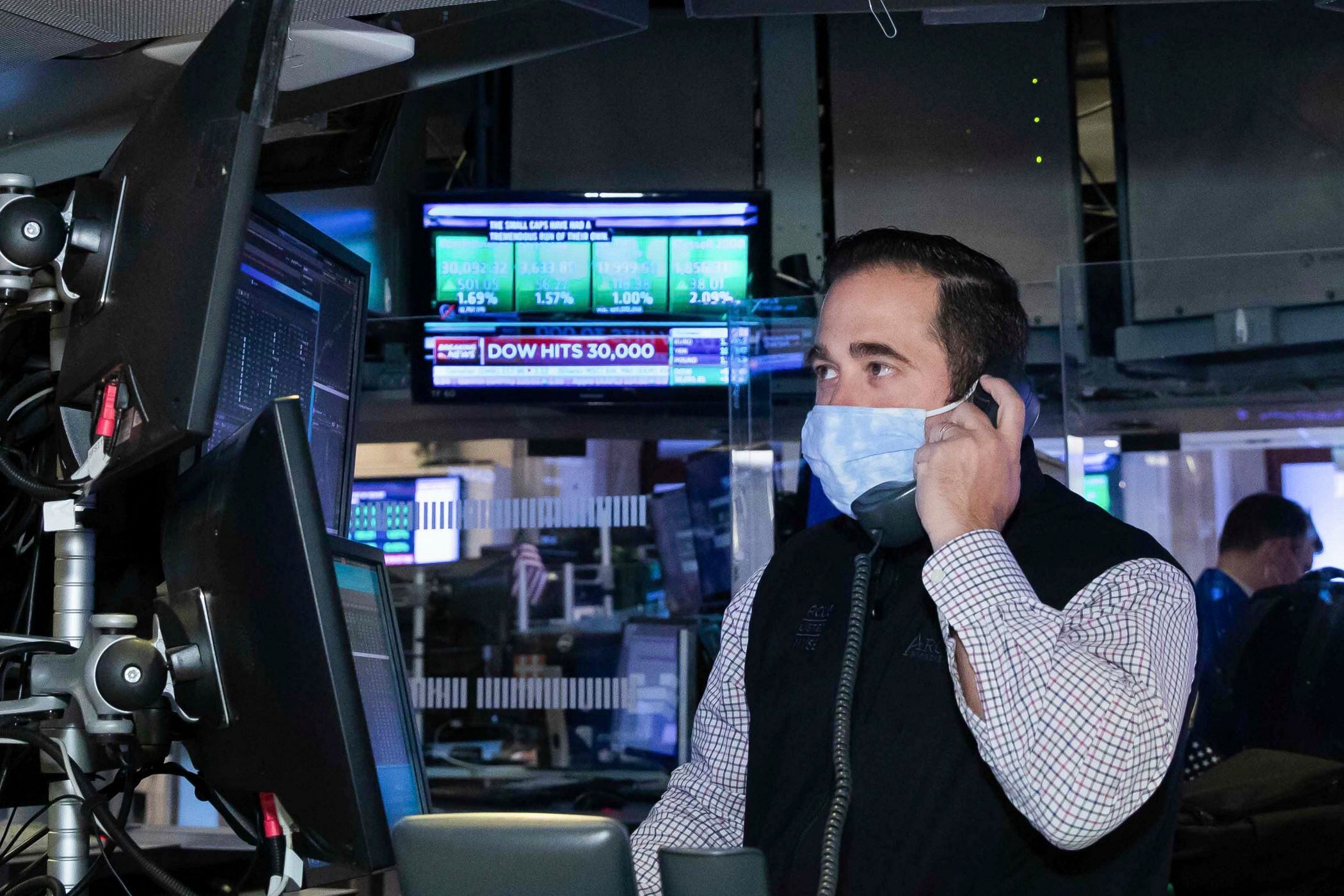
The Dow Jones Industrial Average closed above 30,000 points for the first time Tuesday as progress in the development of coronavirus vaccines and news that the transition of power in the U.S. to President-elect Joe Biden will finally begin kept investors in a buying mood.
Traders were also encouraged to see that Biden had selected Janet Yellen, a widely respected former Federal Reserve chair, as treasury secretary. The Dow rose more than 450 points, or 1.5%, to cross the milestone. The S&P 500 index, which has a far greater impact on 401(k) accounts than the Dow, rose 1.6%, climbing to its own all-time high.
The gains extend a monthlong market rally driven by growing optimism that development of coronavirus vaccines and treatments will loosen the pandemic's stranglehold on the economy. They also mark a rapid climb for the Dow from its March 23 low of just under 18,600 during the worst of its early pandemic nosedive.
“We are one step closer to moving past the election uncertainty,” said Lindsey Bell, chief investment strategist at Ally Invest. “People are still optimistic about what 2021 has to bring, from an economic perspective and an earnings perspective.”
The S&P 500 rose 57.82 points to 3,635.41. The Dow gained 454.97 points to 30,046.24. Both indexes eclipsed record highs set early last week. The technology-heavy Nasdaq composite picked up 156.15 points, or 1.3%, to 12,036.79.
Traders continued to favor stocks that stand to gain the most from a gradual reopening of the economy, such as banks and industrial companies. Technology and communication stocks, which have been investor favorites through the pandemic, also helped lift the market.
In another signal that investors were feeling confident, the Russell 2000 index of smaller stocks outpaced the broader market, picking up 35.23 points, or 1.9%, to 1,853.53, also a record high.
“There’s some relief that Biden is choosing moderates to fill out the cabinet,” said Barry Bannister, head of institutional equity strategy at Stifel. Bannister also said the encouraging vaccine news continues to give hope that there is an end in sight to the pandemic.
On Monday, the head of the federal General Services Administration acknowledged that Biden is the apparent winner of this month’s presidential election. That allows the incoming president to coordinate with federal agencies on plans for taking over on Jan. 20, despite ongoing efforts by President Donald Trump to overturn the election.
Word that Biden has chosen Yellen as treasury secretary also added to investors' confidence. Widely admired in the financial world, Yellen would be the first woman to lead the department in a line stretching back to Alexander Hamilton in 1789, taking on a pivotal role to help shape policies at a perilous time.
“She's also pretty pro-fiscal stimulus and she's able to effectively work with people across the aisle,” Bell said. “She showed that in her time at the Fed.”
Stocks have been pushing higher this month, driving the S&P 500 up by more than 11%, as investors have grown more hopeful that the development of coronavirus vaccines and treatments will help pave the way for the economy to recover next year.
On Monday, drugmaker AstraZeneca reported surprisingly good results from ongoing vaccine studies. It said its potential vaccine, which is being developed with Oxford University, was up to 90% effective. Unlike rival candidates, AstraZeneca’s doesn’t have to be stored at ultra-cold temperatures, making it easier to distribute.
Last week, Pfizer and Moderna both reported study results showing their vaccines were almost 95% effective. And, over the weekend, Regeneron Pharmaceuticals received U.S. government approval for emergency use of its COVID-19 treatment. The drug, which Trump received when he was sickened last month, is meant to try to prevent hospitalization and worsening disease from developing in patients with mild-to-moderate symptoms.
The vaccine developments are tempering lingering concerns over rising virus cases in the U.S., as well as in Asia and other parts of the world, and new government restrictions on businesses aimed at limiting the spread.
Treasury yields rose as investors became more optimistic about the prospects for economic growth. The yield on the benchmark 10-year Treasury note rose to 0.88% from 0.84% late Monday.
U.S. markets will be closed Thursday for the Thanksgiving holiday. They will be open for half the day on Friday, closing at 1 p.m. Eastern.
European markets ended broadly higher, while Asian markets closed mixed.
Updated on November 24, 2020, at 5:04 p.m. ET with the latest information.