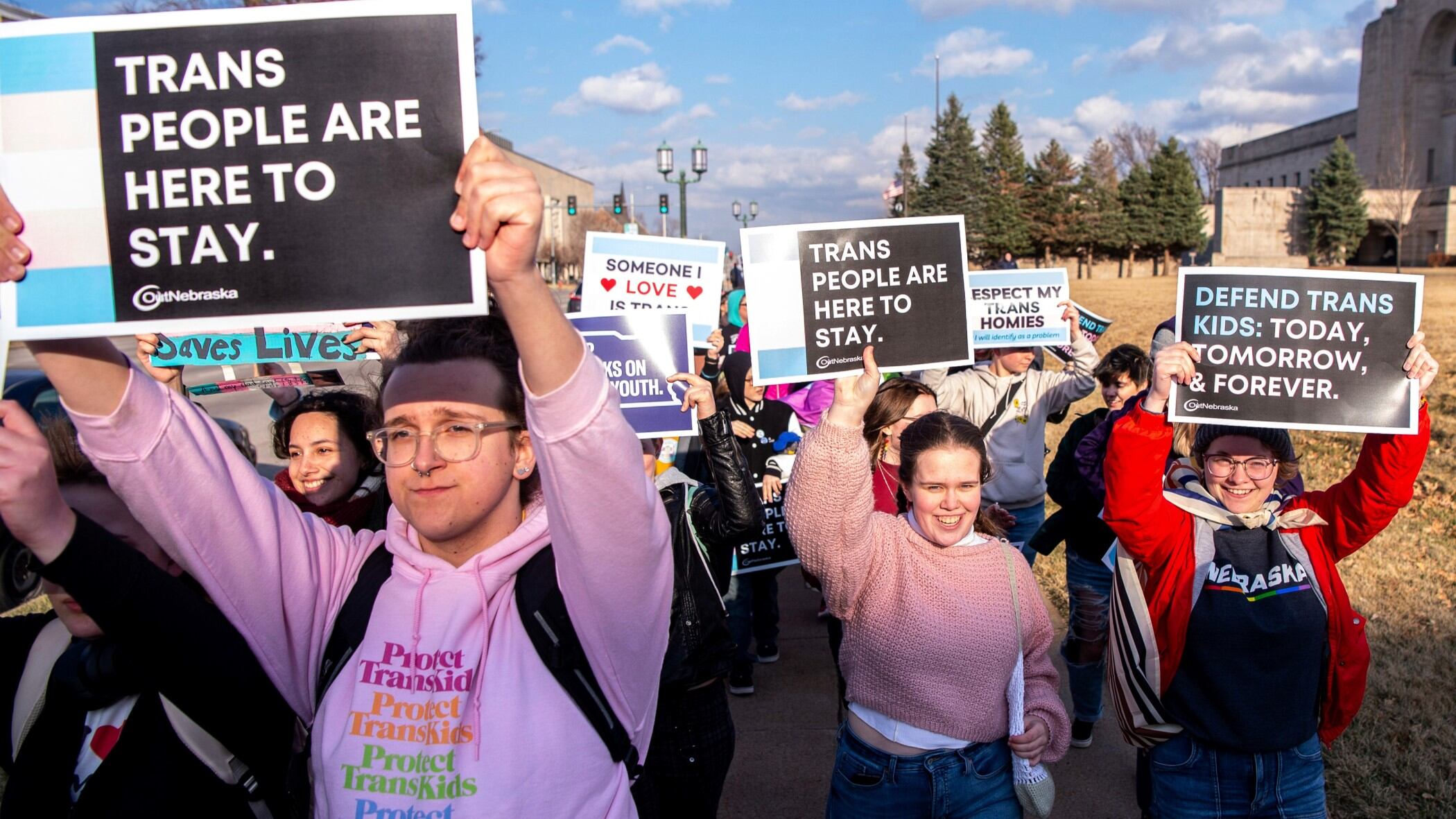
States that declared themselves refuges for transgender people have essentially issued an invitation: Get your gender-affirming health care here without fearing prosecution at home.
Now that bans on such care for minors are taking effect around the country — Texas could be next, depending on the outcome of a court hearing this week — patients and their families are testing clinics' capacity. Already-long waiting lists are growing, yet there are only so many providers of gender-affirming care and only so many patients they can see in a day.
For those refuge states — so far, California, Connecticut, Colorado, Illinois, Massachusetts, Maryland, Minnesota, New Jersey, New Mexico, New York, Washington and Vermont, plus Washington, D.C. — the question is how to move beyond promises of legal protection and build a network to serve more patients.
“We’re trying our best to make sure we can get those kids in so that they don’t experience an interruption in their care,” said Dr. Angela Kade Goepferd, medical director of the gender health program at Children's Minnesota hospital in the Twin Cities. “For patients who have not yet been seen and would be added to a general waiting list, it is daunting to think that it’s going to be a year or more before you’re going to be seen by somebody.”
Appointment requests are flooding into Children's from all over the country — including Texas, Montana and Florida, which all have bans. Requests have grown in a year from about 100 a month to 140-150. The program hopes to hire more staff to meet demand, but it will take time, Goepferd said.
More than 89,000 transgender people ages 13 to 17 live in states that limit their access to gender-affirming care, according to a research letter published in late July in the Journal of the American Medical Association, though not all trans people choose or can afford gender-affirming care.
Rhys Perez, a transmasculine and nonbinary 17-year-old, is preparing to move this month from Houston to Los Angeles to start college. The teen, who said they’re “escaping Texas in the nick of time,” said California’s protection for gender-affirming care was one of the main factors in their decision on where to go for college.
Perez has just begun their search for a provider in Southern California but already has encountered several clinics with waits for an initial consultation between nine and 14 months. They were disappointed to learn they likely could not begin hormone replacement therapy until their sophomore year.
“Hormones and stuff, that was never something my family fully understood or supported, really,” Perez said. “I figured it was best to wait until I move for college, but now it’s frustrating to know I’m going to have to wait even longer.”
“I wish I could start college as fully me,” they said.
Initial sanctuary laws or executive orders were an emergency step to protect transgender people and their families from the threat of prosecution by more than 20 states that have restricted or banned such health care, advocates say. They generally do not contain provisions to shore up health systems, but advocates say that needs to be the next step.
“That's what we’re hoping to set up over the next year to two years, is making sure that not only are we making this promise of being a refuge for folks, but we’re actually living up to that and ensuring that folks who come here have access to care when they need it,” said Kat Rohn, executive director of the LGBTQ+ advocacy group OutFront Minnesota.
Those efforts will likely need to involve legislators, governors, large employers, Medicaid plans and boards of medicine, said Kellan Baker, executive director of the Whitman-Walker Institute, the policy and education arm of a clinic with the same name in Washington, D.C.
“I would hope that it would be a comprehensive effort, that everyone at every level enacting these shield laws is aware that it’s not just about making a promise of access on paper, but that it needs to be backed up by the availability of providers,” Baker said.
Texas Gov. Greg Abbott, a Republican, became the first governor to order the investigation of families of transgender minors who receive gender-affirming care, and legislators this year passed a ban on such care.
Whether that law takes effect on Sept. 1 will be decided by a state judge in Austin, who is hearing arguments this week in a lawsuit filed by families and doctors seeking a temporary injunction. The lawsuit argues the bill violates parental rights and discriminates against transgender teens. It is unclear when the judge will rule.
A plaintiff, identified only by the pseudonym Gina Goe, testified Tuesday about her 15-year-old transgender son's efforts to continue testosterone treatments: “I have reached out to a Colorado facility, but there is, like, a waiting list. ... There is going to be a gap in his medical care.”
Ginger Chun, the education and family engagement manager at the Transgender Education Network of Texas, said she was in contact last year with about 15 families with trans family members. This year already, she has talked to about 250 families, who are asking about everything from clarification on legislation to looking for ways to access care. Those who are looking for care outside Texas are encountering waiting lists.
The research published in JAMA found that Texas youths’ average travel time to a clinic for gender-affirming care increased from just under an hour to over 7 1/2 hours.
“It’s like a daily, ever-changing process to figure out where people can access care,” Chun said.
Minnesota state Rep. Leigh Finke, a Democrat who sponsored a bill to protect gender-affirming care, predicts “thousands” of people will travel to the state for care within two years. She’s also seeking solutions to the provider shortage and expects to take a closer look when the next legislative session begins in February.
“I’m not sure what as a legislature we can do to increase the number of people who provide a certain kind of medical care,” said Finke, a transgender woman who represents part of the Twin Cities area. “I’m not sure as a policymaker what the mechanisms are to say we need more of one kind of specific health care provider, assuming that those exist. I’m certainly going to be interested in looking at them.”
The number of providers nationwide is limited, and for many, it’s not their full-time job. Minnesota, for instance, is home to 91 providers, according to a search on the website of the World Professional Association for Transgender Health. The state has 29,500 transgender people 13 and older, according to the Williams Institute, an LGBTQ+ think tank at the UCLA School of Law.
Dr. Katy Miller, the medical director of adolescent medicine for Children’s Minnesota, estimates “probably at least hundreds of families” are moving to the Twin Cities for gender-affirming care.
“People are going to kind of extraordinary lengths, like pulling kids out of school, moving.” Miller said.
In many ways, the quest for gender-affirming care parallels that of abortion access, for which people also cross state borders, sometimes under threat of prosecution. The main difference with gender-affirming care is that treatment is ongoing, generally for the rest of a person's life, so permanent access is key.
Anticipating long waits, some parents preemptively sought out gender-affirming care providers for a child, like Minnesota activist Kelsey Waits. Her 10-year-old transgender child, Kit, got into the system at a hospital that could eventually provide blockers or hormones so that they wouldn't have to start puberty without a doctor's support.