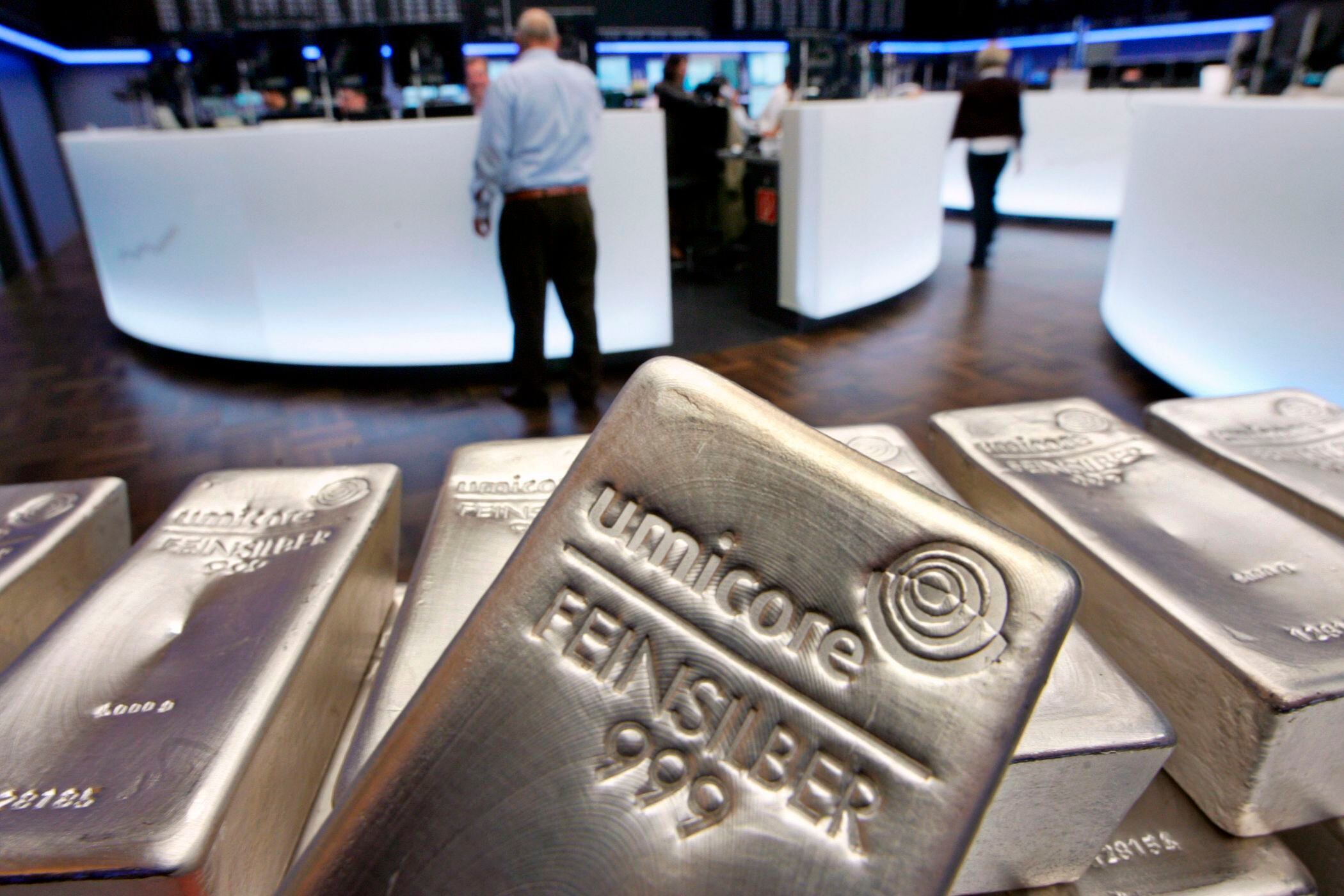
The erratic trading in shares of underdog companies like GameStop that turned markets combustible last week appears to have migrated to commodities, sending silver prices surging to an eight-year high.

Silver futures jumped more than 9% on Monday to $29.42 per ounce with #silversqueeze trending on Twitter. That exuberance spread to companies that mine precious metals, especially silver. Shares of Pan American Silver surged more than 9%, First Majestic Silver rose 18.7%, Hecla Mining spiked 21.8%, and Coeur Mining soared 17.6%.

Some analysts called price jump the latest assault by the smaller investors who sent GameStop soaring recently. But many of those same traders instead called it a trap set by hedge funds to divert their attention away from GameStop, as the saga captivating Wall Street gets even more dramatic.

An online army of Reddit traders banded together for the past week to snap up thousands of shares of GameStop, AMC and other struggling chains, stocks that have been heavily shorted (bets that the stock will fall) by a number of hedge funds. In the process, they've done heavy damage to those hedge funds in a stunning reversal of financial power on Wall Street.

Some of these smaller traders believe the hedge funds that were pillaged last week are behind the surge in silver. Communications on messaging boards claim hedge funds have now become active on Reddit anonymously, attempting to drive them out of GameStop bets and into silver, but only after hedge funds had taken huge positions.

“IT’S A TRAP!” one Redditor warned, though no one really seemed certain.

Meanwhile, GameStop shares dropped 28% to $233 but the stock price has been tremendously volatile of late. Last week a 44% drop on Thursday was followed by a 68% jump Friday.

The number of GameStop shares that have been shorted (bets that the stock will fall), were slashed by more than half in recent days, according to a report Monday by the analytics firm S3 Partners.

Last week’s turmoil caused hedge funds to pull back on their investments by the sharpest degree since February 2009, during the market collapse caused by the financial crisis, according to Goldman Sachs, which provides services such as clearing and consulting to hedge funds.

Goldman says hedge funds have have been getting out of both short sales, where they’re betting a stock will fall, and more traditional investments that bank on rising prices “in every sector,” according to a Goldman Sachs report Monday.

Even so, hedge funds' exposure to the stock market remains close to record levels. That means there’s still risk for more sell-offs by hedge funds.

The narrative has burst from financial pages, reaching even the White House, where President Joe Biden and Treasury Secretary Janet Yellen were peppered with questions about it last week.

On Monday, White House press secretary Jen Psaki was asked about GameStop and said that the incident/market volatility raises “an important set of policy issues.”

“We think congressional attention to these issues is appropriate,” Psaki adds.

The story has also moved out of Reddit chatrooms and into places where silver actually trades hands. Coin dealers are being overwhelmed by orders Monday.

The Silver Mountain, a Netherlands-based bullion dealer, said on its website that, “Due to extreme market volatility we cannot accept any new orders at this moment,” adding it hoped to reopen by the afternoon.

____

Jonathan Lemire contributed to this story from Washington.

Updated on February 1, 2021, at 3:42 p.m. ET with the latest details.
Share:
More In Business
Exxon, Apple Become Latest Companies to Cut Ties with Russia
A growing wave of major U.S. companies have taken steps to cut ties with Russia or offer support to Ukraine, as tensions escalate in the region. Exxon, Apple and Boeing are just the latest companies to make the move, following the likes of Google, Meta and BP who have all announced plans to exit the region in response to the conflict. Courtney Vinopal, Breaking News Reporter, Quartz joined Cheddar's Opening Bell for more.
How Companies Are Investing in Data and Analytics
Traci Gusher, EY Americas data and analytics leader, joins Cheddar News to discuss how companies have made strides within data and analytics throughout the pandemic and what the chief information officers of today need to focus on and dedicate resources to.
Wall Street Roars Back to Rally Mode, Even as Oil Rises Anew
Wall Street took another sharp swing Wednesday, this time back to rally mode, as stocks and Treasury yields rose even as U.S. crude oil prices climbed to the highest level in more than a decade. The S&P 500 rose 1.9%, recouping its losses from earlier in the week, after Federal Reserve Chair Jerome Powell said he supports a more modest rise in interest rates this month than some investors had feared. He also said he still expects inflation, which is at its highest level in 40 years, to moderate through the year. “Although we’ve had some Fed governors lately saying ‘Oh my God, this is such a huge crisis,’ the conventional wisdom is slow and steady wins the race right now,” said J.J. Kinahan, chief strategist with TD Ameritrade. The comments helped drive the market higher, adding to modest gains from earlier in the morning. Other areas of the market also gained ground a day after worries about Russia’s invasion of Ukraine sent the S&P 500 tumbling 1.5% and prices soaring for all kinds of commodities. Treasury yields jumped to recover some of their steep losses from the past week. Gold receded, and a measure of nervousness among stock investors on Wall Street eased after swinging sharply in recent days. “We’ve seen wild swings, but not major changes in the indexes,” said Jeff Kleintop, chief global investment strategist at Charles Schwab. “Geopolitical conflicts can be very unsettling, but you don’t tend to get bear markets from these, just periods of volatility.” Markets have been spinning wildly as investors try, sometimes blindly, to gauge how high Russia's attack on Ukraine will push prices for oil, wheat and other commodities where the region is a major producer. On top of that are worries about what upcoming hikes in interest rates by the Federal Reserve and other central banks around the world will do to the economy and inflation. Powell said in testimony to Congress that the Fed is set to raise its key interest rate for the first time since 2018. But he also said the attack on Ukraine may have muddied conditions, with its impact on the U.S. economy “highly uncertain,” adding that “we're never on autopilot.” The Fed is balancing a tightrope where it needs to raise interest rates enough to rein in the highest inflation in generations but not so much that it pushes the economy into a recession. All the while, higher interest rates tend to put downward pressure on stocks and most other investments. The yield on the 10-year Treasury leaped to 1.89% from 1.72% late Tuesday, while the two-year Treasury surged to 1.53% from 1.31%. Yields, though, remain well below where they were before Russia’s invasion. The 10-year yield was above 2% last month, before it plunged as investors plowed into investments seen as safer amid worries about war. The price of U.S. oil jumped another 7% to $110.60 per barrel, the highest level in just over a decade. Brent crude, the international standard, climbed 7.6% to $112.93 per barrel. Leaders of OPEC and other major oil-producing countries decided Wednesday to stick with their plan to gradually increase oil production. The OPEC+ coalition of oil producers, made up of OPEC members led by Saudi Arabia and non-cartel members led by Russia, chose to increase oil production by 400,000 barrels per day in April. The move follows a perhaps less impactful decision by the United States and other major governments in the International Energy Agency to release 60 million barrels from strategic reserves to boost supplies. “Markets dismissed the notion that 60 million barrels of strategic reserves released will be consequential to the risks of Russian supply jeopardized,” Tan Boon Heng of Mizuho Bank said in a report. “Russia pumps more than that in just six days.” In the stock market, all the uncertainty about oil prices and inflation has led to big swings not only by the day but also by the hour. The S&P 500 swung between gains of 0.4% and 2.2% Wednesday. It closed 80.28 points higher to 4,386.54. The Dow Jones Industrial Average rose 596.40 points, or 1.8%, to 33,891.35, while the Nasdaq composite gained 219.56 points, or 1.6%, to 13,752.02. More than 90% of stocks in the S&P 500 rose, with technology, financial and health care companies accounting for a big share of the rally. Bank stocks led the gainers, climbing 2.6%, as higher longer-term interest rates can mean bigger profits for them making loans. Energy stocks also helped lift the index as they rode higher energy prices. Ross Stores climbed 6.1% after the retail chain reported stronger profit for its last quarter than analysts expected. Ford jumped 8.4% after it said it was accelerating its transformation into an electric-vehicle company and split its EV and internal combustion operations into two individual businesses. Stock markets around the world were mixed. France’s CAC 40 rose 1.6%, Germany’s DAX returned 0.7% and Japan’s Nikkei 225 fell 1.7%. Russia’s central bank said stock trading on the Moscow exchange would remain closed Wednesday for a third day, though trading of currencies and precious metals would resume for the first time this week. Late Tuesday, President Joe Biden announced he was joining U.S. allies in closing the country’s air space to Russian aircraft, the latest in a set of sanctions and other measures meant to isolate Russia. But Biden also said in his annual State of the Union speech that he would try to cushion Americans against the impact of higher oil prices. “I will use every tool at our disposal to protect American businesses and consumers,” Biden said.
Stocks Close Sharply Lower as Russia-Ukraine Fighting Intensifies
Scott Clemons, Partner and Chief Investment Strategist at Brown Brothers Harriman, joins Cheddar News' Closing Bell, where he discusses the factors leading to the sell-off on Wall Street today and explains why uncertainty is worse than bad news for the investors.
Load More