By Lisa Mascaro, Stephen Groves, Farnoush Amiri and Kevin Freking
Republicans chose Rep. Mike Johnson as their latest nominee for House speaker desperate to unite their fractious majority and end the chaos, just hours after an earlier pick abruptly withdrew in the face of opposition from Donald Trump.
Johnson of Louisiana, a lower-ranked member of the House GOP leadership team, becomes the fourth Republican nominee in what has become an almost absurd cycle of political infighting since Kevin McCarthy's ouster as GOP factions jockey for power.
When the House convenes at noon Wednesday ahead of a floor vote, Johnson, who won the majority behind closed doors, will need almost all Republicans in the public roll call to win the gavel.
“Mike! Mike! Mike!” lawmakers chanted at a press conference late Tuesday night, surrounding Johnson and posing for selfies in a show of support.
Three weeks on, the Republicans have been frittering away their majority status — a maddening embarrassment to some, democracy in action to others, but not at all how the House is expected to function.
Refusing to unify, far-right members won’t accept a more traditional speaker and moderate conservatives don’t want a hardliner. While Johnson had no opponents during the private roll call, some two dozen Republicans did not vote, more than enough to sink his nomination.
Anxious and exhausted, Republican lawmakers are desperately trying to move on. “Pretty sad commentary on governance right now,” said Rep. Steve Womack, R-Ark. “Maybe on the fourth or fifth or sixth or 10th try, we’ll get this thing right.”
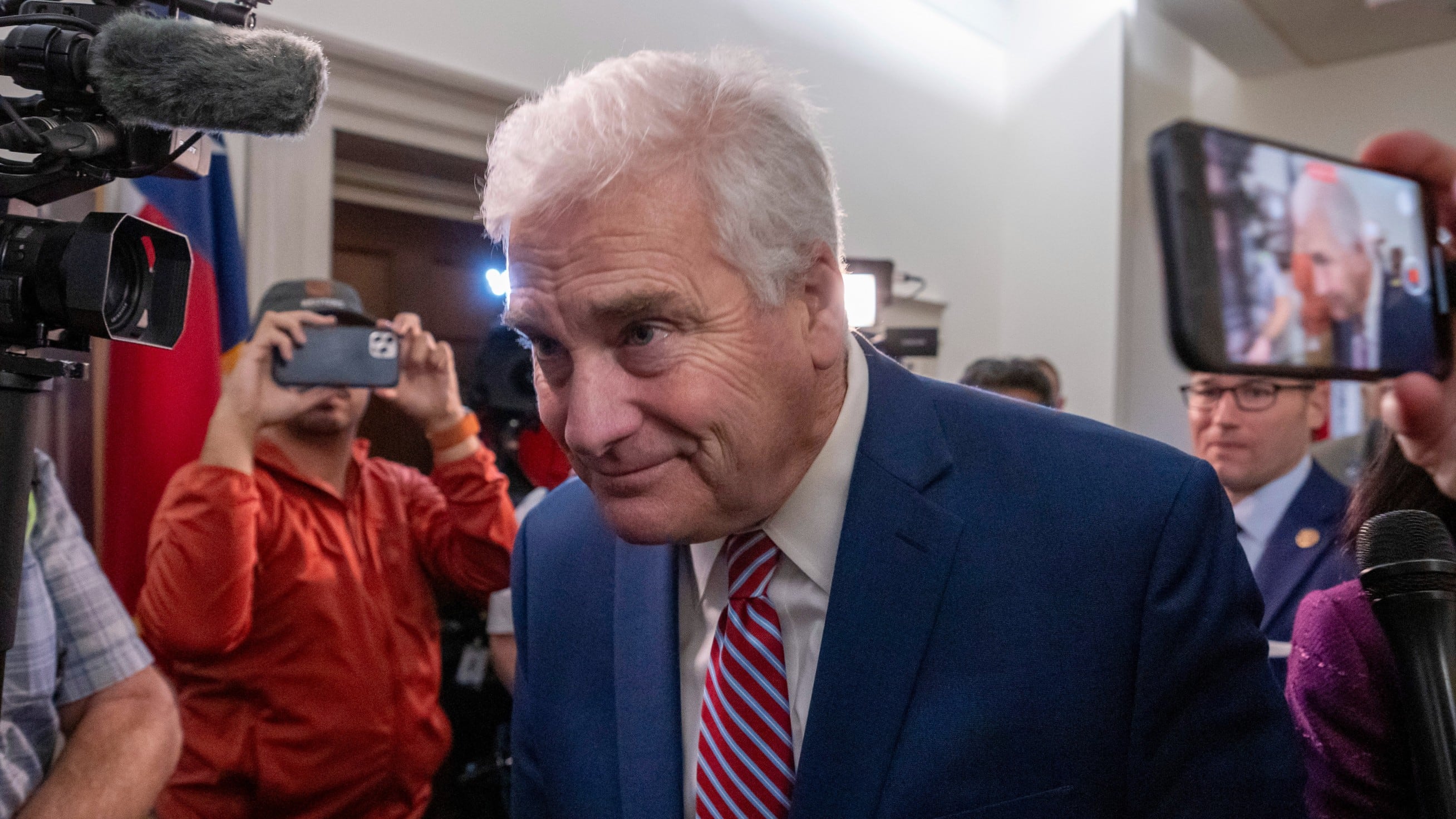
After he withdrew Tuesday afternoon, Rep. Tom Emmer briskly left the building where he had been meeting privately with Republicans. He said later at the Capitol that Trump's opposition did not affect his decision to bow out.
“I made my decision based on my relationship with the conference,” he said, referring to the GOP majority. Emmer said he would support whomever emerges as the new nominee. “We'll get it done.”
Trump, speaking as he left the courtroom in New York where he faces business fraud charges, said his “un-endorsement” must have had an impact on Emmer’s bid.
“He wasn’t MAGA," said Trump, the party's front-runner for the 2024 presidential election, referring to his Make America Great Again campaign slogan.
House Republicans returned behind closed doors, where they spend much of their time, desperately searching for a leader who can unite the factions, reopen the House and get the U.S. Congress working again.
Attention quickly turned to Johnson, 51, who was the second highest vote-getter on Tuesday morning's internal ballots.
A lawyer specializing in constitutional issues, Johnson had rallied Republicans around Trump’s legal effort to overturn the 2020 election results.
Elevating Johnson to speaker would giving Louisianans two high-ranking GOP leaders, putting him above Majority Leader Steve Scalise, who was rejected by hardliners in his own bid as speaker.
But hardliners swiftly resisted Johnson's bid and a new list of candidates emerged. Among them was Rep. Byron Donalds of Florida, a Trump ally who ran third on the morning ballot, and a few others.
In the end, Johnson won 128 votes on the evening ballot, more than any other candidate. McCarthy, who was not on the ballot, won a surprising 43 votes.
“Democracy is messy sometimes, but it is our system,” Johnson said afterward, Scalise standing behind him. “We're going to restore your trust in what we do here.”
One idea circulating, first reported by NBC News, was to reinstall McCarthy as speaker with hardline Rep. Jim Jordan in a new leadership role.
It was being pitched as a way to unite the conference, lawmakers said, but many said it would not fly.
“I think sometimes it’s good to have fresh ideas and fresh people,” said Rep. Victoria Spartz, R-Ind.
While Emmer won a simple majority in a morning roll call behind closed doors — 117 votes — he lost more than two dozen Republicans, leaving him far short of what will be needed during a House floor tally ahead.
With Republicans controlling the House 221-212 over Democrats, any GOP nominee can afford just a few detractors to win the gavel.
Trump allies, including the influential hard-right instigator Steve Bannon, have been critical of Emmer. Some point to his support of a same-sex marriage initiative and perceived criticisms of the former president. Among the far-right groups pressuring lawmakers over the speaker’s vote, some quickly attacked Emmer.
Having rejected the top replacements, Scalise and the Trump-backed Jordan, there is no longer any obvious choice for the job.
“We’re in the same cul-de-sac,” said Rep. Scott Perry, R-Pa., the chairman of the far-right House Freedom Caucus.
Yet Rep. Ralph Norman, R-S.C., one of the hardliners, said, “This is what democracy looks like.”
Republicans have been flailing all month, unable to conduct routine business as they fight amongst themselves with daunting challenges ahead.
The federal government risks a shutdown in a matter of weeks if Congress fails to pass funding legislation by a Nov. 17 deadline to keep services and offices running. More immediately, President Joe Biden has asked Congress to provide $105 billion in aid — to help Israel and Ukraine amid their wars and to shore up the U.S. border with Mexico. Federal aviation and farming programs face expiration without action.
Many hardliners have been resisting a leader who voted for the budget deal that McCarthy struck with Biden earlier this year, which set federal spending levels that far-right Republicans don't agree with and now want to undo. They are pursuing steeper cuts to federal programs and services with next month's funding deadline.
Rep. Marjorie Taylor Greene of Georgia said she wanted assurances the candidates would pursue impeachment inquiries into Biden and other top Cabinet officials.
During the turmoil, the House is now led by a nominal interim speaker pro tempore, Rep. Patrick McHenry, R-N.C., the bow tie-wearing chairman of the Financial Services Committee. His main job is to elect a more permanent speaker.
Some Republicans — and Democrats — would like to simply give McHenry more power to get on with the routine business of governing. But McHenry, the first person to be in the position that was created in the aftermath of the Sept. 11, 2001, terror attacks as an emergency measure, has declined to back those overtures.
Associated Press writer Jill Colvin in New York contributed to this report.
Updated Oct. 25 at 5:45 a.m. ET with the latest details.