By Janie Har and Haven Daley
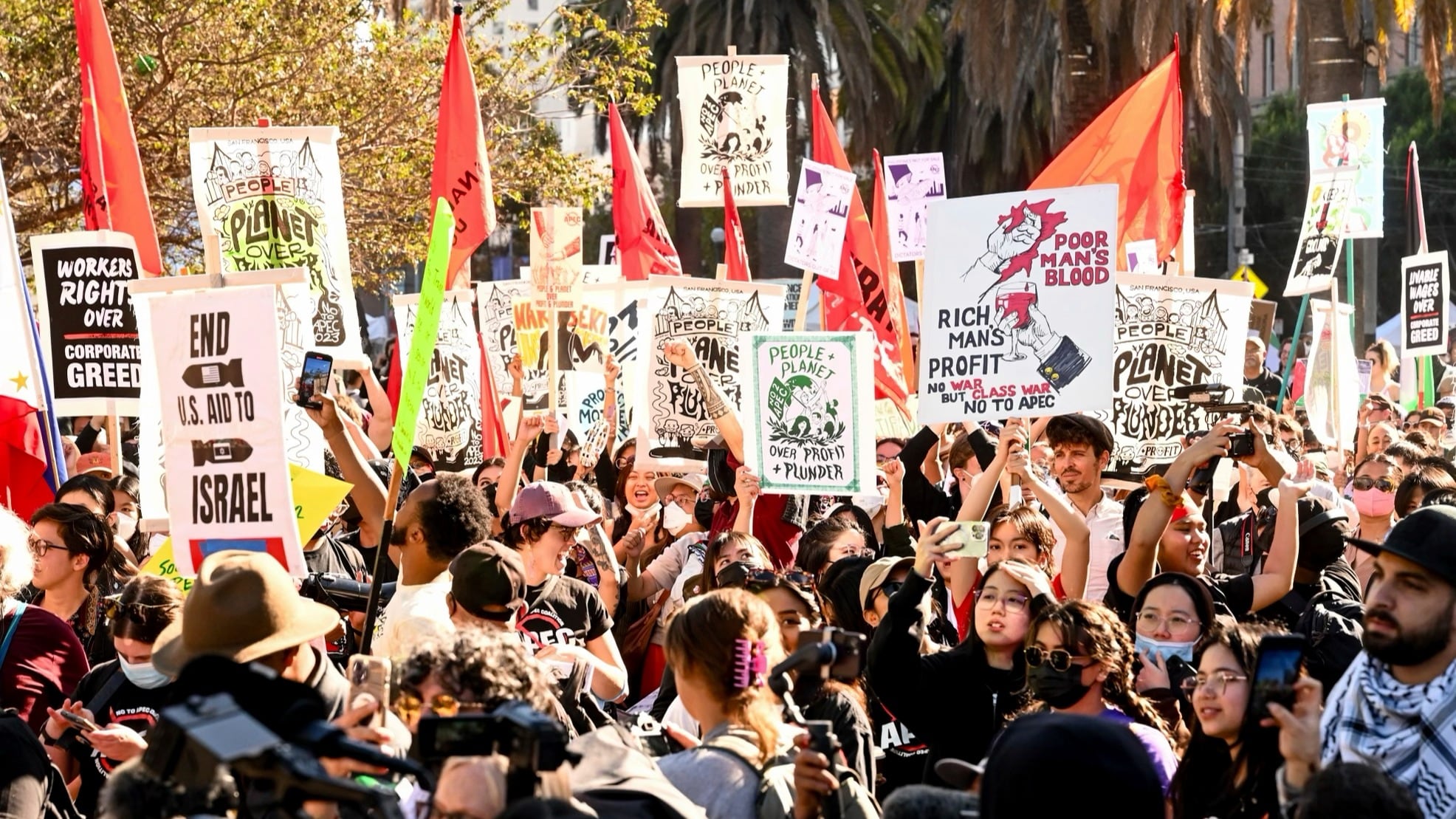
Activists protesting corporate profits, environmental abuses, poor working conditions and the Israel-Hamas war marched in downtown San Francisco on Sunday, united in their opposition to a global trade summit that will draw President Joe Biden and leaders from nearly two dozen countries.
Protests are expected throughout this week's Asia-Pacific Economic Cooperation leaders’ conference, which could draw more than 20,000 attendees, including hundreds of international journalists. The No to APEC coalition, made up of more than 100 grassroots groups, says trade deals struck at summits such as APEC exploit workers and their families.
It's unlikely world leaders will even glimpse the protests given the strict security zones accessible only to attendees at the Moscone Center conference hall and other summit sites. But Suzanne Ali, an organizer for the Palestinian Youth Movement, says the U.S. government needs to be held to account for supplying weapons to Israel in its war against Hamas.
“Even if they cannot see us, as we’re mobilizing and marching together, they will know that we’re out there,” she said.
Thousands of demonstrators gathered Sunday to hear speeches from activists supporting various causes, followed by a march through downtown. Among the voices were environmentalists chanting “Rise up” and carrying banners that read “People and planet over profit and plunder!”
They're opposed to the framing of “supposed ‘clean’ and ‘green’ economies that are really propping up corporate profits,” said Nik Evasco, an organizer with the climate block of the No to APEC coalition.
“Any time there are so-called free trade deals, what we’ve seen historically is that it’s really about opening up pristine lands that go toward making money for corporations,” Evasco said.
San Francisco has a long tradition of loud and vigorous protests, as do trade talks. In 1999, tens of thousands of protesters took to the streets of Seattle during a World Trade Organization conference. Protesters succeeded in delaying the start of that conference and captured global attention as overwhelmed police fired tear gas and plastic bullets and arrested hundreds of people.
Chile withdrew as APEC host in 2019 due to mass protests. Last year, when Thailand hosted the summit in Bangkok, pro-democracy protesters challenged the legitimacy of the Thai prime minister. Police fired at the crowd with rubber bullets that injured several protesters and a Reuters journalist.
Chief Bill Scott of the San Francisco Police Department said he expects several protests a day, although it's uncertain how many will materialize. He warned against criminal behavior.
“People are welcome to exercise their constitutional rights in San Francisco, but we will not tolerate people committing acts of violence, or property destruction or any other crime,” Scott said. “We will make arrests when necessary.”
APEC, a regional economic forum, was established in 1989 and has 21 member countries, including the world's two largest economic superpowers — China and the U.S — as well as Mexico, Brazil and the Philippines. An accompanying CEO summit is scheduled for this week, which critics also plan to protest Wednesday.
Headlining the summit is a highly anticipated meeting between Biden and Chinese President Xi Jinping, who rarely — if at all — encounters protesters on home soil.
China has heavy security ahead of any events within its borders to ensure no protests occur. It also steps up border checks at city limits and at transit points such as railway stations and airports. Human rights activists based in China will often receive visits or phone calls from police ahead of important events as reminders to not demonstrate.
Rory McVeigh, sociology professor and director of the Center for the Study of Social Movements at the University of Notre Dame, said politicians use protests to gauge public opinion and that media attention helps.
“Probably a lot of protests just don’t make much difference, but occasionally they do, and occasionally they can make a huge difference," he said.
The United Vietnamese American Community of Northern California plans to protest Xi and Vietnam President Vo Van Thuong. The International Coalition for Human Rights in the Philippines will be rallying for the rights of Indigenous Filipinos and protesting the presence of President Bongbong Marcos, the son of dictator Ferdinand Marcos.
Protesters are disappointed that San Francisco, with its rich history of standing up for the working class, would host CEOs of companies and leaders of countries that they say do great harm.
“It's silly, from the mayor to the governor to the president, they want to say this is a great idea to have all these people who have been profiting off the intersecting crises of our time,” Evasco said. “It's just sickening.”
Associated Press writer Huizhong Wu in Bangkok contributed to this report.