By Alan Fram
House Speaker Nancy Pelosi faced a fresh hurdle Friday to passing President Joe Biden’s multi-trillion dollar domestic policy aspirations, as nine moderate Democrats threatened to derail a budget blueprint crucial to opening the door to much of that spending.
In a letter to Pelosi, D-Calif., the nine said they “will not consider voting" for a budget resolution mapping Democrats' ambitious fiscal plans until the House approves a separate, Senate-passed package of road, broadband and other infrastructure projects and sends it to Biden.
“We simply can’t afford months of unnecessary delays and risk squandering this once-in-a-century, bipartisan infrastructure package,” the centrists wrote.
That's the opposite of Pelosi's current strategy as party leaders plot how to steer Biden's agenda through a Congress the party runs by paper-thin margins. She's repeatedly said her chamber won't vote on the bipartisan, $1 trillion infrastructure measure that moderates covet until the Senate sends the House a companion, $3.5 trillion bundle of social safety net and environmental initiatives favored by progressives.
Progressives have applied their own pressure, saying many would vote against the infrastructure measure until the Senate approves the $3.5 trillion social and environment bill. That larger measure is unlikely to be ready until autumn.
Seeming to take middle ground, White House press secretary Jen Psaki said Friday that officials believe House Democrats will approve “both key elements of the President's economic agenda,” as the Senate has.
“Both are essential, and we are working closely with Speaker Pelosi and the leadership to get both to the President’s desk,” Psaki said in a written statement.
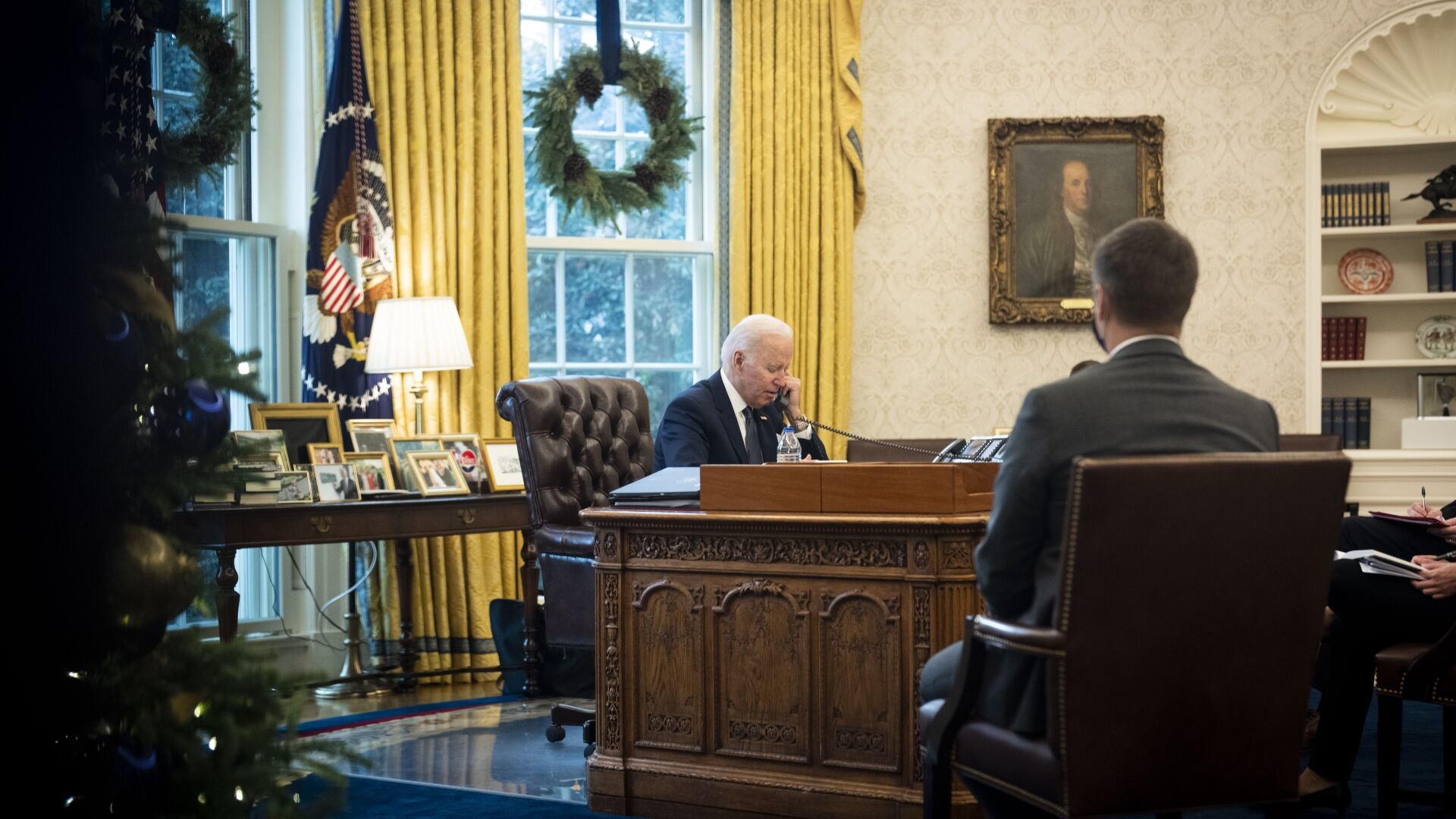
Biden consulted with his legislative affairs team about his economic plan’s pathway in the House, the White House said.
Democrats have too much at stake to let internal turmoil sink their domestic ambitions, but it was initially unclear how leaders would untie the knot. Biden, Pelosi and Senate Majority Leader Chuck Schumer, D-N.Y., who faces a similar moderates vs. progressives balancing act in his chamber, may need to chart a course and apply public pressure to prod rank-and-file lawmakers into line.
Democrats control the House by just three votes, giving virtually all 220 of the party's lawmakers tremendous leverage. They run the 50-50 Senate only with Vice President Kamala Harris' tie-breaking vote.
The House returns to Washington from its summer recess on Aug. 23 to vote on the budget resolution and perhaps other legislation, giving Biden, Pelosi and other leaders time to decide their next move.
Together, the infrastructure and social and environment bills make up the heart of Biden’s governing goals, and their enactment would likely stand as one of his legacy achievements as president. But neither wing of his party in Congress fully trusts the other to back both packages, so leaders want to sequence votes in a way that gives neither faction an edge.
Pelosi, first elected to Congress in 1987 and her party's House leader since 2003, is a seasoned crisis manager and vote counter who Friday was showing no signs of backing down.
Asked about Pelosi’s next move, a senior House Democratic aide said the party doesn’t have enough votes to pass the infrastructure bill this month. The aide contrasted the nine moderates with the dozens of progressive Democrats who would vote against that measure unless it comes after the House gets the Senate’s $3.5 trillion social and environmental bill.
The aide was not authorized to publicly discuss the party’s internal dynamics and spoke on condition of anonymity.
Congressional passage of the budget resolution ultimately seems certain because it's a necessity for Democrats. Without it, Senate Republicans would be able to use a filibuster, or procedural delays, to kill the follow-up $3.5 trillion bill.
The Senate approved the $1 trillion infrastructure bill Tuesday with a bipartisan, 69-30 vote. Hours later, the chamber approved the budget resolution on a party-line 50-49 roll call, telegraphing the partisan pathway the subsequent $3.5 trillion social and environmental bill faces.
Moderates, including many who represent swing districts and face competitive reelection races next year, are leery of that huge bill because of its massive price tag. Democrats plan to pay for much of it with tax boosts on the wealthy and large corporations and want it to include provisions crafting a pathway to citizenship for millions of immigrants in the U.S. illegally, which also worry centrist Democrats.
Two of the Senate's most moderate Democrats, Sens. Joe Manchin of West Virginia and Kyrsten Sinema of Arizona, have already said they consider $3.5 trillion too expensive.
The measure would renew tax credits for children, mandate paid family leave, expand Medicare coverage and provide free pre-Kindergarten and community college. There would be increased spending to encourage a shift from carbon to clean energy fuels, housing and home care, and the government would negotiate pharmaceutical prices to drive down prescription drug costs.
Republicans are certain to use campaign ads accusing Democrats who back that huge measure of voting for proposals that will fuel inflation, raise taxes and cost jobs.
The moderates' letter was signed by Reps. Josh Gottheimer of New Jersey; Carolyn Bourdeaux of Georgia; Filemon Vela, Henry Cuellar and Vicente Gonzalez of Texas; Jared Golden of Maine; Ed Case of Hawaii; Jim Costa of California; and Kurt Schrader of Oregon.
___
Associated Press writer Zeke Miller contributed to this report.
Updated on August 13, 2021, at 4:35 p.m. ET with the latest details.