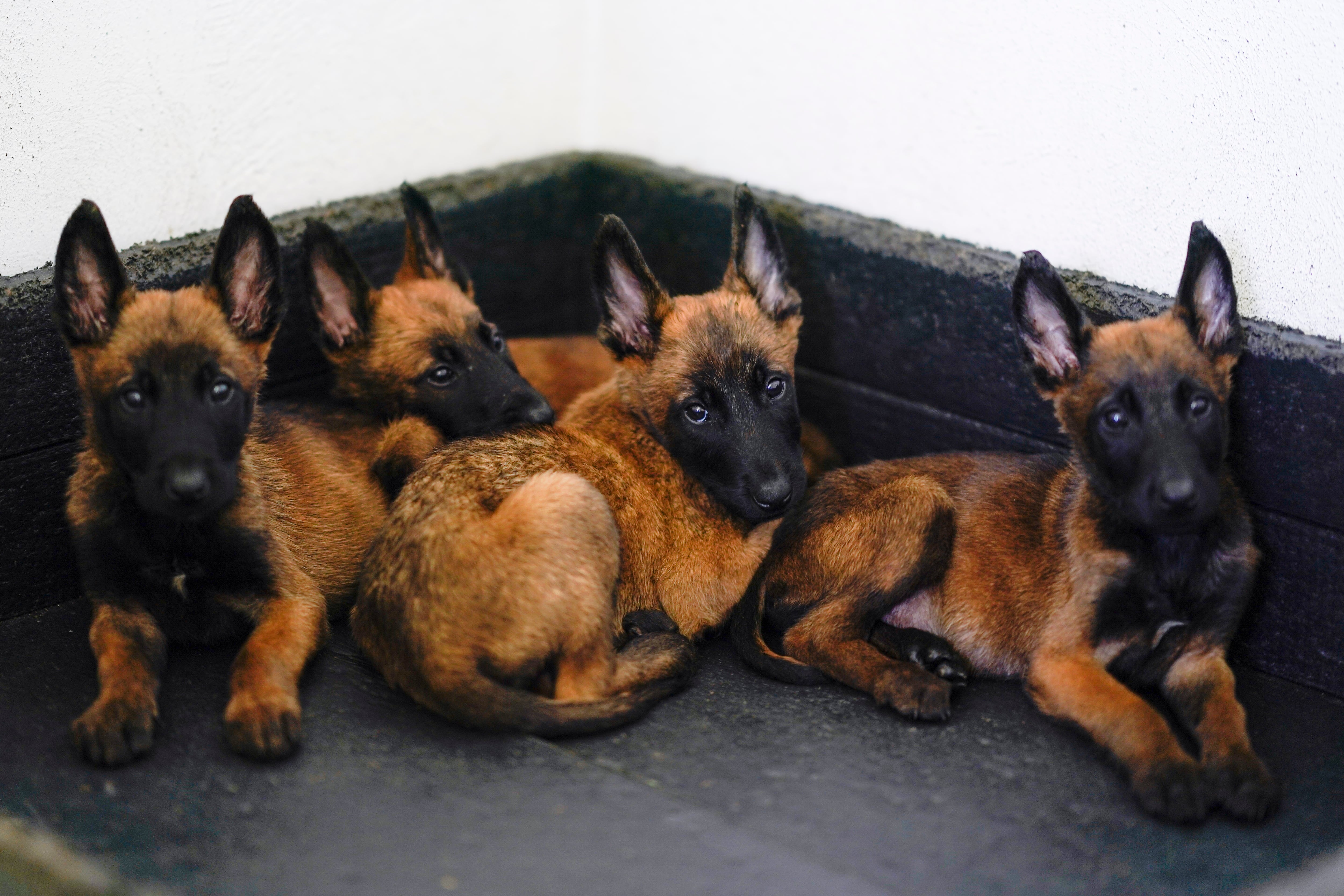
In the middle of a military base outside Mexico City, an army colonel runs what he calls a kindergarten for dogs.

Puppies that one day will become rescue dogs, or sniffer dogs for drugs or explosives, get their basic training here, at Mexico’s Army and Air Force Canine Production Center. The puppies are born and spend their first four months at the facility, before being sent to military units around the country for more specialized training.

Founded in 1998, the center has in the past produced breeds such as German Shepherds and Rottweilers.

Now, it exclusively breeds Belgian Malinois — about 300 of them a year.

“It’s a very intelligent dog, it’s a dog with a lot of hardiness, very resistant to diseases,” said Col. Alejandro Camacho Ibarra, a veterinarian and the center’s director. It is the Mexican military’s only such production facility, and Camacho said it may be the largest in Latin America.

The mainly green-and-white, one-story buildings look like any others at the military camp in the State of Mexico, near Mexico City. But the difference here is in the sounds that fill the air: high-pitch barking from dozens of puppies scattered through its maternities and training camps.

Precautions here are strict because of a recent canine parvovirus outbreak that sickened some of the puppies. Visitors are disinfected with a spray, and must step into a watery solution to clean shoe soles. Only military personnel can touch the puppies. If you want to get close, you need to wear scrubs, shoe protectors and a mask, but you still cannot hold or pet the animals.

The training starts early in life, about a month after birth once the weaning process finishes. And everything is taught as a game.

“We start playing with the dog,” Camacho said. The idea is to draw them to items that trainers call “attractors” — like a ball or a rag — and puppies are challenged to catch t

hem. “Every time it holds his prey, it’s rewarded, congratulated, and it learns to go after that prey, after that attractor,” Camacho added.

Unlike in civilian life, where puppies often get food treats, in the military the only prize for a job well done is a caress and some praise.

In one section of the camp, there’s a trail with obstacles including rocks, a tunnel, a section of empty plastic bottles to clamber over, a ladder and tires.

A soldier beckons the little dogs with a rag they must capture. The brown puppies with black snouts begin running through the trail, jumping over the rocks and crossing the obstacles. One takes the lead and the second struggles to cross over the plastic bottles, but also finishes. Both go to bite the rag the soldier holds.

“Very, very good, sons! Very good, boys,” he repeats while dragging the puppies as they maintain their grasp on the rag for several moments.

Camacho explains that the puppies are known by a number until they are three months old, when they are given a proper name. Each year, the center gives names according to a single letter of the alphabet. In 2023, that letter is “F.”

Febo, Frodo, Fósil, Forraje and Fido are some of this year’s names.

The basic training ends when the puppies are 4 months old. Then, they move to other military units to become specialists in detection of drugs or explosive, in search and rescue or in protection and security.

The current government of Mexico’s President Andrés Manuel López Obrador has relied heavily on the armed forces for various initiatives, from public safety to the building of airports and a tourist train line. And K-9 units have been a key element of some of the military’s activities, like the detection of drugs.

Col. Camacho said that some dogs born at the center have been trained to detect fentanyl, a synthetic opioid trafficked by Mexican cartels that has been blamed for about 70,000 overdose deaths per year in the United States.

That kind of specialized training happens elsewhere, but the colonel says it builds on his center's basic training by using “attractor” objects but having them impregnated with the scent of what the dogs need to track, such as a drug.

Dogs retire from their military service after eight years, Camacho says.

Many of the dogs have become unsung heroes of missions in Mexico and abroad. Occasionally they become publicly known, like a German Shepherd named Proteo who was part of a rescue team sent in February to Turkey after a 7.8-magnitude earthquake that killed more than 40,000 people.

Proteo died during the search for survivors of the quake. A statue of him now stands at the center.

Another dog that made headlines in Mexico and abroad was a yellow Labrador retriever rescue dog named Frida. The Navy dog gained fame in the days following Mexico’s Sept. 19, 2017, earthquake that left more than 300 dead in the capital. She retired in 2019 and died in 2022.

Col. Camacho said that the dogs have a symbiotic relationship with their handlers during their working life in the military.

“The dog uses us to survive, but we also use the dog to do a job,” he said. “So it’s a coordinated work where we both get a benefit."

Share:
More In Culture
U.S. Stocks Close Mixed as Nasdaq Closes at Session High
Markets closed the day mixed, and well off their lows of the day following a market meltdown earlier in the session. The Nasdaq staged a comeback late in the day, even amid ongoing worries about the Federal Reserve raising interest rates. Doug Flynn, certified financial planner and co-founder of Flynn Zito Capito, joined Cheddar News' Closing Bell to discuss the markets' close and what's driving the major indexes.
CrossTower Partners With BankProv to Provide Crypto Lending Platform
Two companies recently announced a new partnership aimed at addressing the growing demand to borrow against crypto - digital assets capital markets firm CrossTower is partnering with commercial bank, BankProv. The companies are launching a crypto lending platform that will allow Bitcoin miners to receive loans to invest in crypto mining equipment. The companies say the program also addresses the difficulty of breaking into crypto mining due to the high cost. CrossTower research analyst Martin Gaspar joins Cheddar News' Closing Bell to discuss.
Break the Love Raises $2.5 Million Seed Funding Round to Get People Playing Tennis
Next-gen social sports platform Break the Love recently raised $2.5 million in seed funding. Break the Love's platform and iOS app allows users to discover and book group-based tennis activities, to either learn, train, or compete. The new company has already gotten support from a few big names in the world of tennis, including the coach of Naomi Osaka, as well as the United States Tennis Association and the brand Wilson. Break the Love founder and CEO Trisha Goyal joins Cheddar News' Closing Bell to discuss.
Nurses Call For Protection For HealthCare Workers
As the Omicron variant continues to sweep across the country. The US Supreme Court is expected to hear arguments at the end of this week on whether or not the Biden administration can force private companies to vaccinate or test millions of their employees. In addition, the National Nurses United has spearheaded legal action to protect nurses and health care workers, patients, and the public while on the job. President of the National Nurses Union, Zenei Cortez, joined Cheddar to discuss more.
China Crackdown on "Sissy Men"
China's ongoing crackdown of its own entertainment industry has been raising eyebrows for once now. With the ruling Communist Party instructing media companies to boycott immoral and overly entertaining stars. But the country has gone even further. Now experts warn that this could lead to further issues such as gender-based violence. Professor at the Institute of Sociology at National Tsinghua University, Hsiu-Hua Shen, and Associate Professor of Politics at Keough School of Global Affairs at the University of Notre Dame Joshua Eisenman, joined Cheddar to discuss more.
Lawmakers Reflect Back on January 6th Capitol Riots
Today marks one year since the January 6 Attack on the United States Capitol. The Country watched as supporters of then-President Trump stormed what was assumed to be the most secure building in the country in an attempt to stop the certification of the 2020 Election. Several lawmakers, including the Vice President, could be seen ducking down as they feared for their lives. Democratic Michigan Representative Dan Kildee, joined Cheddar to discuss more.
Bed Bath & Beyond's Stock Jumps Despite Earnings Miss as Meme Stock Mania Reappears
Bed Bath & Beyond delivered disappointing fiscal third-quarter results for 2022. Shares initially dove more than 9% in premarket trading on the news but finished the day up nearly 8%. Bed Bath & Beyond has been a meme-stock target for online investors in the past -- so was meme-stock mania a factor in the recent stock movement for the company? Jaime Rogozinski, the founder of the subreddit WallStreetBets, joins Cheddar News' Closing Bell for more, as his forum helped spark the meme stock phenomena. He also discussed some decentralized finance services and trends for the retail investor to watch for in 2022.
Pear Therapeutics CEO on How Its Apps Work for Conditions Like Addiction
Digital medical care provider Pear Therapeutics rang the closing bell on the Nasdaq Friday and President and CEO Dr. Corey McCann, joined Cheddar to talk about how the company plans to grow the business of software-based therapeutics and how the first FDA authorized prescription digital therapeutics company will go about treating illnesses like insomnia and addiction. "These really are pieces of software. In many cases, they're apps and in the cases of our addiction products, these are based on something called cognitive behavioral therapy or CBT," he said. "These products change the patient's brain circuitry to help them be abstinent, to help them stay in treatment, and that's exactly what we see in randomized clinical trials and that's what we see in the real world." He also addressed the ongoing mental health crises brought on by the pandemic. **copy updated to remove IPO information as Pear Therapeutics went public in December**
Load More