Twenty-six questions into day one of questioning, senators have largely directed inquiries to their own sides, assisting respective legal teams in poking holes in the opposition's case.
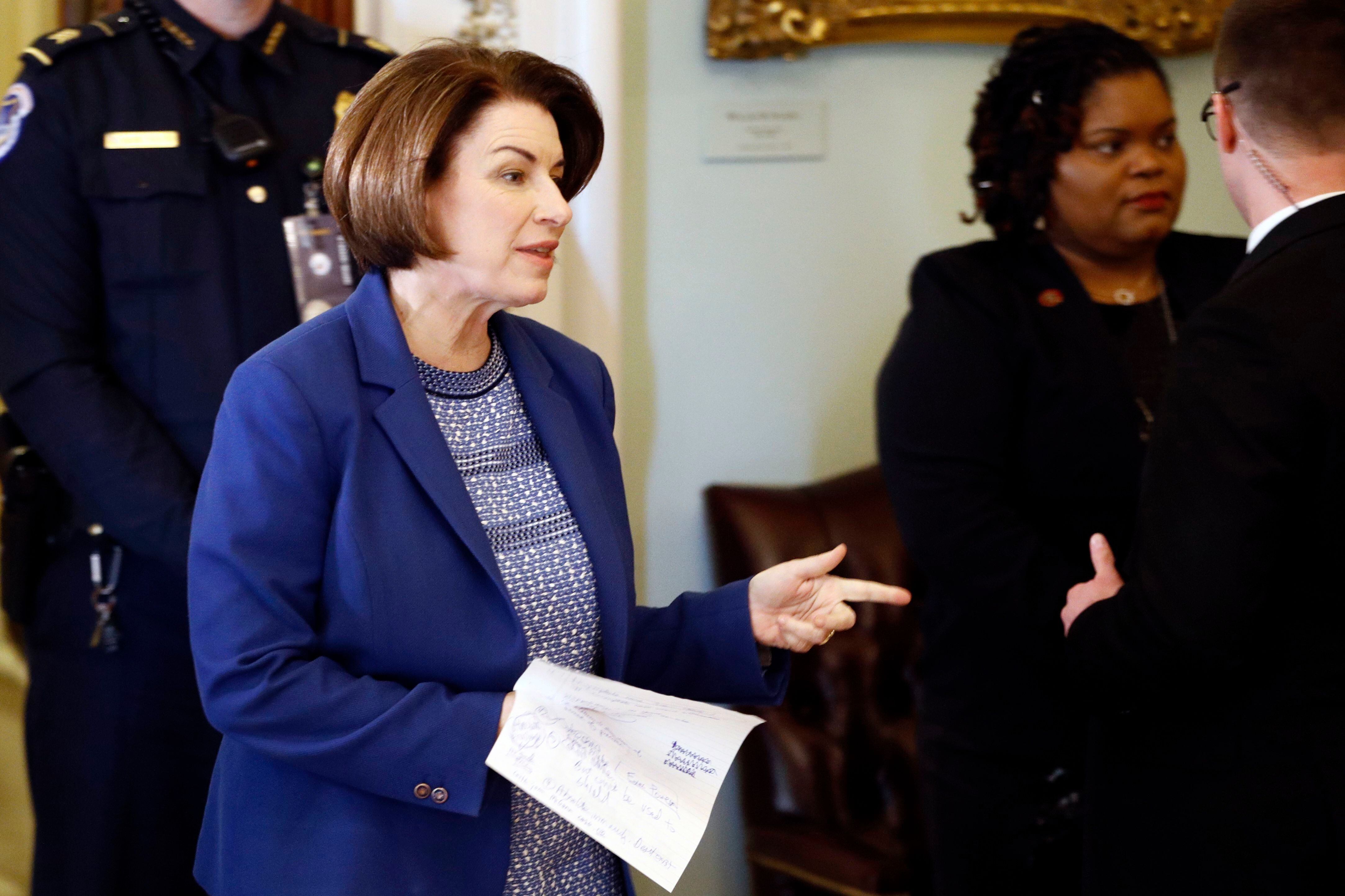
During the first break of the day, nearly three hours after questioning began, Sen. Amy Klobuchar (D-Minn.) told Cheddar she plans to ask a question about absolute immunity. The president has argued he has absolute immunity to bar testimony, though a federal judge ruled in November that former White House counsel Don McGahn must obey a subpoena compelling him to testify. The judge wrote at the time "with respect to senior-level presidential aides, absolute immunity from compelled congressional process simply does not exist."
The president's defense team has repeatedly sought to portray the president as needing the freedom to speak candidly with his advisors. However, House Managers have emphasized the president is not able to exercise blanket immunity.
"Some of the questions were planned ahead, but you can always adjust them," Klobuchar said. "I have one question that I want to focus on, on the absolute immunity issue, but if it's fully asked, maybe I'll switch to another one. You're not bound into what your question is. And then there's other questions that I have — you'll see that Senator Whitehouse is going to ask one of them. He and I shared the same question so he's asking on his behalf and my behalf."
Throughout the first portion of today's session, some senators appeared to have pre-written questions on cards while others, like Senators Lindsey Graham (R-S.C.) and Ted Cruz (R-Texas) exited the room to presumably discuss a question before posing one jointly. Others still, like Senators Martha McSally (R-Ariz.), Joni Ernst (R-Iowa), Richard Burr (R-N.C.), Jerry Moran (R-Kan.) and Kelly Loeffler (R-Ga.) seemed to have empty cards on their desks.
Senators must submit written questions to the Chief Justice and, alternating between parties, a Senator stands, asks Supreme Court Chief Justice John Roberts to hear his or her question, and a high school page carries the card to Roberts, who is facing the Senators from the elevated seat usually reserved for the Vice President. At one point Roberts paused while attempting to read a question from Republicans, as it seemed he was having trouble reading the hand-written question.
The Senate Press Gallery sits above the Republican side of the chamber, which allows better access to see the Republican Senators than the Democrat officials.
Alan Dershowitz, an attorney for the defense who came to today's session to answer questions about his testimony earlier this week, said anything a sitting president does to stay in power is in the national interest, emphasizing a very expansive view of presidential power. Lead House Manager and chairman of the House Intelligence Committee Rep. Adam Schiff (D-Calif 28th District) answered the final question of the early session pushing back against Dershowitz's argument and attempted to portray the president as believing himself to wield broad powers, accusing Trump of being a "president who identifies the state as being himself."
Liana Guzmán, CEO of FOLX Health, joins Cheddar News to discuss the company launching billboards across the country in response to anti-LGBTQ+ legislation.
President Biden has announced an additional $800 million in military assistance to Ukraine, including artillery, armored personnel carriers, and helicopters. It comes as Russian forces appear to be preparing for a new, aggressive offensive in the eastern part of Ukraine. Paul McLeary, defense reporter for Politico, joined Cheddar to discuss this new round of aid and what it means for the U.S. commitment to arming the embattled country.
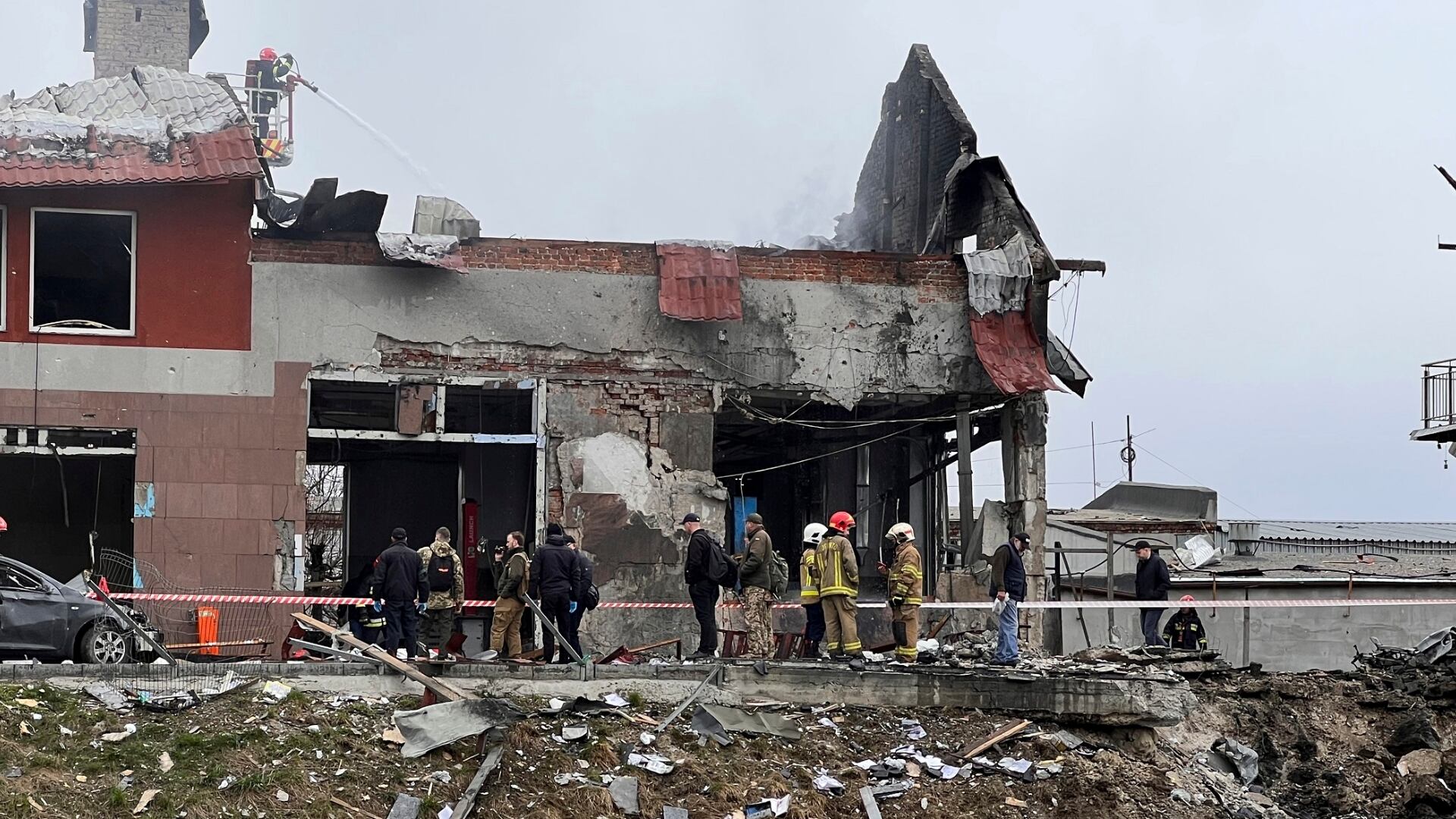
Catching you up on what you need to know on April 18, 2022, with Russian missile attacks on the Ukrainian city of Lviv killing seven, mass shootings in South Carolina and Pittsburgh, Lucky Charms cereal under official investigation by the FDA, and more.
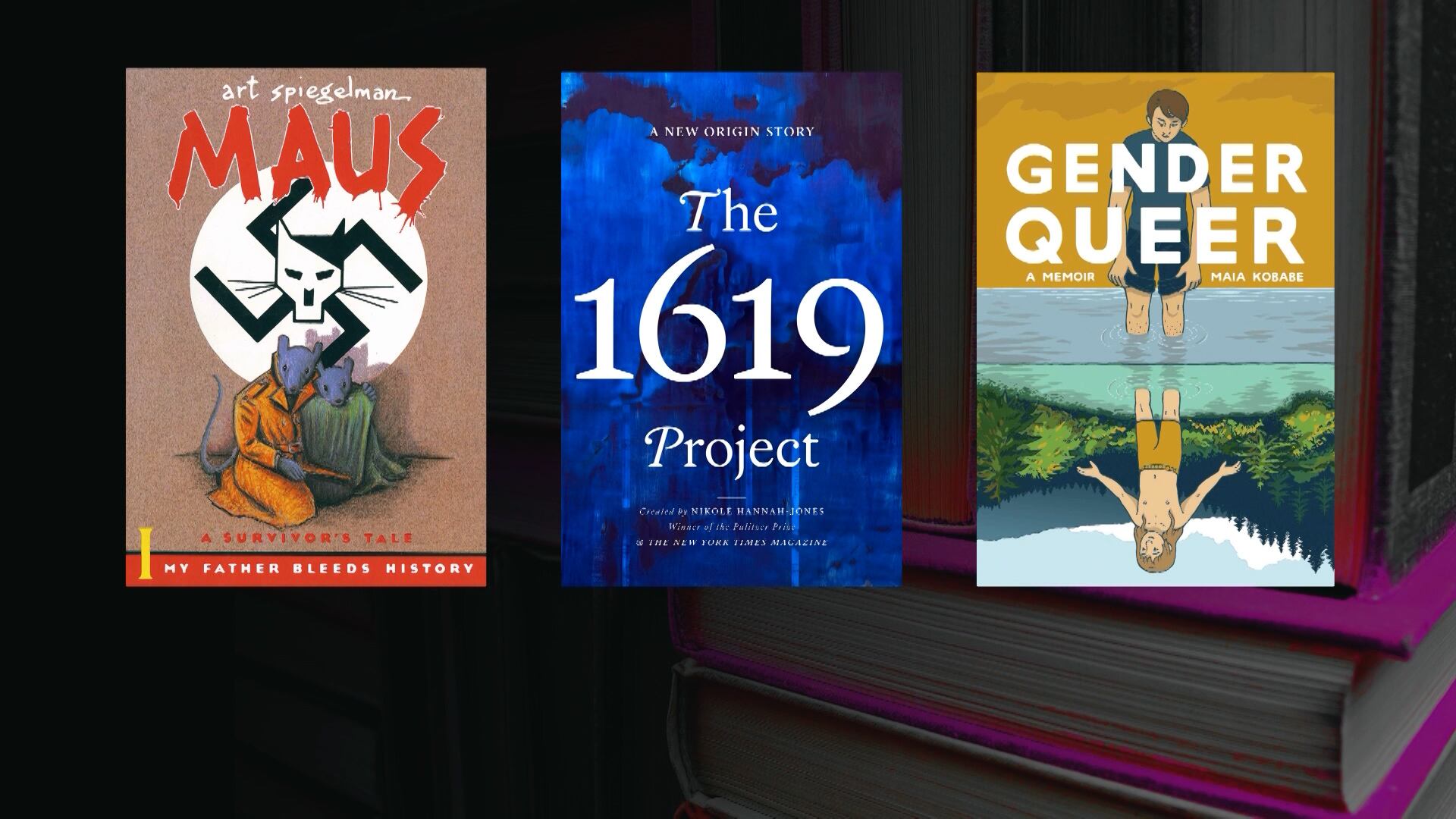
Activism is growing around the country in response to school boards banning books from shelves that focus on sexuality, gender, identity, or race. Jen Cousins, co-founder of The Florida Freedom to Read Project, joins Cheddar News to discuss.
As the Russian invasion of Ukraine intensifies, President Biden has announced a ban on importing Russian oil, gas, and energy. To discuss how this ban will impact the war and Americans, Amir Handjani, non-resident fellow at Quincy Institute, joins Cheddar News.
Thousands of protesters around the world are expressing their solidarity with Ukraine against Russia's invasion.
Jason Beardsley, national executive director of the Association of the U.S. Navy and national security expert, joins Cheddar News to discuss.
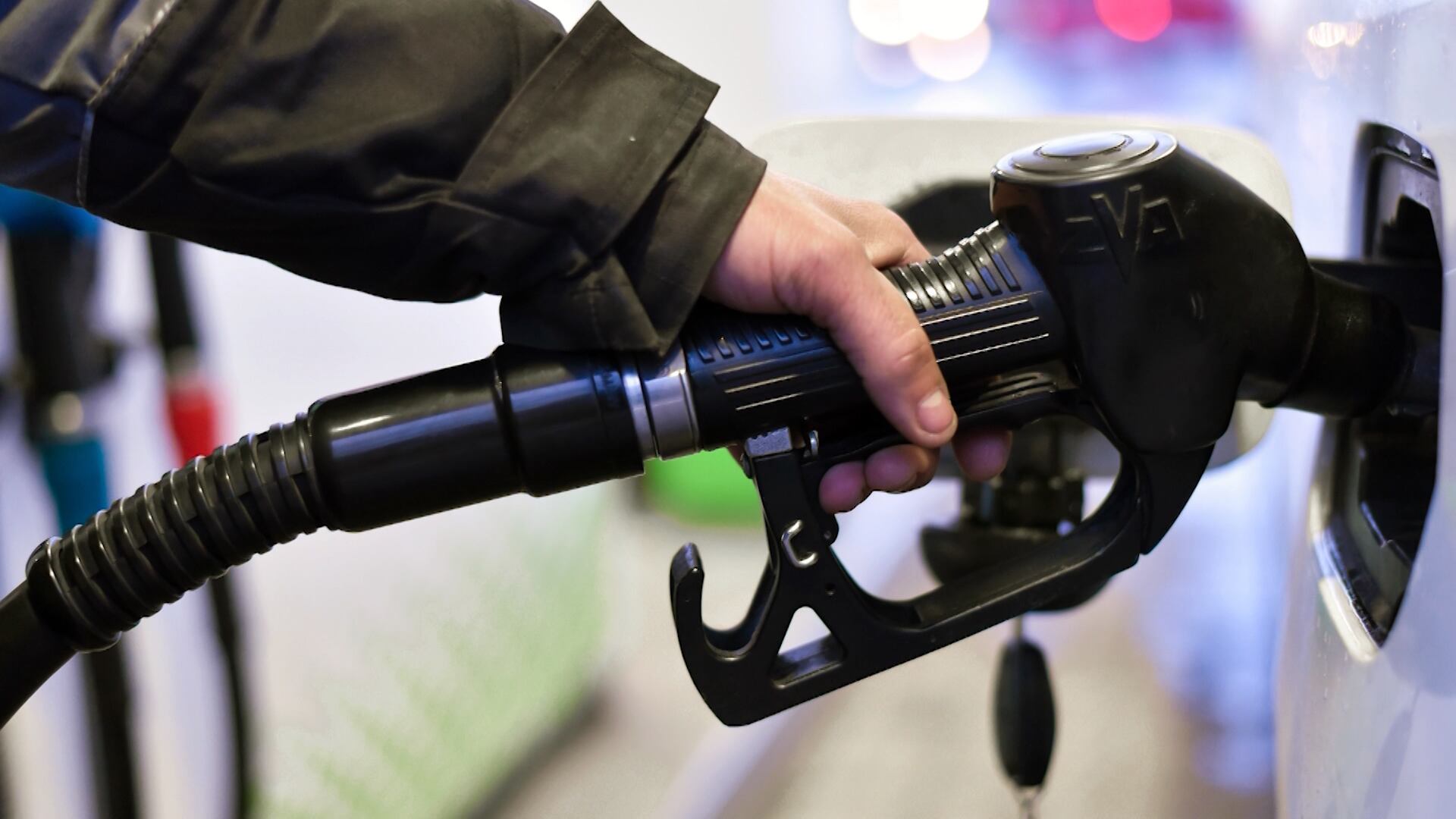
As gas prices surge amid the Russian invasion of Ukraine, other nations could potentially transition faster to using clean energy than previously expected. Philip K. Verleger, a senior fellow at the Niskanen Center, joined Cheddar News to explain how this could be a possibility in the near future. "Part of the reason I think we have this invasion and the tantrum that's being thrown by Russia, terrible tantrum, is because the Russians were trying to slow down the transition," he said. "Ironically they speeded it up."
Following the invasion of Ukraine, a multitude of Western companies have paused doing business with Russia. PepsiCo, Coca-Cola, McDonald's, and Starbucks are the most recent companies to temporarily cease operations in Russia. Dean of Miami Herbert Business School at the University of Miami, John Quelch, joined Cheddar News to discuss what message this sends to Russia and the Russian consumer. “I would not underestimate the collective strength of all of these multinational companies, essentially coming together to make their collective statement in support of the political statements that have come out of Washington," he said.
The war in Ukraine continues to reveal heartbreaking gut-wrenching stories. The war in itself is not only devastating but also expensive. Experts estimate that Russia is draining nearly $20 million dollars each day to continue occupying and invading Ukraine. All this could force the country to turn to cryptocurrencies. It's a major turn for the country that briefly considered outlined digital assets entirely, but it could also have serious implications for cryptos. Managing Director at Quantum Fintech Group, Harry Yeh, joined Cheddar to discuss more.