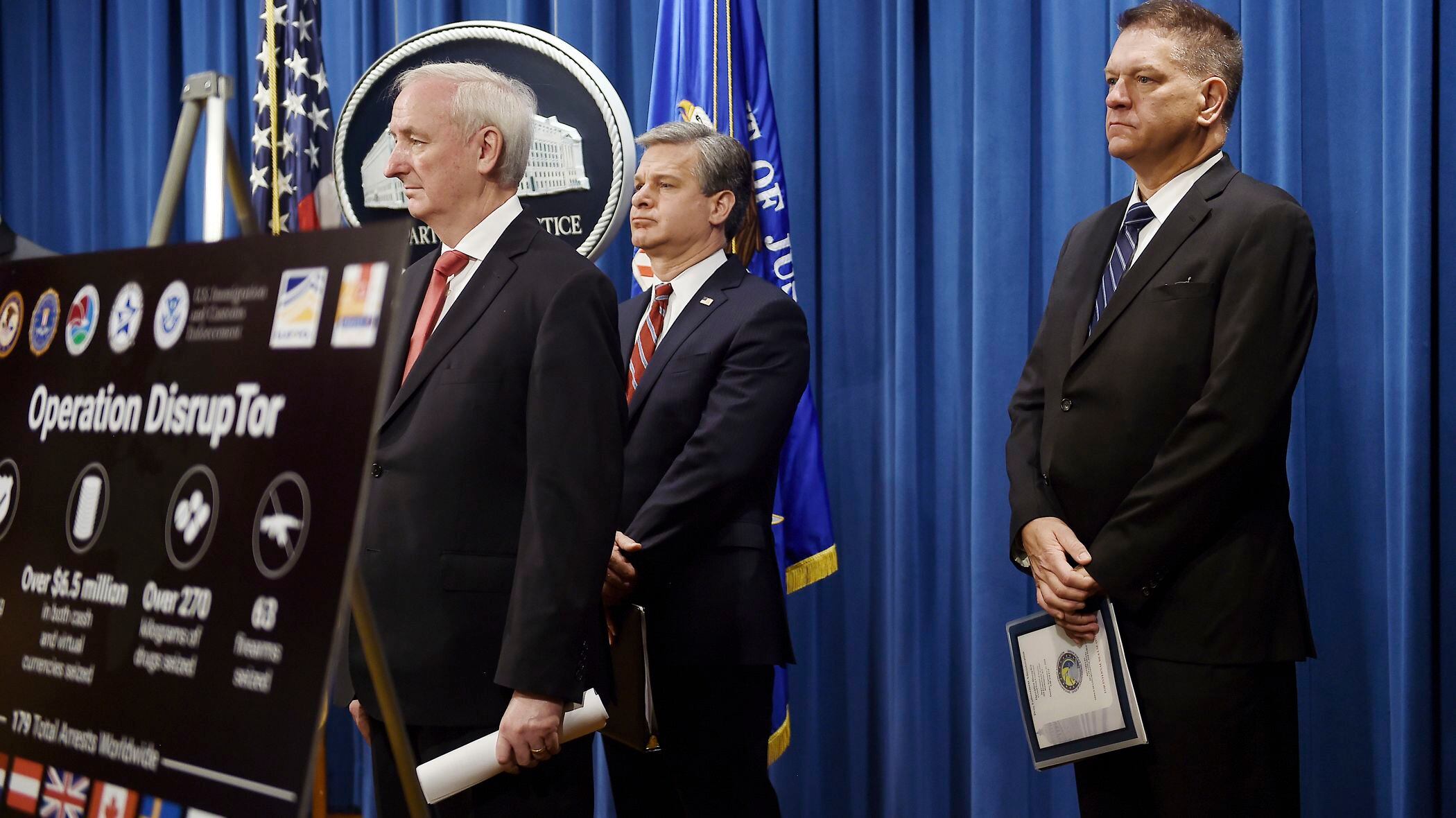
Deputy Attorney General Jeffrey Rosen, announces a worldwide crackdown on opioid trafficking on the darknet with FBI Director Christopher Wray, center, and DEA Acting Administrator Timothy Shea, during a press conference at the Department of Justice, Tuesday, Sept. 22, 2020 in Washington. Law enforcement officials have arrested 179 people and seized more than $6.5 million. The operation announced Tuesday mainly occurred in the U.S. and in Europe. Rosen said the takedown showed “there will be no safe haven for drug dealing in cyberspace.” (Olivier Douliery/Pool via AP)
By Michael Balsamo
Law enforcement officials arrested 179 people and seized more than $6.5 million in a worldwide crackdown on opioid trafficking on the darknet, the U.S. Justice Department said Tuesday.
The operation, which mainly occurred in the U.S. and in Europe, comes more than a year after officials took down the "Wall Street Market," which was believed to be one of the largest illegal online marketplaces on the darknet.
The darknet is a part of the internet hosted within an encrypted network and accessible only through specialized anonymity-providing tools, most notably the Tor Browser.
As part of the initiative, law enforcement officials seized over $6.5 million in cash and virtual currency, in addition to 500 kilograms of drugs, the Justice Department said. About 275 kilograms of drugs, including fentanyl, heroin, cocaine, ecstasy, and other opioids, had been seized in the U.S.
The arrests include 121 made in the U.S., two in Canada, 42 in Germany, eight in the Netherlands, four in the United Kingdom, three in Australia, and one in Sweden. The Justice Department said its investigation was ongoing and investigators were still working to identify other individuals behind darknet accounts.
Deputy Attorney General Jeffrey Rosen said the takedown showed "there will be no safe haven for drug dealing in cyberspace."
Deena LaMarque Piquion, Chief Marketing Officer at Xerox, joins ChedHER to discuss how women can break the glass ceiling in the workplace, and why and how women should stop saying 'sorry' so often.
Marylyn Harris, President of Harrland Healthcare Consulting, joins ChedHER to discuss how her experience in the military prepared her for a cybersecurity career, advice to pivot in your career, and how she's paving the way for women of color in the industry
Amanda Carlson Phillips, Senior Vice President of Exos' performance team, joins ChedHER to discuss how wellness programs can fight burnout, how businesses can better support women leaders and teammates in order to close the exhaustion gap.
President Biden heads to Poland, Ginni Thomas' texts to overthrow the 2020 election, and the founder of .gifs has passed away. Here is all the news you Need2Know for Friday. March 25, 2022.
Students are finally back in the classroom, but how are their grades holding up? A recent study compared the test results from students across the country to see how the return to in-person classes is affecting students' learning. Gene Kerns, vice president and academic officer of Renaissance Learning, joins Cheddar News to discuss.