When North Dakota restricted what bathrooms transgender students can use in public schools and universities this year, the school district in the state's largest city promised to ignore the new rules. A Republican legislator then called for confiscating its state funding, but the law doesn't include that possibility.
The defiance in Fargo shows that it's not exactly clear how bathroom laws will play out in local communities after being enacted in at least 10 states with Republican-controlled legislatures.
Kansas' GOP attorney general planned to discuss his state's law Monday, five days before it was to take effect. His view is likely to be challenged.
Even Florida's law, allowing the state to threaten the licenses of educators who don't comply, says a transgender student or staffer must first be asked to leave a restroom and refuse.
Some schools already have gender-neutral bathrooms and changing spaces or allow trans students to use staff restrooms. In others, trans students try to make it through the day without using a restroom.
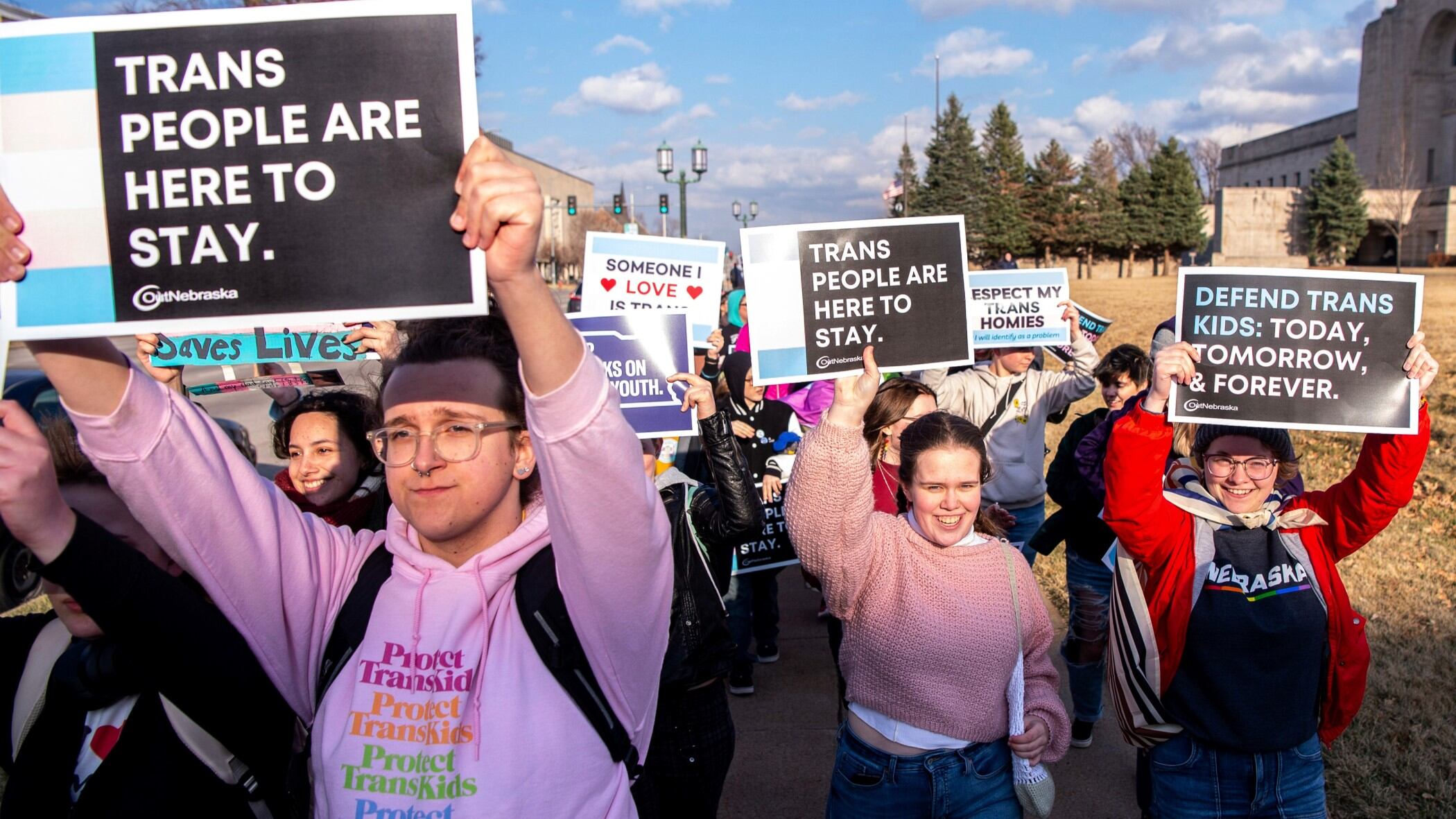
Advocates for transgender people worry that bullying will increase.
“Especially in smaller towns where, say, that bullying could be really bad because transgender individuals are really misunderstood,” said Caedmon Marx, outreach chair for LGBTQ+ advocacy group Dakota OutRight and a 23-year-old nonbinary Bismarck State University student.
While the laws focus mostly on transgender students, critics believe they also encourage harassment of trans adults at work and while they're shopping and eating out — and even harassment of cisgender people, or those whose gender identity matches the sex they were assigned at birth.
“By men, I get harassed for going into a women’s restroom because people think that — the way I look, the way I dress, they way my hair is — that I’m a man,” Kansas state Rep. Susan Ruiz, a Kansas City-area Democrat and a lesbian, said during a debate over the Kansas bathroom measure. “This is going to just open up the doors for that.”
North Carolina Republicans enacted a bathroom law in 2016, but rolled it back following protests and economic boycotts. A new wave of anti-LGBTQ+ measures began building in 2020, when Idaho enacted the nation's first law barring transgender athletes from girls and women's sports. State lawmakers across the U.S. considered hundreds of proposals this year.
Supporters argue that bathroom laws protect the privacy of cisgender women and girls. They've also pitched the laws as safety measures, without evidence of threats or assaults by transgender people against cisgender women or girls.
In North Dakota, Republican state Rep. Robin Weisz, chair of a committee that handled bathroom legislation, said some lawmakers worried about "being taken over by a radical agenda” on gender identity.
A GOP colleague, state Rep. Bill Tveit, said: "Our whole society is catering to it and encouraging it, and I don’t think that that’s where we’re at, nor should be.”
States' laws vary in their sweep. Florida and North Dakota are applying their restrictions to state universities and prisons. Arkansas is making it a misdemeanor for transgender adults to be in any public changing room associated with their gender identities if a minor is present and the purpose is “arousing or gratifying a sexual desire.” Kansas' law applies not just to restrooms and locker rooms, but to rape crisis centers, domestic violence shelters, prisons and other detention centers.
State laws also differ in what they say about enforcement.
If an Oklahoma school violates that state's 2022 law, its district can lose 5% of its state funding, though none have so far.
Florida schools and universities must have policies for punishing students who don't comply, and educators who flout the law could risk losing their state licenses. Starting in July 2024, the state attorney general can sue schools that don't comply.
Arkansas mandates a minimum fine of $1,000 for defiant educators, and Iowa residents can file complaints with the state's attorney general. Arkansas, Idaho, Oklahoma and Tennessee allow private lawsuits against schools.
But laws in Alabama, Kansas, Kentucky and North Dakota don't spell out any enforcement regime.
Transgender, nonbinary and gender-nonconforming people and LGBTQ-rights advocates predict that states will rely on “vigilante” enforcement by private individuals. Sarah Warbelow, legal director for the Human Rights Campaign, expects lawsuits from people “dedicated to making life impossible for transgender people.”
All of the laws permit schools and other institutions to make special accommodations for trans students, such as providing gender-neutral bathrooms, so long as they aren't allowed into facilities associated with their gender identities.
In Kansas' largest school district in Wichita, schools already have worked with individual students and their parents to make accommodations. In northeast Iowa, the Decorah school district sought guidance on what the signs outside its single-use restrooms should say.
“We're following the law,” Superintendent Tim Cronin said. “We're not trying to editorialize on any of this.”
In Des Moines, Iowa, the school district already had been preparing for a bathroom law for several years and “the facilities were in place” when the state's law was enacted, spokesman Phil Roeder said. The Shawnee Mission district in the affluent Kansas suburbs of Kansas City is adding gender-neutral restrooms, too, with most of the work completed.
But in Tulsa, Oklahoma, Al Stone-Gebhardt, an 18-year-old transgender man, recently graduated from a high school that didn't have gender-neutral restrooms. After using the girls restroom during his junior year, he planned to use the nurse's but was turned away the first day of his senior year.
His mother, Erika DuBose, acknowledged “flipping out” when her son texted her about it. She sent an email to school staff that demanded, “HOW DARE YOU DENY MY CHILD THEIR BIOLOGICAL NEEDS?" To avoid using any restroom at school, her son was wasn't eating or drinking much.
The school became more accommodating, they said.
“It is literally putting trans students at risk,” Stone-Gebhardt said. “Having to choose between being hydrated and being outed is extremely traumatic and inherently problematic as well.”
Warbelow said states can expect some “civil disobedience."
In the liberal community of Lawrence in northeast Kansas, the home of the University of Kansas' main campus, the local district attorney declared that she wouldn't prosecute violations of the new state law.
And in Fargo, one of North Dakota's rare politically blue places, the school board backed Superintendent Rupak Gandhi's public statement that, "We will not participate in anything that we think is going to subject students to further discrimination or increase their self-harm.”
That prompted Tveit to email fellow state lawmakers, suggesting the district lose its state funding. But North Dakota's Legislature won't be in session again until 2025.
“I think any law that goes into place needs a specific penalty,” Tveit said, “because without a specific penalty, then you have this defiance.”