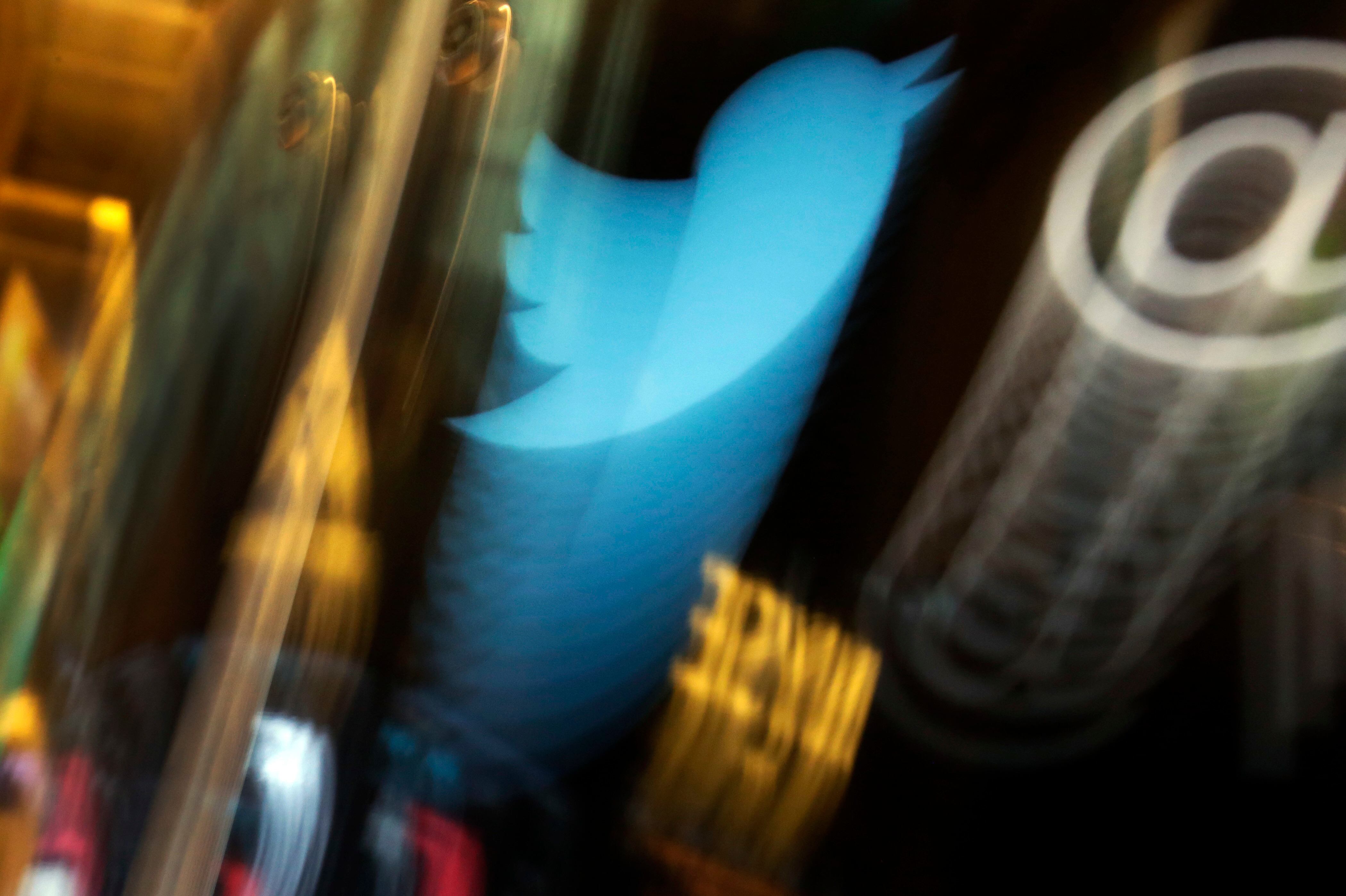
In this Wednesday Nov. 6, 2013, file photo, the Twitter logo appears on an updated phone post on the floor of the New York Stock Exchange. Twitter says the hackers responsible for a recent high-profile breach used the phone to fool the social media company's employees into giving them access. The company revealed a few more details late Thursday, July 30, 2020 about the hack earlier this month, which it said targeted “a small number of employees through a phone spear phishing attack.” (AP Photo/Richard Drew, File)
By David Fischer
Updated 4:34 pm ET
A British man, a Florida man, and a Florida teen hacked the Twitter accounts of prominent politicians, celebrities, and technology moguls to scam people around the globe out of more than $100,000 in Bitcoin, authorities said Friday.
Graham Ivan Clark, 17, was arrested Friday in Tampa, where the Hillsborough State Attorney's Office will prosecute him as an adult. He faces 30 felony charges, according to a news release. Meanwhile, Mason Sheppard, 19, of Bognor Regis, UK, and Nima Fazeli, 22, of Orlando, were charged in California federal court.
In one of the most high-profile security breaches in recent years, hackers sent out bogus tweets on July 15 from the accounts of Barack Obama, Joe Biden, Mike Bloomberg, and a number of tech billionaires including Amazon CEO Jeff Bezos, Microsoft co-founder Bill Gates and Tesla CEO Elon Musk. Celebrities Kanye West and his wife, Kim Kardashian West, were also hacked.
The tweets offered to send $2,000 for every $1,000 sent to an anonymous Bitcoin address.
"There is a false belief within the criminal hacker community that attacks like the Twitter hack can be perpetrated anonymously and without consequence," U.S. Attorney David L. Anderson for the Northern District of California said in a news release. "Today's charging announcement demonstrates that the elation of nefarious hacking into a secure environment for fun or profit will be short-lived."
Although the case against the teen was also investigated by the FBI and the U.S. Department of Justice, Hillsborough State Attorney Andrew Warren explained that his office is prosecuting Clark in Florida state court because Florida law allows minors to be charged as adults in financial fraud cases such as this when appropriate.
"This defendant lives here in Tampa, he committed the crime here, and he'll be prosecuted here," Warren said.
Twitter previously said hackers used the phone to fool the social media company's employees into giving them access. It said hackers targeted "a small number of employees through a phone spear-phishing attack."
"This attack relied on a significant and concerted attempt to mislead certain employees and exploit human vulnerabilities to gain access to our internal systems," the company tweeted.
After stealing employee credentials and getting into Twitter's systems, the hackers were able to target other employees who had access to account support tools, the company said.
The hackers targeted 130 accounts. They managed to tweet from 45 accounts, access the direct message inboxes of 36, and download the Twitter data from seven. Dutch anti-Islam lawmaker Geert Wilders has said his inbox was among those accessed.
Spear-phishing is a more targeted version of phishing, an impersonation scam that uses email or other electronic communications to deceive recipients into handing over sensitive information.
Twitter said it would provide a more detailed report later "given the ongoing law enforcement investigation."
The company has previously said the incident was a "coordinated social engineering attack" that targeted some of its employees with access to internal systems and tools. It didn't provide any more information about how the attack was carried out, but the details released so far suggest the hackers started by using the old-fashioned method of talking their way past security.
British cybersecurity analyst Graham Cluley said his guess was that a targeted Twitter employee or contractor received a message by phone asking them to call a number.
"When the worker called the number they might have been taken to a convincing (but fake) helpdesk operator, who was then able to use social engineering techniques to trick the intended victim into handing over their credentials," Clulely wrote Friday on his blog.
It's also possible the hackers pretended to call from the company's legitimate help line by spoofing the number, he said.
___
Associated Press Writer Kelvin Chan in London contributed to this report.
California's new composting law will affect what residents do in their kitchens. As of this week, Californians will have to recycle excess food in an effort to reduce emissions caused by food waste. Cities and counties will turn recycled food into compost or use it as a renewable energy source. California's new law is the largest mandatory residential food waste recycling program in the country. Rachel Wagoner, Director of the California Department of Resources, Recycling and Recovery called the law 'the biggest change to trash' since recycling started in the 1980s. She joined Cheddar Climate to discuss.
Fast-casual restaurant chain Sweetgreen is rolling out its first salad subscription service called sweetpass as it looks to customers tackling new year weight loss and health goals. Members will receive up to 30 percent off of purchases.
Washington DC and the surrounding areas saw a record breaking snow storm Monday as a strong storm system works its way across the eastern U.S. The extreme weather event caused extensive damage in the greater Washington area, leaving thousands in the region without power. Jonathan Porter, Chief Meteorologist, AccuWeather, joined Wake Up with Cheddar to discuss the fierce storm.
Airlines canceled more than 3,000 flights on Monday over severe weather and crew shortages. The cancellations come on one of the busiest travel days of the holiday season, and is a continuation of the industry-wide disruption that started before Christmas. Thomas Pallini, Aviation Reporter for Insider joined Wake Up with Cheddar to discuss.
Millions of Americans with young children have relied on the child tax credit since the federal government began issuing checks in July 2021. The last round of payments was sent out just before the Christmas holiday — at the same time as the omicron variant surged. Leah Hamilton, associate professor of social work at Appalachian State University, joined Cheddar to discuss what the end to the tax credit means as the U.S. sees the end of many relief programs and its highest number of COVID cases since the start of the pandemic. "It'll become harder for families to meet their basic needs, increasing national childhood poverty rates and the proportion of families who have difficulty putting food on the table, maintaining stable housing, and paying their bills," Hamilton said. She also pointed to research that the credit as a long-term investment in children offsets claims that it contributes to macroeconomic impacts like inflation.
Several Silicon Valley insiders are being accused of contorting a 1990s-era tax break to avoid taxes on millions of dollars of investment profits. The tax break is known as the qualified small business stock exemption, and it allows early investors in certain companies to avoid half of the taxes on up to $10 million in capital gains. A piece recently published in the New York Times says venture capital firms like Andreessen Horowitz replicated the tax exemption by giving shares of companies to friends and family, who would otherwise face a 23.8% capital gains bill. The CEO of Roblox is also accused of replicating the tax break for his family members at least 12 times. Although the loophole known as 'stacking' is considered to be legal, the Times piece implies that the exemption has been manipulated for the ultra-wealthy to become more wealthy. Greycroft co-founder and Chairman Emeritus Alan Patricof joins Cheddar News' Closing Bell to discuss.
There is a new player in the mobile app stock trading space.
Zingeroo recently announced a funding round of $8.5 million. The company says it aims to bring 'friendly competition' to stock trading, by literally breaking trading down into daily and weekly competitions between friends. Zingeroo also says it hopes its new approach can make trading more accessible, educational, and social than ever before. Zingeroo co-founder and CEO Zoe Barry joins Cheddar News' Closing Bell for more.