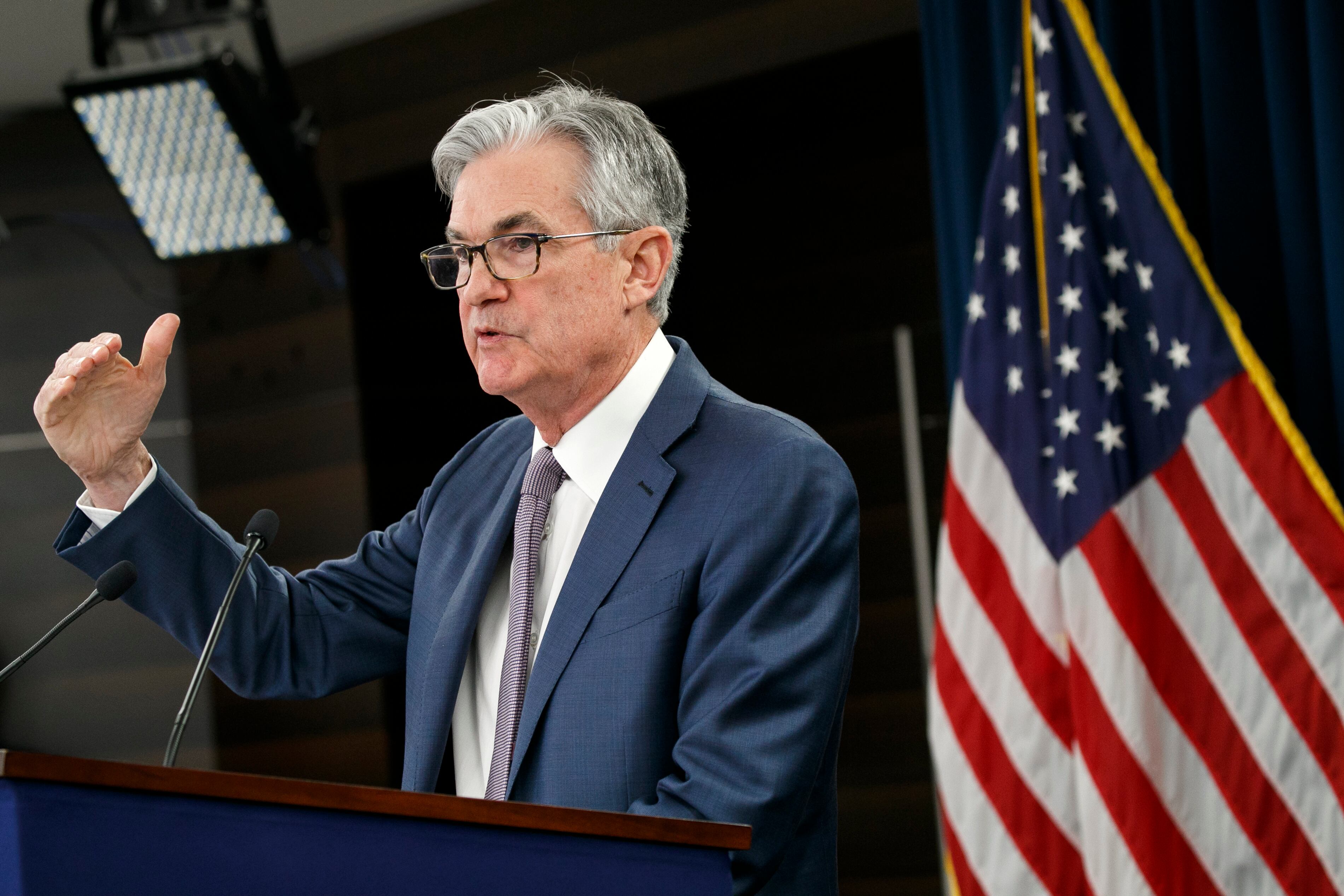
In this March 3, 2020 file photo, Federal Reserve Chair Jerome Powell speaks during a news conference to discuss an announcement from the Federal Open Market Committee, in Washington. (AP Photo/Jacquelyn Martin, File)
By Martin Crutsinger
The Federal Reserve announced a significant change Thursday in how it manages interest rates by saying it plans to keep rates near zero even after inflation has exceeded the Fed’s 2% target level.
The change signifies that the Fed is prepared to tolerate a higher level of inflation than it generally has in the past. And it means that borrowing rates for households and businesses — for everything from auto loans and home mortgages to corporate expansion — will likely remain ultra-low for years to come.
The new goal says that “following periods when inflation has been running persistently below 2%, appropriate monetary policy will likely aim to achieve inflation moderately above 2% for some time.”
The new Fed policy sought to underscore its belief that a low jobless rate was good for the economy by saying it would seek to assess the “shortfalls” in employment from the maximum level.
In a speech detailing the changes, Chairman Jerome Powell made clear that the policy change reflects the reality that high inflation — once the biggest threat to the economy — no longer appears to pose a serious danger, even when unemployment is low and the economy is growing strongly. Rather, Powell said, the economy has evolved in a way that allows the Fed to keep rates much lower than it otherwise would without igniting price pressures.
“The economy is always evolving,” Powell said. “Our revised statement reflects our appreciation for the benefits of a strong labor market, particularly for many in low- and moderate-income communities and that a robust job market can be sustained without causing an unwelcome increase in inflation."
In his speech, Powell said that the Fed's decision to allow unemployment to fall to a 50-year low before the pandemic had played an important role in lifting the fortunes of low-income workers.
Stocks closed lower Thursday with all three major indexes on track to end the week lower. The tech-heavy Nasdaq is on track for its worst week since March 2020, and is down 12% from its record high. Meanwhile, the Dow closed below its 200-day moving average for the first time since December 2021. The S&P 500 didn't fare much better, falling 1.1%. Christopher Wolfe, Chief Investment Officer at First Republic Private Wealth Management, joins Cheddar News' Closing Bell to discuss today's close, this week's market volatility, and more.
Eric Marshall, portfolio manager, Hodges Funds, joins Cheddar News' Closing Bell, where he says the airlines are still not out of the woods when it comes to their COVID-19 recovery, and also addresses the impact of Omicron and inflation weighing on companies at the start of 2022.
Connected cars software development platform Smartcar announced this week it has raised $24 million in a Series B round led by Energize Ventures. Smartcar's software can be integrated into mobile and web apps from mobility businesses. It allows users to do things like locate and unlock a vehicle, as well as check its mileage, fuel level, and battery if the vehicle is electric. Smartcar's technology is compatible with 22 different vehicle brands in 31 different countries. Smartcar co-founder and CEO Sahas Katta joined Cheddar News' Closing Bell to discuss.
Google currently does not accept cryptocurrency as a form of payment in contrast with other big businesses that have taken advantage of the new crypto wealth that's accrued. The tech giant recently hired former PayPal executive Arnold Goldberg to lead its payment division, likely more firmly entering digital currency usage. "I think the real question is, why given the size of the industry, has Google not done this before or been actively accepting and using cryptocurrency, and it's really a lack of regulatory clarity," Halsey Minor, executive chairman of Public Mint, told Cheddar.
The drama surrounding tennis star Novak Djokovic continues after he was deported from Australia over the weekend due to the nation's COVID-19 vaccine requirements. Djokovic was forced to leave the country on the eve of what was to be his first match in defense of his Australian Open title after three judges ruled in favor of his removal and revealed their reasoning for doing so. Adding to his woes, a law recently passed in France is putting his chances of defending his French Open title in jeopardy. The director of Marist's Center for Sports Communication, Jane McManus, joined Cheddar to discuss the ongoing fallout.