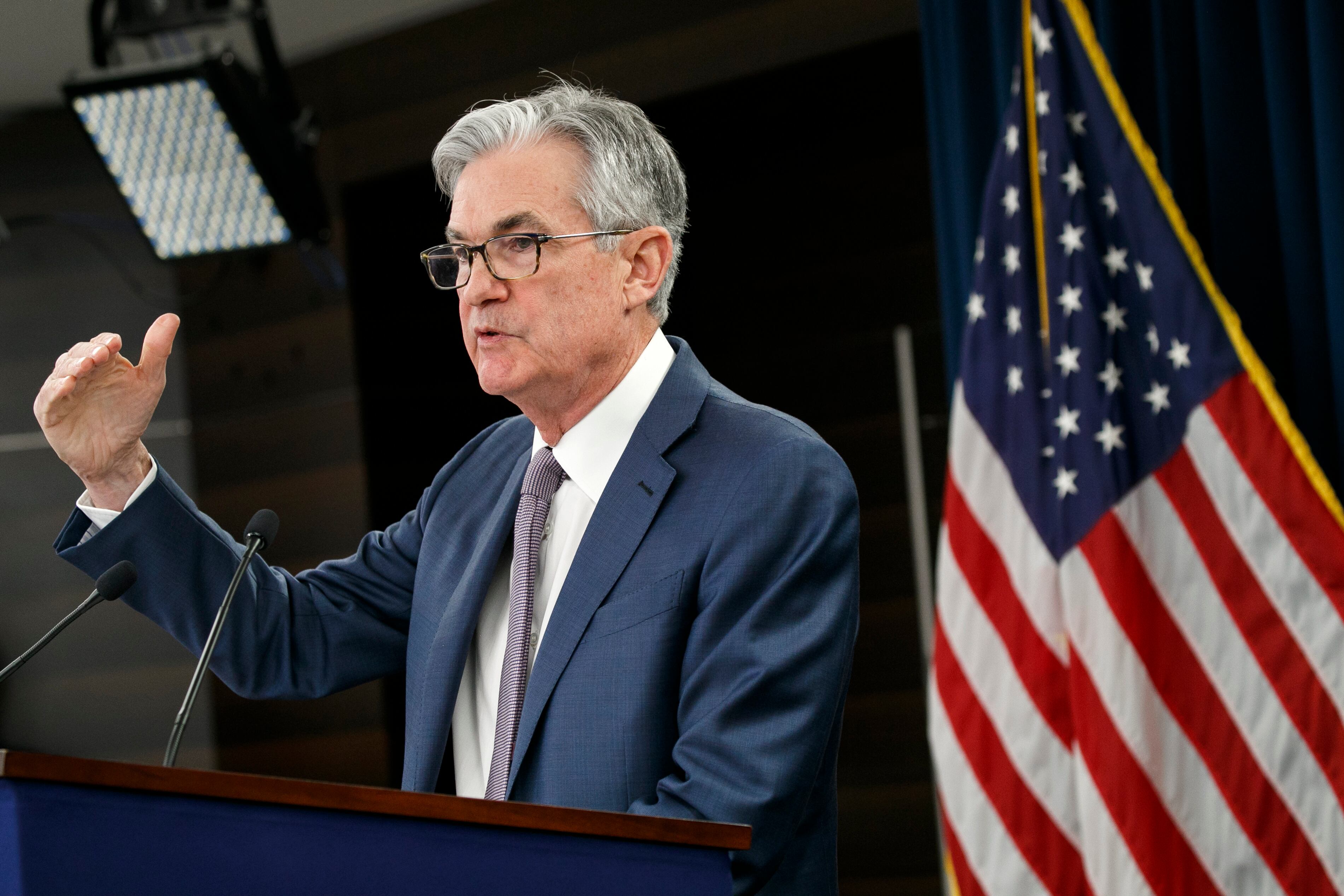
In this March 3, 2020 file photo, Federal Reserve Chair Jerome Powell speaks during a news conference to discuss an announcement from the Federal Open Market Committee, in Washington. (AP Photo/Jacquelyn Martin, File)
By Martin Crutsinger
The Federal Reserve announced a significant change Thursday in how it manages interest rates by saying it plans to keep rates near zero even after inflation has exceeded the Fed’s 2% target level.
The change signifies that the Fed is prepared to tolerate a higher level of inflation than it generally has in the past. And it means that borrowing rates for households and businesses — for everything from auto loans and home mortgages to corporate expansion — will likely remain ultra-low for years to come.
The new goal says that “following periods when inflation has been running persistently below 2%, appropriate monetary policy will likely aim to achieve inflation moderately above 2% for some time.”
The new Fed policy sought to underscore its belief that a low jobless rate was good for the economy by saying it would seek to assess the “shortfalls” in employment from the maximum level.
In a speech detailing the changes, Chairman Jerome Powell made clear that the policy change reflects the reality that high inflation — once the biggest threat to the economy — no longer appears to pose a serious danger, even when unemployment is low and the economy is growing strongly. Rather, Powell said, the economy has evolved in a way that allows the Fed to keep rates much lower than it otherwise would without igniting price pressures.
“The economy is always evolving,” Powell said. “Our revised statement reflects our appreciation for the benefits of a strong labor market, particularly for many in low- and moderate-income communities and that a robust job market can be sustained without causing an unwelcome increase in inflation."
In his speech, Powell said that the Fed's decision to allow unemployment to fall to a 50-year low before the pandemic had played an important role in lifting the fortunes of low-income workers.
Earnings season kicks into high gear this week as big players are on tap to report their Q4 numbers, including Microsoft, Apple, and Tesla. Investors will be watching for key indicators on how the companies are dealing with inflation, Omicron and interest rates. Christine Short, VP of Research, Wall Street Horizon joined Cheddar's Opening Bell to discuss.
Stan Farnsworth, chief marketing officer at PulseForge, joined Cheddar to talk about his company's debut at CES 2022 and how it plans to innovate the sustainable tech manufacturing space. PulseForge is bringing a new approach to industrial thermal processing, which contributes to 30 percent of global greenhouse gas emissions, according to Farnsworth. "By using 85 percent less energy in the processing of materials through a variety of manufacturing processes, we can make a direct impact in reducing carbon output and reducing carbon footprint associated with manufacturing," he said.
Oliver Chen, senior retail analyst at Cowen, joined Cheddar's "Opening Bell" to discuss the latest details about department store chain Kohl's after it received at least two offers from buyers to take the company private. Chen stated that Kohl's is an attractive landing spot for prospective buyers because of its premium real estate and undervalued stock prices. He also noted that despite the rise in online shopping, there is still room for brick and mortar shops to flourish. "We're very bullish on bricks meets clicks. The integration of stores and digital," Chen told Cheddar. "People love to return items in stores, people love the treasure hunt of shopping and the convenience and immediacy of stores."
Four-day week global, an organization in the UK, is pushing for a society where health and wellbeing come first, and a world in which people work to live, rather than live to work. They're demanding a four-day work week based o a recent study that proves productivity increases when working hours are reduced to 32 hours a week. Now, at least 30 companies in the UK are taking part in a four-day work week trial. joining me now is Charlotte Lockhart, founder of four-day week global.