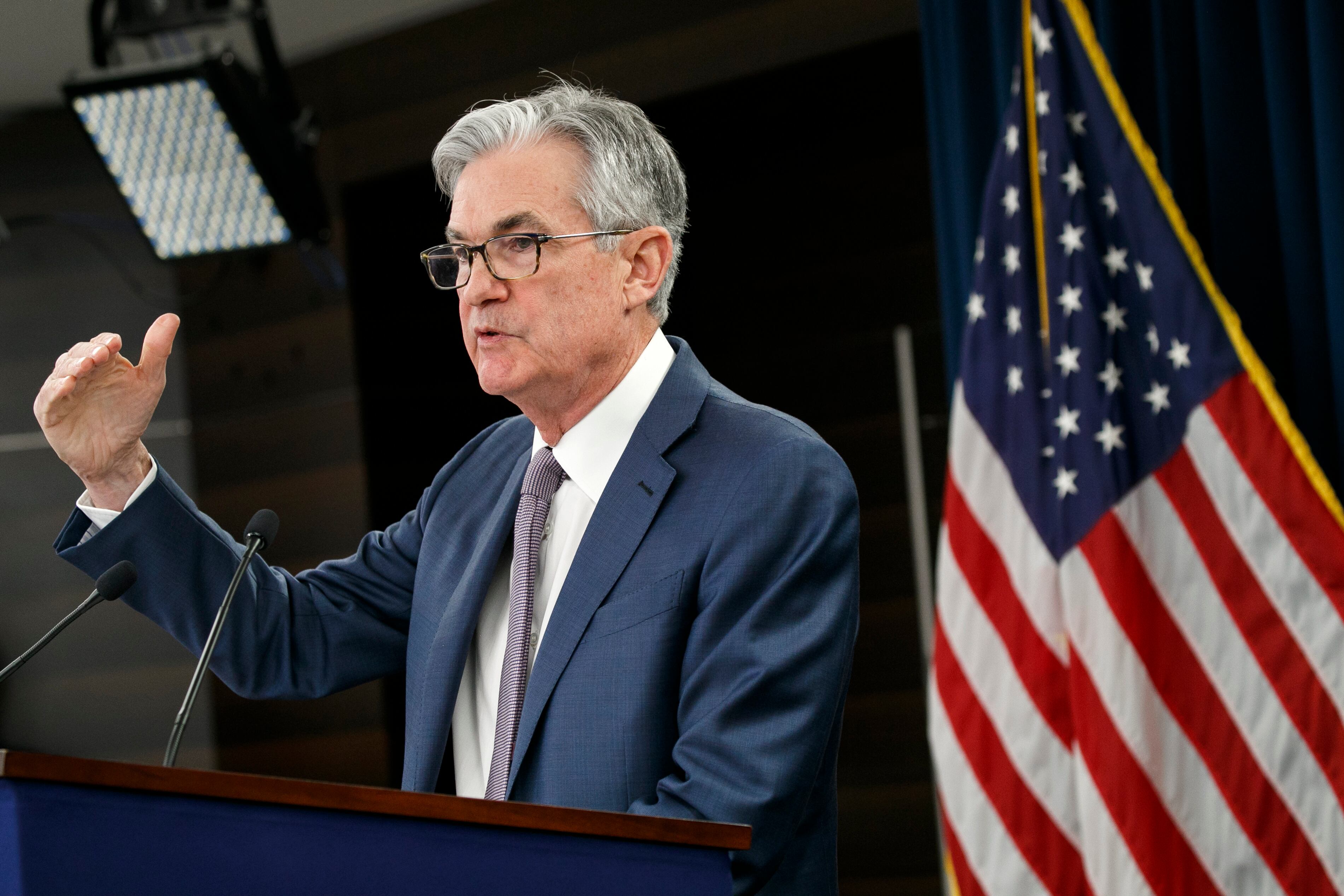
In this March 3, 2020 file photo, Federal Reserve Chair Jerome Powell speaks during a news conference to discuss an announcement from the Federal Open Market Committee, in Washington. (AP Photo/Jacquelyn Martin, File)
By Martin Crutsinger
The Federal Reserve announced a significant change Thursday in how it manages interest rates by saying it plans to keep rates near zero even after inflation has exceeded the Fed’s 2% target level.
The change signifies that the Fed is prepared to tolerate a higher level of inflation than it generally has in the past. And it means that borrowing rates for households and businesses — for everything from auto loans and home mortgages to corporate expansion — will likely remain ultra-low for years to come.
The new goal says that “following periods when inflation has been running persistently below 2%, appropriate monetary policy will likely aim to achieve inflation moderately above 2% for some time.”
The new Fed policy sought to underscore its belief that a low jobless rate was good for the economy by saying it would seek to assess the “shortfalls” in employment from the maximum level.
In a speech detailing the changes, Chairman Jerome Powell made clear that the policy change reflects the reality that high inflation — once the biggest threat to the economy — no longer appears to pose a serious danger, even when unemployment is low and the economy is growing strongly. Rather, Powell said, the economy has evolved in a way that allows the Fed to keep rates much lower than it otherwise would without igniting price pressures.
“The economy is always evolving,” Powell said. “Our revised statement reflects our appreciation for the benefits of a strong labor market, particularly for many in low- and moderate-income communities and that a robust job market can be sustained without causing an unwelcome increase in inflation."
In his speech, Powell said that the Fed's decision to allow unemployment to fall to a 50-year low before the pandemic had played an important role in lifting the fortunes of low-income workers.
Dating app Bumble announced its first acquisition, expanding into Europe by picking up Fruitz, a French Platform. The Fruitz app allows its users to convey dating preferences through fruit metaphors.
Meat production giant Tyson Foods reported a beat on its Q1 earnings. In spite of obstacles posed by supply chain issues and inflation, the company exceeded expectations on earnings per share and revenue.
TC BioPharm, a biopharmaceutical company focused on developing cell therapy products targeting, went public on the Nasdaq in January. CEO Bryan Kobel joined Cheddar to talk about the company's IPO launch, its cancer-fighting therapeutics tech, and its potential for using its research to treat COVID-19. "The opportunity here for us is to really get safety data and covid and expand into other areas," Kobel said. "So from COVID, where we hope to treat patients, hopefully maybe the elderly population, populations that that really can't handle the antivirals because they're too hard in the system, well then we'll expand out into maybe severe influenza Ebola, other viral and viral infections where we think we can be helpful."
The gaming industry has been under the spotlight so far this year following some big mergers and acquisitions. This week featured earnings of three major gaming companies, but also Meta and for the latter, things are not doing too hot. Joining Cheddar News to break it all down was Kenny Rosenblatt, President and Co-Founder of Arkadium.
Following the surprising big beat on estimates for the January jobs report, William M. Rodgers III, vice president and director of the Institute for Economic Equity at the Federal Reserve Bank of St. Louis, joined Cheddar News to break down the data. “We ended 2021 with a strong crescendo to a recovery that had taken hold, and we started 2022 in good fashion." He also discussed the dueling pressures of wage growth and inflation.
While it was a volatile week in tech as Meta experienced the biggest one-day drop in the history of the U.S. stock market, industry giant Amazon reported 40 percent growth — largely on the strength of the cloud. Dan Ives, managing director of equity research at Wedbush Securities, joined Cheddar News to break down how the e-commerce company stock managed to pop despite headwinds against its core retail business. "It's all about cloud because of sum of the parts, you could argue, amazon could be $3,500/$4,000 stock just based on cloud," he said. Ives also addressed the apparent the differing impact of Apple iOS changes on Facebook and Snapchat.