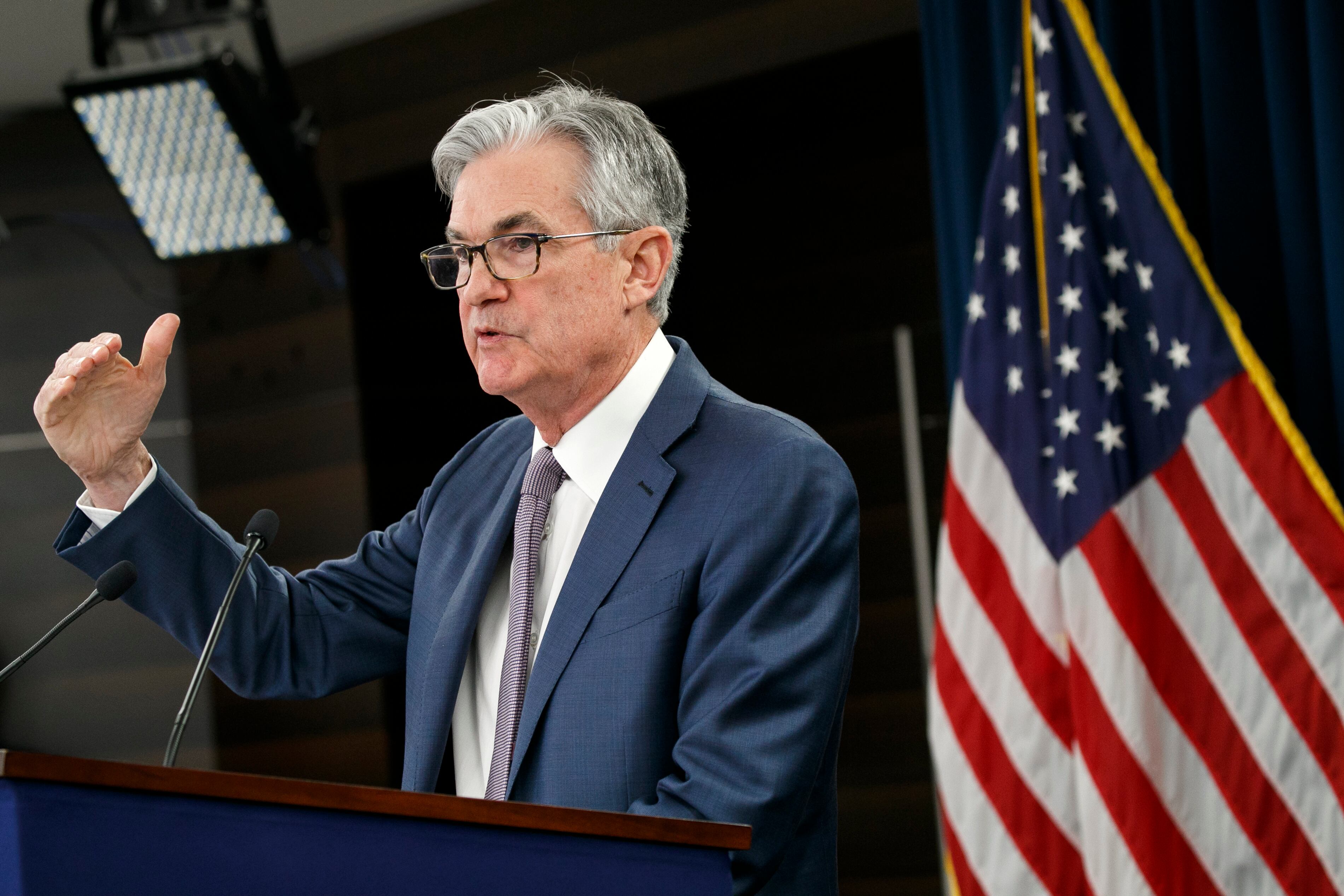
In this March 3, 2020 file photo, Federal Reserve Chair Jerome Powell speaks during a news conference to discuss an announcement from the Federal Open Market Committee, in Washington. (AP Photo/Jacquelyn Martin, File)
By Martin Crutsinger
The Federal Reserve announced a significant change Thursday in how it manages interest rates by saying it plans to keep rates near zero even after inflation has exceeded the Fed’s 2% target level.
The change signifies that the Fed is prepared to tolerate a higher level of inflation than it generally has in the past. And it means that borrowing rates for households and businesses — for everything from auto loans and home mortgages to corporate expansion — will likely remain ultra-low for years to come.
The new goal says that “following periods when inflation has been running persistently below 2%, appropriate monetary policy will likely aim to achieve inflation moderately above 2% for some time.”
The new Fed policy sought to underscore its belief that a low jobless rate was good for the economy by saying it would seek to assess the “shortfalls” in employment from the maximum level.
In a speech detailing the changes, Chairman Jerome Powell made clear that the policy change reflects the reality that high inflation — once the biggest threat to the economy — no longer appears to pose a serious danger, even when unemployment is low and the economy is growing strongly. Rather, Powell said, the economy has evolved in a way that allows the Fed to keep rates much lower than it otherwise would without igniting price pressures.
“The economy is always evolving,” Powell said. “Our revised statement reflects our appreciation for the benefits of a strong labor market, particularly for many in low- and moderate-income communities and that a robust job market can be sustained without causing an unwelcome increase in inflation."
In his speech, Powell said that the Fed's decision to allow unemployment to fall to a 50-year low before the pandemic had played an important role in lifting the fortunes of low-income workers.
President Biden announced a ban on Russian oil and natural gas imports to the U.S. in response to its invasion of Ukraine, a move he warned could lead to an even greater surge in gas prices. The ban is prompting a conversation about the current oil production levels in the U.S. and whether or not the industry can ramp up production to soften the blow to American families at the gas pump. Clark Williams-Derry, Energy Finance Analyst with the Institute for Energy Economics and Financial Analysis, breaks down the state of the U.S. oil industry and how the ban might impact production levels here at home.
PepsiCo, Coca-Cola, McDonald’s, and Starbucks are the latest American food brands to have halted business operations in Russia after having faced scrutiny and criticism for originally failing to do so amid the country's invasion of Ukraine.
As Russia intensifies its war on Ukraine, President Biden announced a ban on oil imported from the aggressor nation. Critics of Russia have said this would be the best way to force Putin to pull back, but curbs on Russian oil exports are expected to send already skyrocketing oil and gas prices even higher, further impacting consumers, businesses, financial markets, and the global economy. Leslie Beyer, CEO of the Energy Workforce and Technology Council, joined Cheddar News' Closing Bell to discuss. "It's certainly going to increase pricing, but it is the right thing to do," she said. "The industry itself has already pulled out of the significant portion of its operations in Russia."
As airlines recover from COVID-19 and the industry becomes more competitive than ever, low-fare carrier Breeze Airlines is offering 35 new routes and reduced prices for its first-class experiences. CEO David Neeleman joined Cheddar News to talk about the rollout of services amid plenty of headwinds including high fuel costs. "We can limit a lot of costs because we're a technology company that happens to fly airplanes," he noted.
Despite women as a whole being among the groups most impacted by pandemic job losses, homesharing platform Airbnb reported that women hosts brought in $12 billion in revenue last year. Catherine Powell, Airbnb's global head of hosting, joined Cheddar News to discuss how women hosting has become a huge asset for the company. "Last year 21 percent more women joined the platform than men," she said. "So they are joining the platform. They are being successful. They're more super hosts, and they're doing incredibly well."