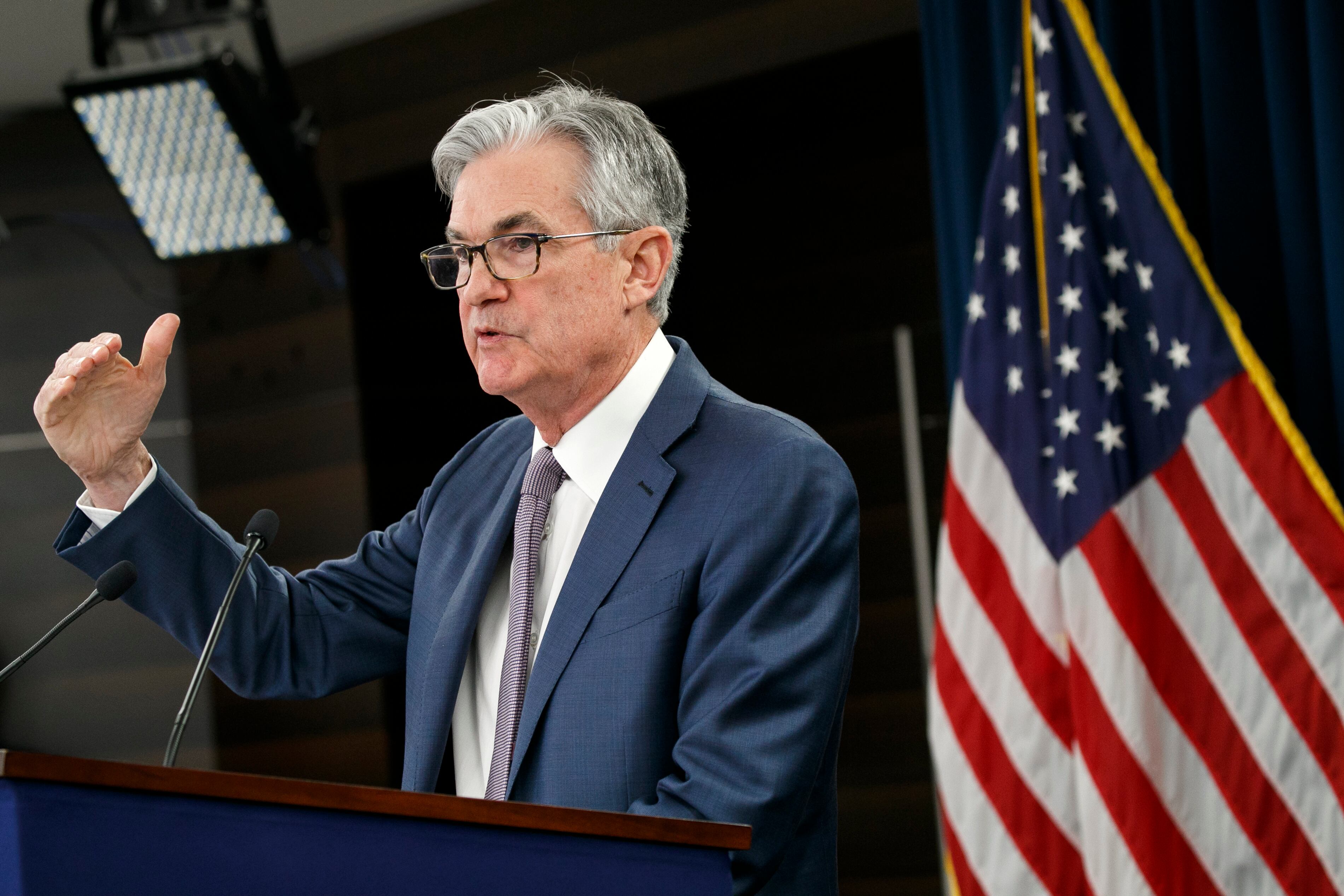
In this March 3, 2020 file photo, Federal Reserve Chair Jerome Powell speaks during a news conference to discuss an announcement from the Federal Open Market Committee, in Washington. (AP Photo/Jacquelyn Martin, File)
By Martin Crutsinger
The Federal Reserve announced a significant change Thursday in how it manages interest rates by saying it plans to keep rates near zero even after inflation has exceeded the Fed’s 2% target level.
The change signifies that the Fed is prepared to tolerate a higher level of inflation than it generally has in the past. And it means that borrowing rates for households and businesses — for everything from auto loans and home mortgages to corporate expansion — will likely remain ultra-low for years to come.
The new goal says that “following periods when inflation has been running persistently below 2%, appropriate monetary policy will likely aim to achieve inflation moderately above 2% for some time.”
The new Fed policy sought to underscore its belief that a low jobless rate was good for the economy by saying it would seek to assess the “shortfalls” in employment from the maximum level.
In a speech detailing the changes, Chairman Jerome Powell made clear that the policy change reflects the reality that high inflation — once the biggest threat to the economy — no longer appears to pose a serious danger, even when unemployment is low and the economy is growing strongly. Rather, Powell said, the economy has evolved in a way that allows the Fed to keep rates much lower than it otherwise would without igniting price pressures.
“The economy is always evolving,” Powell said. “Our revised statement reflects our appreciation for the benefits of a strong labor market, particularly for many in low- and moderate-income communities and that a robust job market can be sustained without causing an unwelcome increase in inflation."
In his speech, Powell said that the Fed's decision to allow unemployment to fall to a 50-year low before the pandemic had played an important role in lifting the fortunes of low-income workers.
Upflex Co-founder and CEO Christophe Garnier discusses how his company is working with WeWork to establish the future of work and elaborates on how his startup will use $30 in new funding.
Dan Ives, Managing Director of Equity Research at Wedbush Securities, joins Cheddar News' Closing Bell, where he provides his insight on what Elon Musk's presence means for Twitter, as well as how recent allegations against the Tesla CEO could impact both the social media platform and the EV giant.
Anthony Bartolacci, VP of Financial Institutions at Sensor Tower, joined Closing Bell to discuss the factors dragging down Snap and other social media and tech stocks.
David Stryzewski, CEO of Sound Planning Group, joins Cheddar News' Closing Bell, where he says that rate hikes are driving the market right now and outlines what must be in place for a stock rally.
Andrew Arons, Founder and Partner at Synergy Advisory Management Group, joins Cheddar News' Closing Bell, where he breaks down Tuesday's market action and provides his insight on Snap's historic slide after the comments made by CEO Evan Spiegel.
Peter Andersen, CIO at Andersen Capital Management, joins Cheddar News' Closing Bell, where he breaks down Monday's trading action and discusses whether this could be the start of a new rally or a blip in an otherwise disappointing stretch.
The crypto industry is still reeling from Terra's recent crash. The company's blockchain was temporarily halted earlier this month after the collapse of its cryptocurrency Luna (LUNA) and its stablecoin TerraUSD (UST), which led to almost $45 billion being wiped from the tokens' market caps within a week. Now, many are left wondering what Terra's struggles mean for the broader crypto market. Reeve Collins, CEO of the NFT platform BLOCKv, joins Cheddar News' Closing Bell from Davos 2022 to discuss.
China's largest ride-hailing company will no longer be listed on the world's largest stock exchange. Didi shareholders voted on Monday to delist from the New York Stock Exchange, less than a year after launching a $4.4 billion IPO with the most significant U.S. share offering by a Chinese company since Alibaba debuted in 2014. Since going public in June of last year, around $70 billion has been wiped from Didi's market value and shares of the company have dropped nearly 90%. Now, Didi is expected to begin preparations to list in Hong Kong. Kevin T. Carter, founder and Chief Investment Officer of EMQQ Global, joins Cheddar News' Closing Bell to discuss.