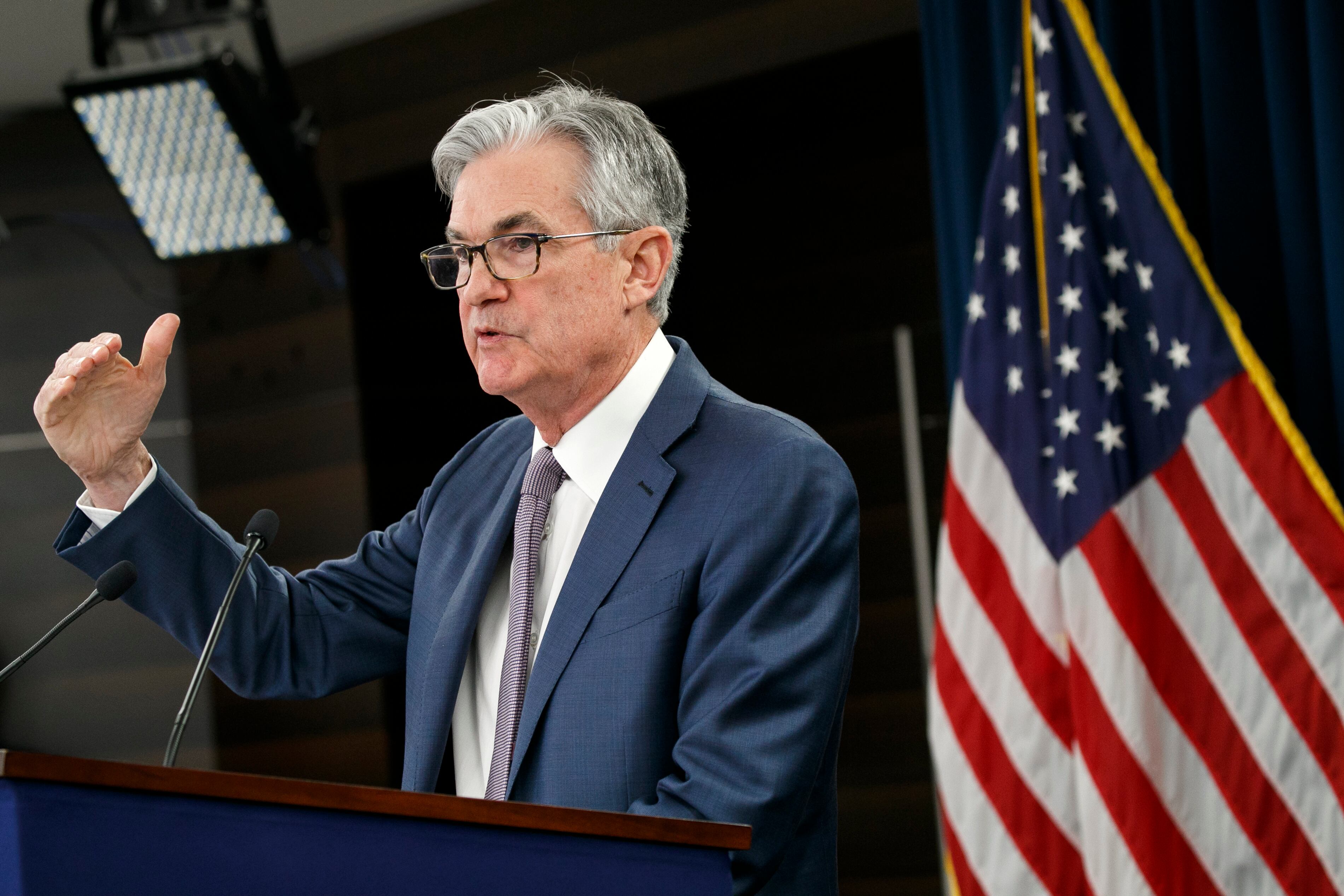
In this March 3, 2020 file photo, Federal Reserve Chair Jerome Powell speaks during a news conference to discuss an announcement from the Federal Open Market Committee, in Washington. (AP Photo/Jacquelyn Martin, File)
By Martin Crutsinger
The Federal Reserve announced a significant change Thursday in how it manages interest rates by saying it plans to keep rates near zero even after inflation has exceeded the Fed’s 2% target level.
The change signifies that the Fed is prepared to tolerate a higher level of inflation than it generally has in the past. And it means that borrowing rates for households and businesses — for everything from auto loans and home mortgages to corporate expansion — will likely remain ultra-low for years to come.
The new goal says that “following periods when inflation has been running persistently below 2%, appropriate monetary policy will likely aim to achieve inflation moderately above 2% for some time.”
The new Fed policy sought to underscore its belief that a low jobless rate was good for the economy by saying it would seek to assess the “shortfalls” in employment from the maximum level.
In a speech detailing the changes, Chairman Jerome Powell made clear that the policy change reflects the reality that high inflation — once the biggest threat to the economy — no longer appears to pose a serious danger, even when unemployment is low and the economy is growing strongly. Rather, Powell said, the economy has evolved in a way that allows the Fed to keep rates much lower than it otherwise would without igniting price pressures.
“The economy is always evolving,” Powell said. “Our revised statement reflects our appreciation for the benefits of a strong labor market, particularly for many in low- and moderate-income communities and that a robust job market can be sustained without causing an unwelcome increase in inflation."
In his speech, Powell said that the Fed's decision to allow unemployment to fall to a 50-year low before the pandemic had played an important role in lifting the fortunes of low-income workers.
Facebook parent Meta officially has changed it’s ticker symbol from ‘FB’ to ‘META’. Paul Meeks, a portfolio manager, Independent Solutions Wealth Management, and a professor of practice in the Baker School of Business at The Citadel, joined Cheddar News to discuss why the tech giant has had to make big changes to its name, its ticker, and its business plans. "When you see what's happening in digital advertising — and there was a slowdown there even before the threat of a recession, which could cause a even more drastic slowdown next year — they had to pivot," he said. Meeks noted he sees Facebook dominating in the metaverse space going forward — whatever that may end up being.
Sports merchandising company Fanatics announced it will be making trading cards featuring college athletes, a deal made possible by the NCAA's change to NIL rules for its players. Anchors Kristen Scholer and Ken Buffa break down the deal for Cheddar.
Catching you up on today’s top business headlines with household wealth falling in Q1 for the first time in two years, Meta officially changing its ticker symbol from ‘FB’ to ‘META’, and updates on Tesla.
The European Union has approved a 40 percent quota for women to sit on company boards. This comes as only 9 of the 27 EU member states have gender equality legislation.
Amanda Victoria, co-founder and CEO of Siponey, joins Cheddar News to talk about the company's canned cocktails. The spritz is made with only four ingredients — wildflower honey, aged rye whiskey, sparkling water, and fresh lemon juice.
Officials and power operators are bracing the public for blackouts caused by higher-than-average temperatures this summer. Utility officials in California and Arizona are warning of potential interruptions this summer due to the strain on energy supplies. Heat waves and drought conditions weaken power grids and available electricity reserves. This also makes hydroelectric power less reliable and raises the risk of wildfires.
Cisco DeVries, CEO of OhmConnect, joins Cheddar News to discuss.
The markets opened lower on Thursday as investors hold their breath ahead of the May consumer price index, which will give investors a better picture of the state of inflation in the United States. Michele Schneider, a partner and the director of trading research and education for MarketGauge.com, joined Cheddar to discuss. "If the CPI read is softer than what's expected, we actually might get a rally," she said. "If it's more than expected, then I think it will spook the market."