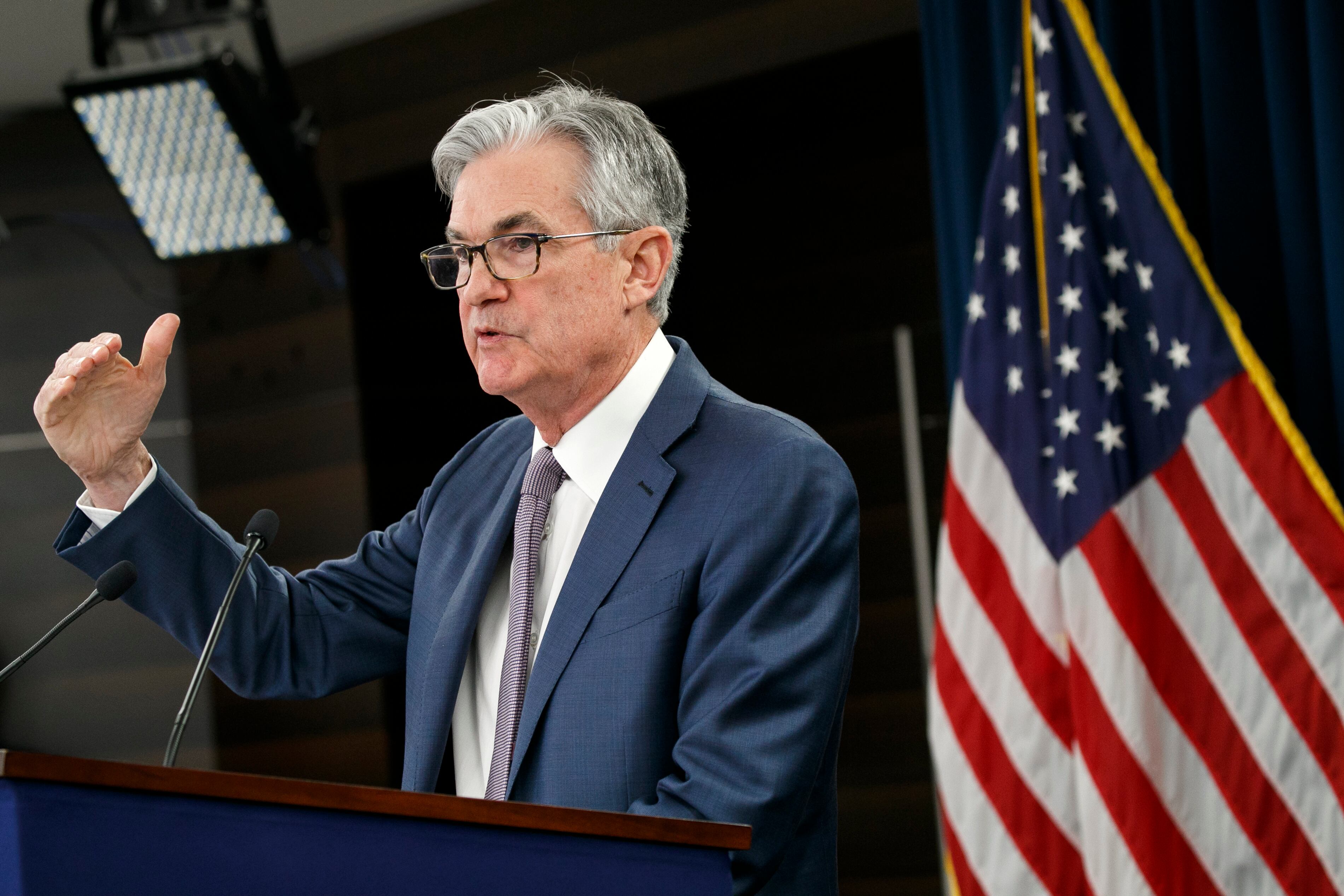
In this March 3, 2020 file photo, Federal Reserve Chair Jerome Powell speaks during a news conference to discuss an announcement from the Federal Open Market Committee, in Washington. (AP Photo/Jacquelyn Martin, File)
By Martin Crutsinger
The Federal Reserve announced a significant change Thursday in how it manages interest rates by saying it plans to keep rates near zero even after inflation has exceeded the Fed’s 2% target level.
The change signifies that the Fed is prepared to tolerate a higher level of inflation than it generally has in the past. And it means that borrowing rates for households and businesses — for everything from auto loans and home mortgages to corporate expansion — will likely remain ultra-low for years to come.
The new goal says that “following periods when inflation has been running persistently below 2%, appropriate monetary policy will likely aim to achieve inflation moderately above 2% for some time.”
The new Fed policy sought to underscore its belief that a low jobless rate was good for the economy by saying it would seek to assess the “shortfalls” in employment from the maximum level.
In a speech detailing the changes, Chairman Jerome Powell made clear that the policy change reflects the reality that high inflation — once the biggest threat to the economy — no longer appears to pose a serious danger, even when unemployment is low and the economy is growing strongly. Rather, Powell said, the economy has evolved in a way that allows the Fed to keep rates much lower than it otherwise would without igniting price pressures.
“The economy is always evolving,” Powell said. “Our revised statement reflects our appreciation for the benefits of a strong labor market, particularly for many in low- and moderate-income communities and that a robust job market can be sustained without causing an unwelcome increase in inflation."
In his speech, Powell said that the Fed's decision to allow unemployment to fall to a 50-year low before the pandemic had played an important role in lifting the fortunes of low-income workers.
An analyst at JP Morgan is predicting massive future growth for Apple in its music and gaming divisions — to the tune of more than $8 billion in revenue by 2025. Cheddar News anchors Kristen Scholer and Hena Doba discuss the glowing forecast for the tech giant.
Catching you up on today’s top headlines with Bitcoin falling below $24,000, U.S. gas prices reaching above $5 on average, Tesla shareholders voting on a 3-for-1 stock split, and more.
On this episode of On The Job presented by ADP: Gemma Burgess, CEO of Ferguson Partners, explains what people are looking for in an employer, and how to convey positive work culture to potential employees; Amy Leschke-Kahle, Vice President of Performance Acceleration at The Marcus Buckingham Company, an ADP company, breaks down how encouraging employee engagement and empowering employee voices can benefit every workplace and busts a myth about employee engagement while working from home; Jim Huether, CEO of Hyperice, discusses Hyperice's new employee mental health initiative, known as the Workplace Alliance, with 100-plus companies to combat the ongoing mental health crisis and how they're taking a hands-on, data-driven approach to the mental health crisis.
Amy Leschke-Kahle, Vice President of Performance Acceleration at The Marcus Buckingham Company, an ADP company, joins Cheddar to discuss how encouraging employee engagement and empowering employee voices can benefit every workplace and busts a myth about employee engagement while working from home.
Jim Huether, CEO of Hyperice, joins Cheddar to discuss Hyperice's new employee mental health initiative, known as the Workplace Alliance, with 100-plus companies to combat the ongoing mental health crisis and how they're taking a hands-on, data-driven approach to the mental health crisis.
Consumer prices saw an 8.6 percent jump in May, with fuel prices showing the biggest surge, climbing 17 percent last month. As inflation continues to climb to levels not seen in 40 years, President Biden took to calling out ExxonMobil and other major oil companies, accusing them of holding back production while continuing to collect huge profits at the cost of the consumer. Mark Avallone, the president of Potomac Wealth Advisors, joined Cheddar's Opening Bell to discuss. “They have reduced long-term expenditures. But why? Because the world is going to alternative energy and as consumers, if we thought that that welcome change to alternatives was going to happen without pain, we might have been mistaken," he said. "The less investment they make in oil because they're getting ready for a new world of electric vehicles, the less we're going to be prepared for oil shocks such as the one we got when Russia invaded Ukraine."
Catching you up on the stories you need to know this morning, the U.S. could soon get its first major gun safety law in years, the House Select Committee investigating the January 6th attack on the U.S. capitol holds its second hearing, and today might just be the day the Supreme Court overturns Roe v. Wade, and decides on new gun laws.