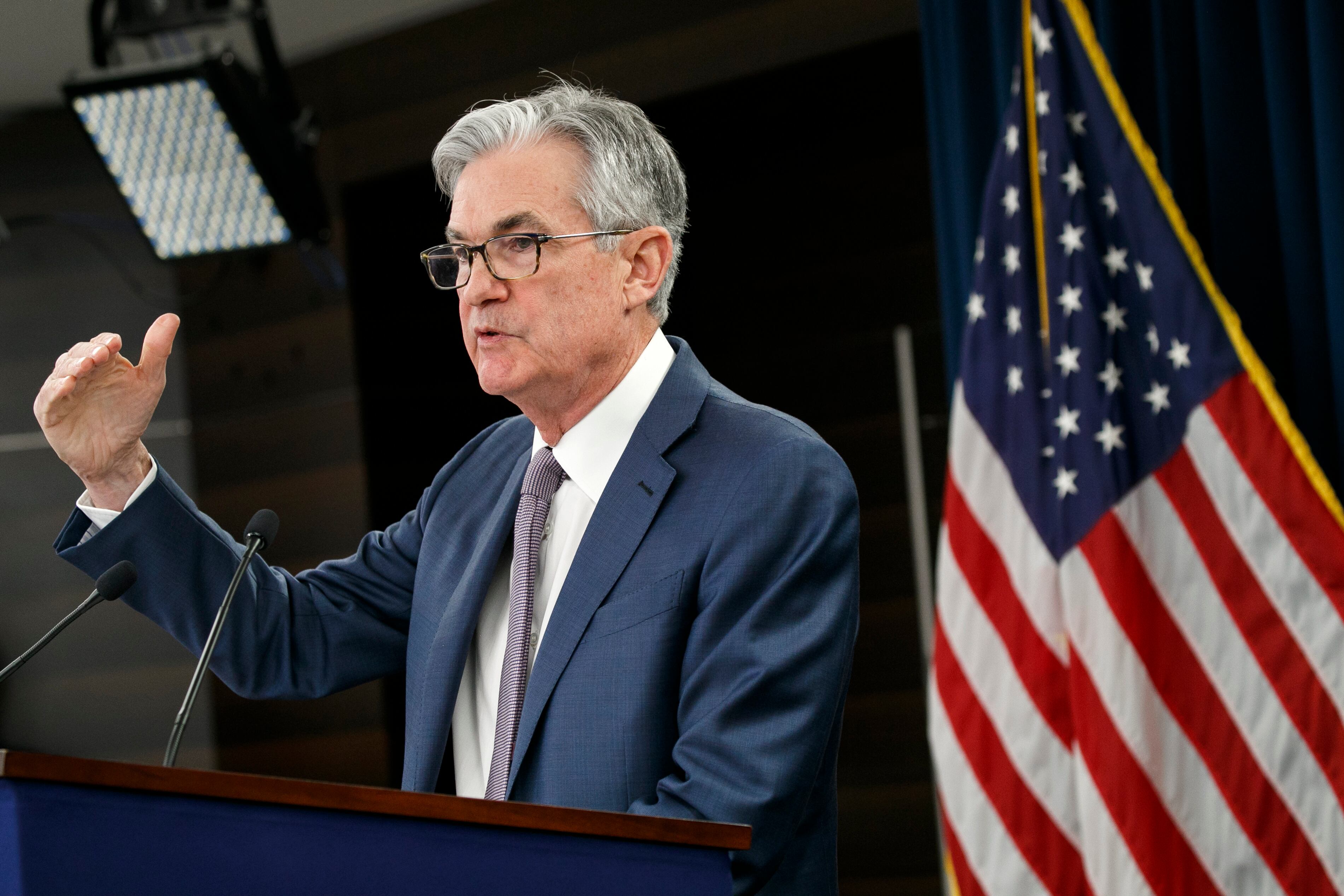
In this March 3, 2020 file photo, Federal Reserve Chair Jerome Powell speaks during a news conference to discuss an announcement from the Federal Open Market Committee, in Washington. (AP Photo/Jacquelyn Martin, File)
By Martin Crutsinger
The Federal Reserve announced a significant change Thursday in how it manages interest rates by saying it plans to keep rates near zero even after inflation has exceeded the Fed’s 2% target level.
The change signifies that the Fed is prepared to tolerate a higher level of inflation than it generally has in the past. And it means that borrowing rates for households and businesses — for everything from auto loans and home mortgages to corporate expansion — will likely remain ultra-low for years to come.
The new goal says that “following periods when inflation has been running persistently below 2%, appropriate monetary policy will likely aim to achieve inflation moderately above 2% for some time.”
The new Fed policy sought to underscore its belief that a low jobless rate was good for the economy by saying it would seek to assess the “shortfalls” in employment from the maximum level.
In a speech detailing the changes, Chairman Jerome Powell made clear that the policy change reflects the reality that high inflation — once the biggest threat to the economy — no longer appears to pose a serious danger, even when unemployment is low and the economy is growing strongly. Rather, Powell said, the economy has evolved in a way that allows the Fed to keep rates much lower than it otherwise would without igniting price pressures.
“The economy is always evolving,” Powell said. “Our revised statement reflects our appreciation for the benefits of a strong labor market, particularly for many in low- and moderate-income communities and that a robust job market can be sustained without causing an unwelcome increase in inflation."
In his speech, Powell said that the Fed's decision to allow unemployment to fall to a 50-year low before the pandemic had played an important role in lifting the fortunes of low-income workers.
Breaking down the good, the bad, and the new in business on Monday, June 13, 2022, with JP Morgan's bullish Apple take, EV startup Electric Last Mile Solutions planning to declare bankruptcy, and Amazon getting ready to roll out its new drone delivery service in California.
Jay Hatfield, Chief Investment Officer at Infrastructure Capital Management, joined Closing Bell to break down the big factors leading to this latest market meltdown, as inflation and an upcoming Fed policy decision affect investor sentiment.
Tech apprenticeship platform Multiverse became a unicorn with a $1.7 billion valuation, after raising $220 million in a Series D round. As companies across the country face challenges in hiring and retaining tech talent, Multiverse says it's trying to offer a solution with a new way to train and hire workers that can serve as an alternative to college and corporate training. Sophie Ruddock, VP and GM North America of Multiverse, joins Cheddar News' Closing Bell to discuss.
Bitcoin's price has fallen below $24,000, its lowest level since December 2020. Matt Hougan, CIO at Bitwise Asset Management, joined Cheddar News to discuss the future of crypto amid the latest high-profile point of concern, the halting of withdrawals at Celsius Network. "Last month we saw Luna collapse. This month we're seeing Celsius possibly collapsing," he said. "So this stress test is finding weaknesses in the crypto ecosystem and it will continue until we get to a strong foundation from which crypto can recover."
An analyst at JP Morgan is predicting massive future growth for Apple in its music and gaming divisions — to the tune of more than $8 billion in revenue by 2025. Cheddar News anchors Kristen Scholer and Hena Doba discuss the glowing forecast for the tech giant.