By Seung Min Kim, Tom Krisher and Chris Megerian
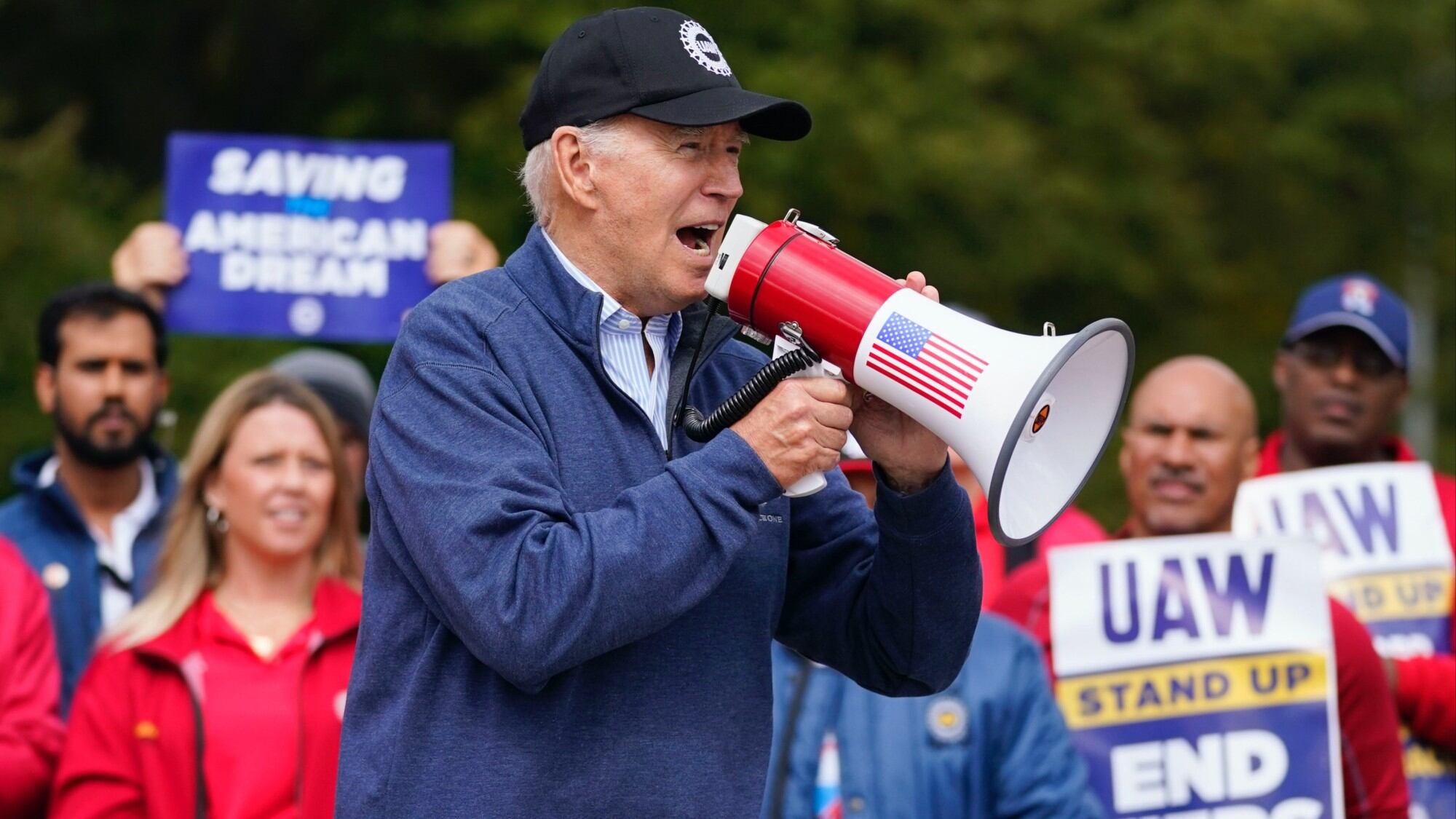
President Joe Biden grabbed a bullhorn on the picket line Tuesday and urged striking auto workers to “stick with it” in an unparalleled show of support for organized labor by a modern president.
Donning a union ballcap and exchanging fist bumps, Biden told United Auto Workers strikers in Van Buren Township, Mich., that “you deserve the significant raise you need” as he stopped in the Detroit area just a day ahead of a planned visit by former President Donald Trump, the frontrunner for the Republican nomination in next year's election.
“No deal, no wheels!” workers chanted as Biden arrived at a General Motors parts distribution warehouse, one of several facilities that has been targeted in a widening strike now in its 12th day. “No pay, no parts!”
Despite concerns that a prolonged strike could undermine the economy, particularly in the crucial battleground state of Michigan, the Democratic president encouraged workers to keep fighting for better wages at a time when car companies have seen rising profits.
Asked if UAW members deserved a 40% raise, one of their demands over the course of negotiations, Biden said: “Yes. I think they should be able to bargain for that.”
He’s repeatedly argued that auto companies have not gone far enough to meet union demands, especially after making concessions in the wake of the 2008 financial crisis.
“The fact of the matter is that you guys, the UAW, you saved the automobile industry back in 2008 ... you made a lot of sacrifices. You gave up a lot. And the companies were in trouble. Now they’re doing incredibly well and guess what? You should be doing incredibly well.”
The White House said Biden was the first modern president to visit a picket line, a sign of how far he’s willing to go to cultivate union support as he runs for reelection.
Lawmakers often appear at strikes to show solidarity with unions, and Biden joined picket lines with casino workers in Las Vegas and auto workers in Kansas City while seeking the 2020 Democratic presidential nomination.
But sitting presidents, who have to balance the rights of workers with disruptions to the economy, supply chains and other facets of everyday life, have stayed out of the strike fray — until Biden.
Unimpressed, Trump called Biden’s visit “nothing more than a PR stunt from Crooked Joe Biden to distract and gaslight the American people from his disastrous Bidenomics policies that have led to so much economic misery across the country.”
The president spent less than half an hour at the Willow Run parts distribution warehouse, where he was joined by UAW President Shawn Fain, who rode with Biden in the presidential limousine to the picket line.
“Thank you, Mr. President, for coming to stand up with us in our generation-defining moment," said Fain, who described the union as engaged in a “kind of war” against “corporate greed.”
“We do the heavy lifting. We do the real work," Fain said. "Not the CEOs.”
Labor historians said they could not recall an instance when a sitting president had joined an ongoing strike, even during the tenures of ardent pro-union presidents such as Franklin Delano Roosevelt and Harry Truman. Theodore Roosevelt invited labor leaders alongside mine operators to the White House amid a historic coal strike in 1902, a decision that was seen at the time as a rare embrace of unions as Roosevelt tried to resolve the dispute.
Biden's visit to the picket line was the most significant demonstration of his pro-union bona fides, a record that includes vocal support for unionization efforts at Amazon.com facilities and executive actions that promoted worker organizing. He also earned a joint endorsement of major unions earlier this year and has avoided southern California for high-dollar fundraisers amid the writers' and actors' strikes in Hollywood.
The United Farm Workers announced their endorsement of Biden on Tuesday, calling him “an authentic champion for workers and their families, regardless of their race or national origin.” Biden’s campaign manager, Julie Chavez Rodriguez, is the granddaughter of Cesar Chavez, the union’s co-founder.
The UAW has not endorsed Biden. Asked about that after landing in Michigan, Biden told reporters that “I’m not worried about that.”
Fain later said any endorsements would come later. “We’ve got to get good contracts first and we’ll work out those things down the road,” he said.
At least one warehouse worker on the picket line was not swayed by the visit. Curtis Cranford, who has 38 years with GM, was happy that Biden visited, but said it wouldn't necessarily deter him from voting Republican in 2024.
“I think it means a lot. It should hopefully put some pressure on the company. The White House is behind us” Cranford said.
Still, he said he and many union members disagree with Democrats on securing the borders, abortion and other issues. And he said both Trump and Biden were too old for the job.
Biden and other Democrats are aggressively touting the president's pro-labor credentials as Trump works to make inroads in critical swing states where unions remain influential, including Michigan and Pennsylvania. Biden is leaning on his union support at a time when labor enjoys broad support from the public, with 67% of Americans approving of labor unions in an August Gallup poll.
The UAW strike, which expanded into 20 states last week, remains a dilemma for the Biden administration since a part of the workers' grievances include concerns about a broader transition to electric vehicles. The shift away from gas-powered vehicles has worried some autoworkers because electric versions require fewer people to manufacture and there is no guarantee that factories that produce them will be unionized.
Adrian Mitchell, who works at the GM parts warehouse, said Biden would be better for the middle class than Trump. “He supports the people in regards to coming out here, showing solidarity with the UAW workers,” Mitchell said. “He’s always been for the middle class. I can’t speak about Trump."
On electric vehicles, Mitchell said workers are concerned that the transition from internal combustion vehicles may cost them jobs. “We haven’t really gotten to that point to see the job losses yet,” he said. "So we can’t look into the future to kind of see what’s really going to happen. But we’re all a little worried about that right now.”
Trump is skipping the second Republican primary debate on Wednesday and will meet with striking autoworkers in Michigan, seeking to capitalize on discontent over the state of the economy and anger over the Biden administration’s push for more electric vehicles — a key component of its clean-energy agenda.
White House officials dismissed any notion that Trump forced their hand and noted that Biden headed to Michigan at the request of Fain, who last week invited the sitting president to join the strikers.
The Biden administration has no formal role in the negotiations, and the White House pulled back a decision from the president earlier this month to send two key deputies to Michigan after determining it would be more productive for the advisers, Gene Sperling and acting Labor Secretary Julie Su, to monitor talks from Washington.
Fain said Tuesday that negotiations were moving slowly and they’ll escalate the strike to more plants if they need to.
Associated Press writer Jill Colvin in Summerville, South Carolina, contributed to this report.
Updated at 5:30 a.m. Sept. 27.