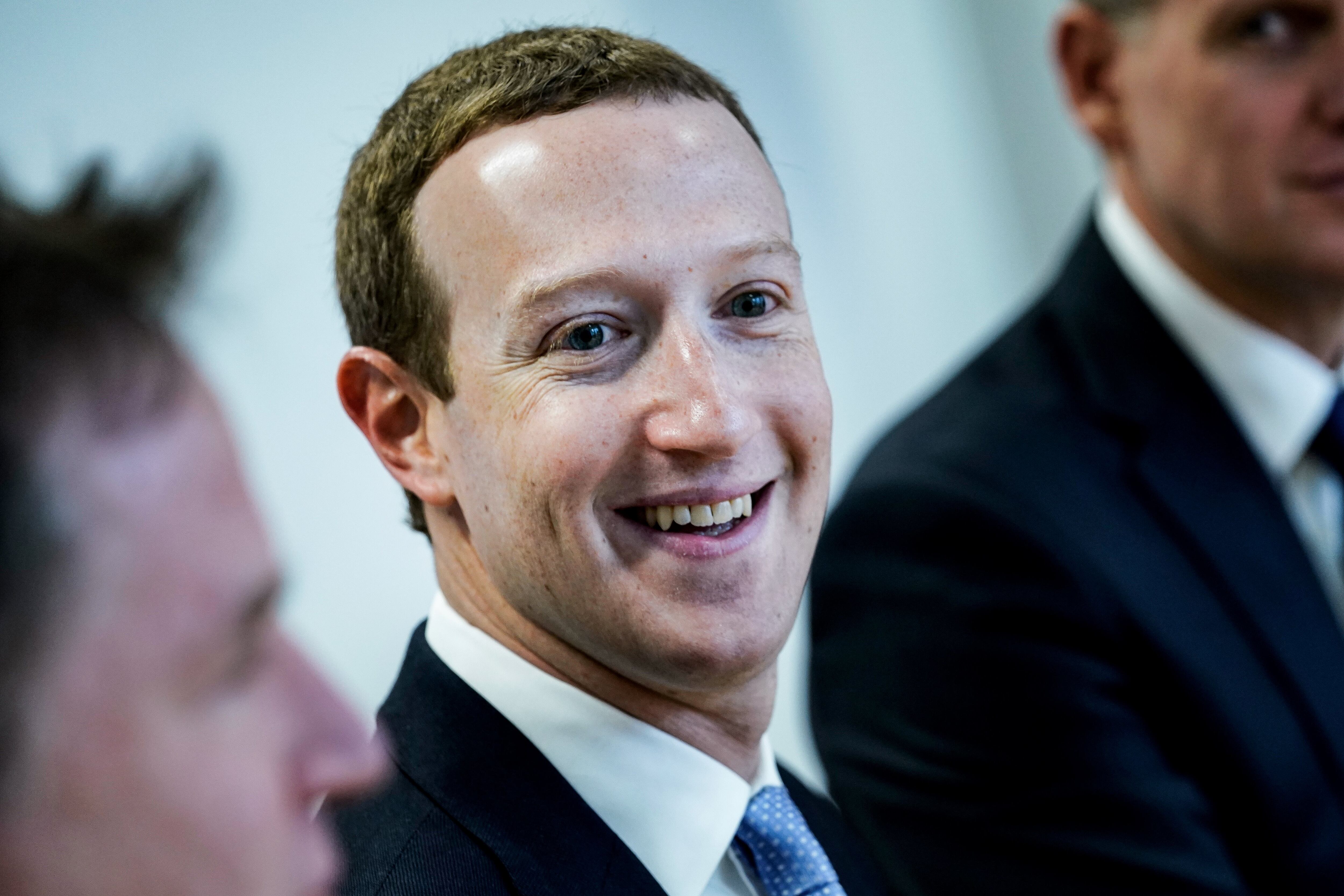
Founder and CEO of US online social media and social networking service Facebook Mark Zuckerberg. Photo by KENZO TRIBOUILLARD/AFP via Getty Images/FILE)
Mark Zuckerberg and his wife Priscilla Chan have donated $25 million through their foundation to a philanthropic effort organized by Bill Gates to explore new coronavirus treatments.
The Gates Foundation donated $50 million last week to what it’s calling the “COVID-19 Therapeutics Accelerator.” The initiative brings together life sciences companies to collaborate on the development of new vaccines, diagnostics, and treatments for COVID-19.
“The Therapeutics Accelerator will enable researchers to quickly determine whether or not existing drugs have a potential benefit against COVID-19,” Chan and Zuckerberg said in a press release. “We hope these coordinated efforts will help stop the spread of COVID-19 as well as provide shared, reusable strategies to respond to future pandemics.”
The two donations are the largest from tech billionaires since the coronavirus outbreak. Wellcome and Mastercard are supporting the effort as well.
The goal of the initiative is to either develop a new drug or adapt an existing treatment that it could help distribute alongside partnering pharmaceutical companies.
The 15 companies participating in the project kicked off the effort by sharing their proprietary libraries of molecular compounds that have some history of being tested with COVID-19.
The lineup includes big names in biotech such as Johnson & Johnson, Merck, Pfizer, Sanofi, and Bristol-Myers Squibb.
It is 'game on' for sports bettors in the state of New York, as mobile betting kicks off on four major betting operating platforms this Saturday. The state, with over 20 million residents, will be the most populous state with legal online sports betting. Max Bichsel, VP of US Business for EmpireStakes.com joins Cheddar News to discuss.
Far too often, Americans are forced to navigate a tangled web of outdated government websites, offices way out of their reach, and hours of time 'on hold' to access the simple government services they depend on. A recent executive order, signed by President Biden, is intended to improve, streamline and modernize the 'customer' experience when accessing government services. Mina Hsiang, the administrator of the United States Digital Service, joins Cheddar News to discuss how the tech workforce is impacted by this executive order.
Cheddar has been following all things innovative, fascinating, and downright cool from CES 2022. Watch the full episode, hosted by Cheddar's Ken Buffa and Michelle Castillo.
Private equity firms in 2021 spent $401.71 billion in U.S. tech investments — doubling 2020's level of $196.34 billion. As tech becomes increasingly interwoven into our lives amid the pandemic, investors grow bullish on the sector, especially software-as-a-service companies. How will 2022 stack up to 2021, and is there potential for parts of the tech sector to sink this year? John Jannarone, Editor in Chief at IPO-Edge, joins Cheddar News' Closing Bell to discuss 2021's record year of deals, how potential interest rate hikes will impact tech investments in 2022, the fastest-growing IPOs, and more.
Bed Bath & Beyond delivered disappointing fiscal third-quarter results for 2022. Shares initially dove more than 9% in premarket trading on the news but finished the day up nearly 8%. Bed Bath & Beyond has been a meme-stock target for online investors in the past -- so was meme-stock mania a factor in the recent stock movement for the company? Jaime Rogozinski, the founder of the subreddit WallStreetBets, joins Cheddar News' Closing Bell for more, as his forum helped spark the meme stock phenomena. He also discussed some decentralized finance services and trends for the retail investor to watch for in 2022.
Digital medical care provider Pear Therapeutics rang the closing bell on the Nasdaq Friday and President and CEO Dr. Corey McCann, joined Cheddar to talk about how the company plans to grow the business of software-based therapeutics and how the first FDA authorized prescription digital therapeutics company will go about treating illnesses like insomnia and addiction. "These really are pieces of software. In many cases, they're apps and in the cases of our addiction products, these are based on something called cognitive behavioral therapy or CBT," he said. "These products change the patient's brain circuitry to help them be abstinent, to help them stay in treatment, and that's exactly what we see in randomized clinical trials and that's what we see in the real world." He also addressed the ongoing mental health crises brought on by the pandemic. **copy updated to remove IPO information as Pear Therapeutics went public in December**
Gamestop shares were up on The Wall Street Journal report that the video game retail company plans to enter the NFT and crypto space. Adam Hollander, the founder of Hungry Wolves NFT, joined Cheddar to break down how it could be a lifeline for the struggling meme stock darling. "They're not resigning themselves to becoming the next Blockbuster story, and so while people may not be buying as many video games in a retail environment anymore, NFTs, in particular, people are starting to expect more gaming utility on the backend — at least for a variety of projects — and I personally think its a very smart move for them to do this," Hollander told Cheddar.
On Saturday, New York will join neighboring New Jersey and Connecticut in authorizing mobile sports betting. Matt Kalish, president and co-founder of Draftkings North America, joined Cheddar to talk about the landmark change that is estimated to rake in $500 million in annual tax revenue on a potential billion-dollar market. Kalish also addressed the possibility that legalized sports betting in the Empire State could cannibalize his company's revenues in the bordering states. "It's pretty inconvenient, you know, to go across the border to make a bet. And people were doing it, but I think it really stifled a lot of the opportunity," he said. "So while there's some of that going on, I think really a tremendous amount, like a giant percent, of New York will be very incremental."
Ben Armstrong, founder of Bitboy Crypto, joins Cheddar News to discuss Bitcoin's downward trend and what's next for crypto after protests in Kazakhstan cause crypto miners to shut down.