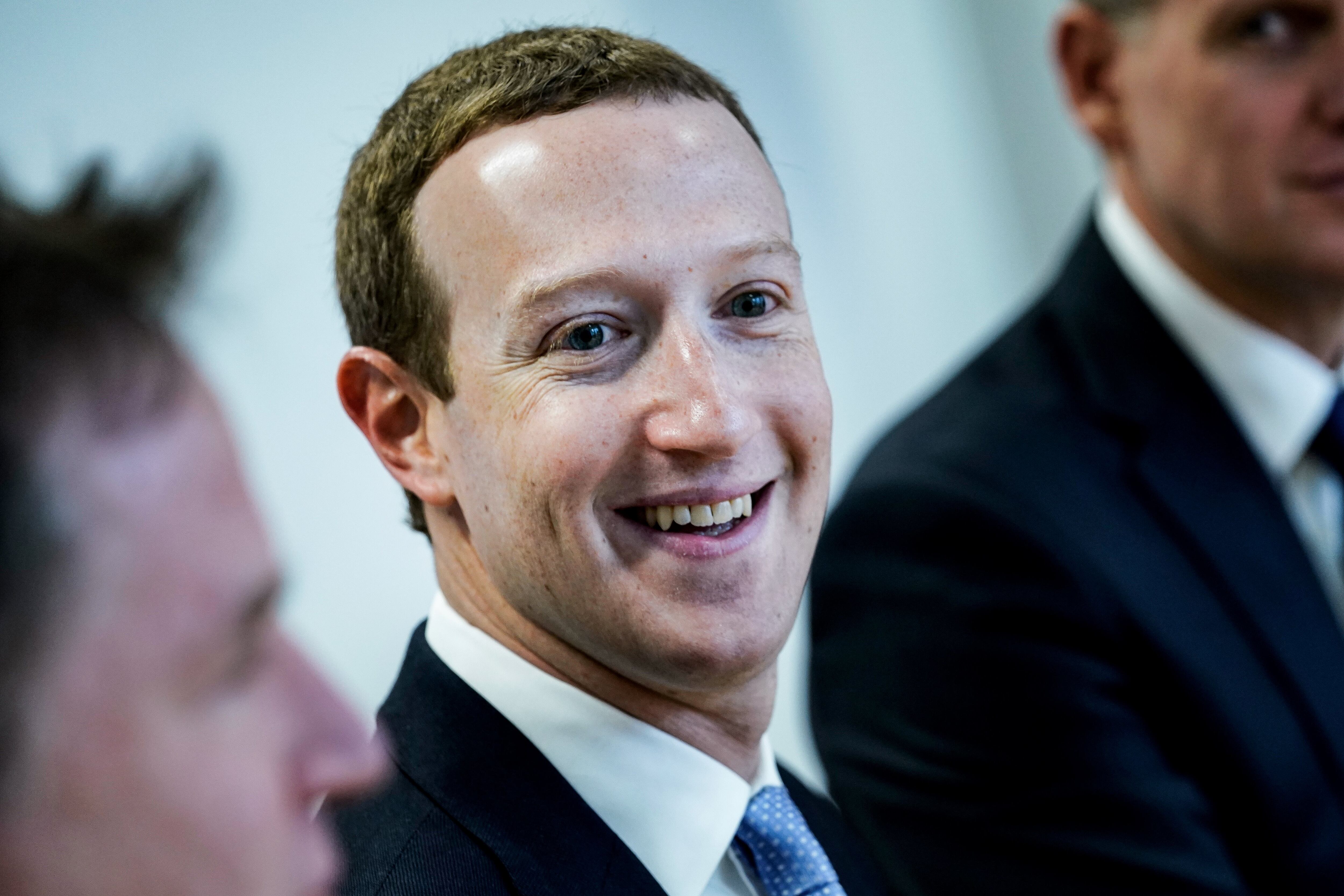
Founder and CEO of US online social media and social networking service Facebook Mark Zuckerberg. Photo by KENZO TRIBOUILLARD/AFP via Getty Images/FILE)
Mark Zuckerberg and his wife Priscilla Chan have donated $25 million through their foundation to a philanthropic effort organized by Bill Gates to explore new coronavirus treatments.
The Gates Foundation donated $50 million last week to what it’s calling the “COVID-19 Therapeutics Accelerator.” The initiative brings together life sciences companies to collaborate on the development of new vaccines, diagnostics, and treatments for COVID-19.
“The Therapeutics Accelerator will enable researchers to quickly determine whether or not existing drugs have a potential benefit against COVID-19,” Chan and Zuckerberg said in a press release. “We hope these coordinated efforts will help stop the spread of COVID-19 as well as provide shared, reusable strategies to respond to future pandemics.”
The two donations are the largest from tech billionaires since the coronavirus outbreak. Wellcome and Mastercard are supporting the effort as well.
The goal of the initiative is to either develop a new drug or adapt an existing treatment that it could help distribute alongside partnering pharmaceutical companies.
The 15 companies participating in the project kicked off the effort by sharing their proprietary libraries of molecular compounds that have some history of being tested with COVID-19.
The lineup includes big names in biotech such as Johnson & Johnson, Merck, Pfizer, Sanofi, and Bristol-Myers Squibb.
Walmart is one of the latest companies looking to adapt to the emerging digital economy by possibly establishing its own cryptocurrency. The retail giant filed at least seven applications with the U.S. Patent and Trademark Office, including one for blockchain assets.
Bitcoin plunged below the $40,000 mark on Monday, hitting its lowest price since September. The world's most valuable cryptocurrency has had months of hot and cold streaks, and the latest drop now has investors wondering just what 2022 will have in store for bitcoin and the crypto space as a whole. Ben McMillan, CIO at IDX Digital Assets, joined Cheddar Movers to discuss.
You could be seeing more electric delivery vans on the road soon. Walmart and FedEx have inked deals with GM's all-electric brand BrightDrop to add thousands of vehicles to their fleets. Walmart has reserved 5,000 vans for the first time, while FedEx is expanding an initial order of 500 vehicles. Michael Zimmerman, partner and head of logistics at Kearney, joined Cheddar to discuss what this means for the electric vehicle market moving forward.
After nearly a century, General Motors is no longer the top-selling automaker in America. Toyota has dethroned the long-reigning champ to become the leader in U.S. auto sales for the first time, and the first non-domestic automaker to take that title. The Japanese automaker outsold GM by about 114,000 vehicles, or 5% more, in 2021. Al Root, senior writer for Barron's, joined Cheddar to discuss the meaning behind these numbers.
This year's worldwide semiconductor shortage limited the supply of everything from new cars to smart phones.
Looking ahead, several experts in the chip industry expect the shortage to continue deep into 2022, and maybe even 2023. Syed Alam, Accenture's Global Semiconductor Lead, joined Cheddar Movers to discuss.
The National Highway Traffic Safety Administration is investigating roughly 580,000 Tesla vehicles due to their front touch screen 'passenger play' gaming feature amid concerns over possible distracted driving. The investigation covers Tesla models ranging from the years 2017-2022. Brian Moody, Executive Editor at Autotrader, joined Cheddar Movers for more.
After a two-week delay of 5G deployment at airports due to the airline industry's claims it will cause "catastrophic disruption," AT&T and Verizon are set to roll out the service on January 19. Michael Boyd, CEO of aviation consultancy Boyd Group International, joined Cheddar to discuss the concerns being voiced by the airlines. "If the airline industry thinks it's going to be something to disrupt our system or impair safety, it shouldn't roll out at all, period," Boyd said, noting that the telecom giants should rethink the activation over safety and security.