By Dalatou Mamane and Frank Jordans
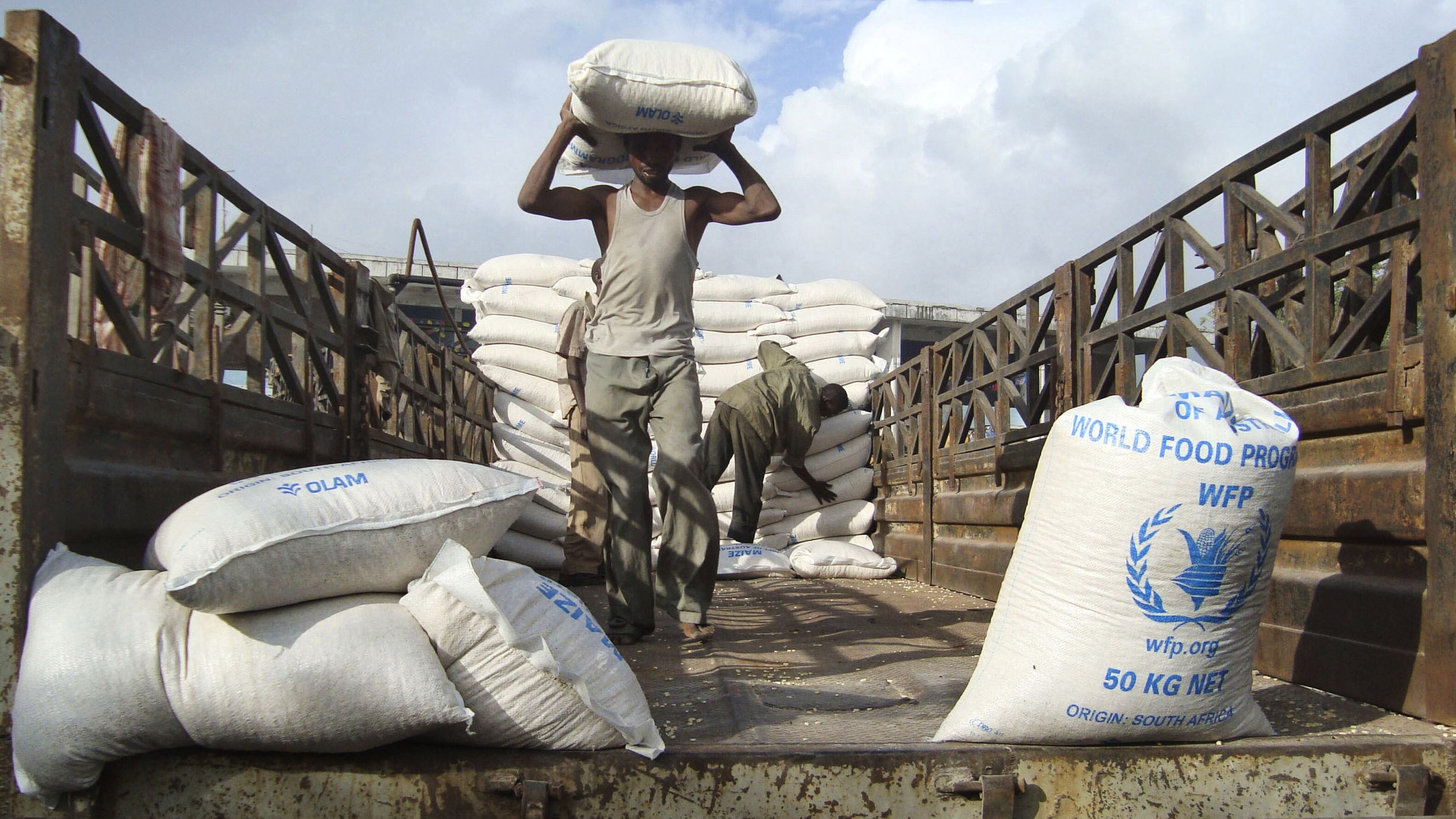
The World Food Program won the Nobel Peace Prize on Friday for its efforts to combat hunger in regions facing conflict and hardship and at a time when the coronavirus pandemic has driven millions more people to the brink of starvation.
The Rome-based United Nations agency has long specialized in getting assistance to some of the world’s most dangerous and precarious places, from air-dropping food in South Sudan and Syria to creating an emergency delivery service that kept aid flowing even as antivirus restrictions grounded commercial flights.
It provided assistance to almost 100 million people in 88 countries last year.
“With this year’s award, the (committee) wishes to turn the eyes of the world to the millions of people who suffer from or face the threat of hunger,” said Berit Reiss-Andersen, the chair of the Norwegian Nobel Committee, announcing the award in Oslo. “The World Food Program plays a key role in multilateral cooperation on making food security an instrument of peace.”
In honoring the U.N. food program, the Nobel peace committee was highlighting the need for global solidarity and multilateralism at a time of increasing polarization and go-it-alone nationalism.
The head of the organization said his entire team deserved the award.
“I know I’m not deserving of an award like this, but all the men and women around the world in the World Food Program and our partners who put their lives on the line every day,” David Beasley told The Associated Press by phone from Niger, where he was visiting Friday.
The organization has long been headed by an American, and U.S. President Donald Trump nominated the former Republican governor of South Carolina for the post in 2017.
WFP staffers in Niger greeted Beasley with cheers and applause as he emerged to address a crowd after the announcement. “Two things,” he told them. “I can’t believe I’m in Niger when we got the award, and No. 2, I didn’t win it, you won it.”
The Nobel Committee said that the problem of hunger has again become more acute in recent years, not least because the pandemic has added to the hardship already faced by millions of people around the world.
“In 2019, 135 million people suffered from acute hunger, the highest number in many years,” it said. “Most of the increase was caused by war and armed conflict. The coronavirus pandemic has contributed to a strong upsurge in the number of victims of hunger in the world.”
In total, WFP estimates that 690 million people suffer some form of hunger in the world today.
It was the ninth award for the U.N. or one of its agencies. Secretary-General Antonio Guterres said he was delighted the award went to “the world’s first responder on the frontlines of food insecurity.”
“In a world of plenty, it is unconscionable that hundreds of millions go to bed each night hungry," he said. "Millions more are now on the precipice of famine due to the COVID-19 pandemic."
The Nobel Committee called on governments to ensure that WFP and other aid organizations receive the financial support necessary to feed millions in countries such as Yemen, Congo, Nigeria, South Sudan and Burkina Faso.
A logistics juggernaut, WFP this year created a global emergency delivery service for humanitarian aid. Officials said the unprecedented effort involved nearly 130 countries and was key in ensuring that aid for the pandemic kept flowing in addition to other assistance, like the drugs and vaccines needed to combat other diseases. Its success was even more marked in a world where commercial air travel nearly ground to a halt.
There was no shortage of causes or candidates on this year’s list, with 211 individuals and 107 organizations nominated ahead of the Feb. 1 deadline.
The Norwegian Nobel Committee maintains absolute secrecy about whom it favors before the announcement of arguably the world’s most prestigious prize, but WFP had been on the shortlist of Dan Smith, the director of the Stockholm International Peace Research Institute
“The global problem of hunger is increasing and so is the global problem of violent conflict," Smith said. “The World Food Program works at the intersection of those two problems (and) it's going to face an increasing workload in the coming years."
The award comes with a gold medal and a 10-million krona ($1.1 million) cash prize that is dwarfed by the funding that WFP requires for its work. So far in 2020, the organization has received almost $6.4 billion in cash or goods, with more than a third, over $2.7 billion, coming from the United States.
Beasley's trip to Niger, where he has been meeting with leaders and visiting villages in the field, follows a three-day visit to neighboring Burkina Faso.
The Sahel region, a band south of the Sahara where both countries are located, is “under attack by extremists and climate extremes” and going through “a devastating” time, he said.
On Monday, the Nobel Committee awarded the prize for physiology and medicine for discovering the liver-ravaging hepatitis C virus. Tuesday’s prize for physics honored breakthroughs in understanding the mysteries of cosmic black holes, and the chemistry prize on Wednesday went to scientists behind a powerful gene-editing tool. The literature prize was awarded to American poet Louise Glück on Thursday for her “candid and uncompromising” work.
Still to come next week is the prize for outstanding work in the field of economics.
Jordans reported from Berlin. Associated Press journalists Karl Ritter, Nicole Winfield, Patricia Thomas in Rome, Vanessa Gera in Warsaw, Poland, Cara Anna in Johannesburg, and Jamey Keaten in Geneva contributed to this report.