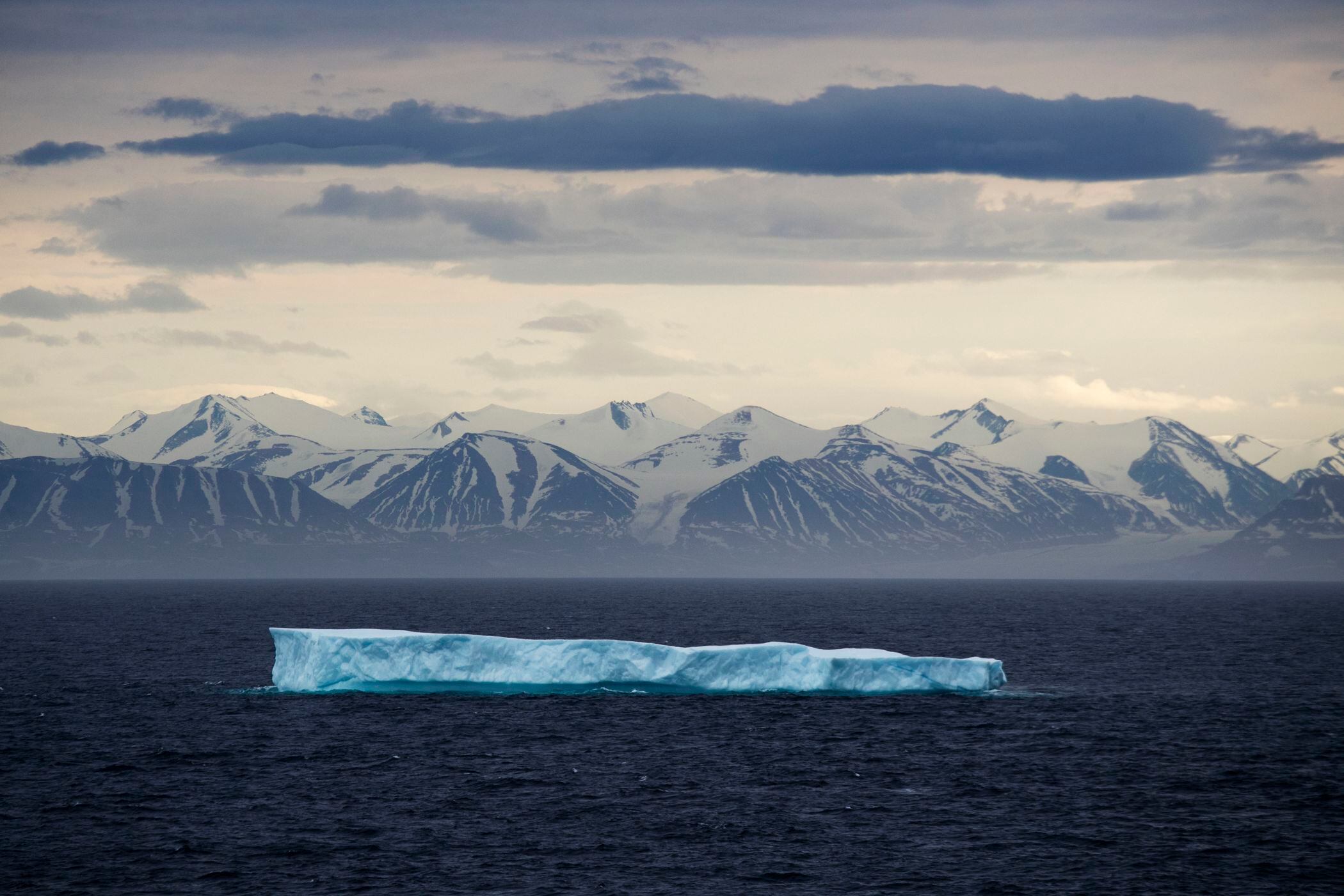
In this July 24, 2017 file photo, an iceberg floats past Bylot Island in the Canadian Arctic Archipelago. The National Oceanic and Atmospheric Administration’s annual Arctic Report Card, released on Tuesday, Dec. 8, 2020, shows how warming temperatures in the Arctic are transforming the region's geography and ecosystems. (AP Photo/David Goldman, File)
By Christina Larson
This year's vast wildfires in far northeastern Russia were linked to broader changes in a warming Arctic, according to a report Tuesday by the National Oceanic and Atmospheric Administration.
Wildfires are a natural part of many boreal ecosystems. But the extent of flames during the 2020 fire season was unprecedented in the 2001-2020 satellite record, and is consistent with the predicted effects of climate change, said Alison York, a University of Alaska Fairbanks fire scientist and a contributor to the annual Arctic Report Card.
The recent wildfires were exacerbated by elevated air temperatures and decreased snow cover on the ground in the Arctic region, the report found.
The past year — from October 2019 to September 2020 — was the second warmest on record in the Arctic, the report said. And the extent of snow on the ground in June across the Eurasian Arctic was the lowest recorded in 54 years.
Under those conditions, trees and plants “are just more flammable,” said York.
“The Arctic isn’t just this collection of components, it’s really an integrated system,” said Dartmouth sea ice scientist Don Perovich, who contributed to the report. "When something happens to one part of the system, it has cascading effects," he said.
Satellites recorded the second lowest extent of sea ice in September since record-keeping began 42 years ago, the report found.
Melting ice is both a result of increased temperatures and an accelerator of further changes, Perovich said. “As sea ice thins, more light can penetrate into the ocean, with unclear impacts for ecosystems,” he said.
As snow and ice cover decreases, the land and ocean surfaces also absorb more heat.
“Changes in the Arctic climate are important because the Arctic acts as a refrigerator for the rest of the world — it helps cool the planet,” said Lawrence Mudryk, a report contributor and a climate scientist at Environment and Climate Change Canada, a governmental research group.
“How much of the Arctic continues to be covered by snow and sea ice reflects part of how efficiently that refrigerator is working,” he said.
Last year's report included essays and research contributed by the Arctic's Indigenous communities for the first time. But in 2020, close collaboration between visiting scientists and Indigenous communities was not possible because of travel restrictions related to COVID-19.
Report contributor Matthew Druckenmiller, a climate scientist at the University of Colorado Boulder, said efforts to involve Indigenous communities would resume after the pandemic subsides.
The consequences of a warming Arctic are already felt far beyond the region.
“The Arctic continues to be a warning siren of how our Earth system is changing and it is important for policymakers and the public to understand that the impacts don’t stay in the Arctic with the polar bears,” said University of Georgia meteorology professor Marshall Shepherd, who was not involved in the report.
“We feel them, too, through changes in our weather patterns, sea level rise, and fisheries."
___
The Associated Press Health and Science Department receives support from the Howard Hughes Medical Institute’s Department of Science Education. The AP is solely responsible for all content.
Neil Young has come up with an ultimatum for Spotify: his music or Joe Rogan’s podcast. This comes over concerns that the podcast is spreading COVID-19 vaccine misinformation to its listeners. "The Joe Rogan Experience," which is exclusive to Spotify, is currently the number one streamed podcast on the platform.
Commercial and residential buildings account for 13% of carbon emissions in the U.S., according to the EPA, and one company says it has a solution. Runwise says it has updated the boiler and heating systems of thousands of buildings, and that its technology not only lowers carbon output but also saves landlords money. Lee Hoffman, Co-Founder and COO of Runwise, joined Cheddar Climate to discuss.
Jo Ruxton, Founder of Ocean Generation, joins Cheddar Climate, where she explains the threat that plastic pollution poses to marine life, but elaborates on why we shouldn't be looking to ban plastic entirely. Ruxton also discusses her biggest takeaways while producing the film ‘A Plastic Ocean.'
President Joe Biden's Build Back Better deal seems all but finished after months of Democratic infighting and the Senate's deadlock over certain provisions. But Biden mentioned during a press conference marking his first year in office that 'chunks' of the bill could be passed. Is that enough motivation to force Democrats to rally around certain parts of the bill - especially those that focus on climate and green energy? Andrew Freedman, Energy and Climate Reporter at Axios, joins Cheddar Climate to discuss whether Senate Democrats will be able to rally around climate provisions, if the idea of passing Build Back Better in 'chunks' is doable, and more.
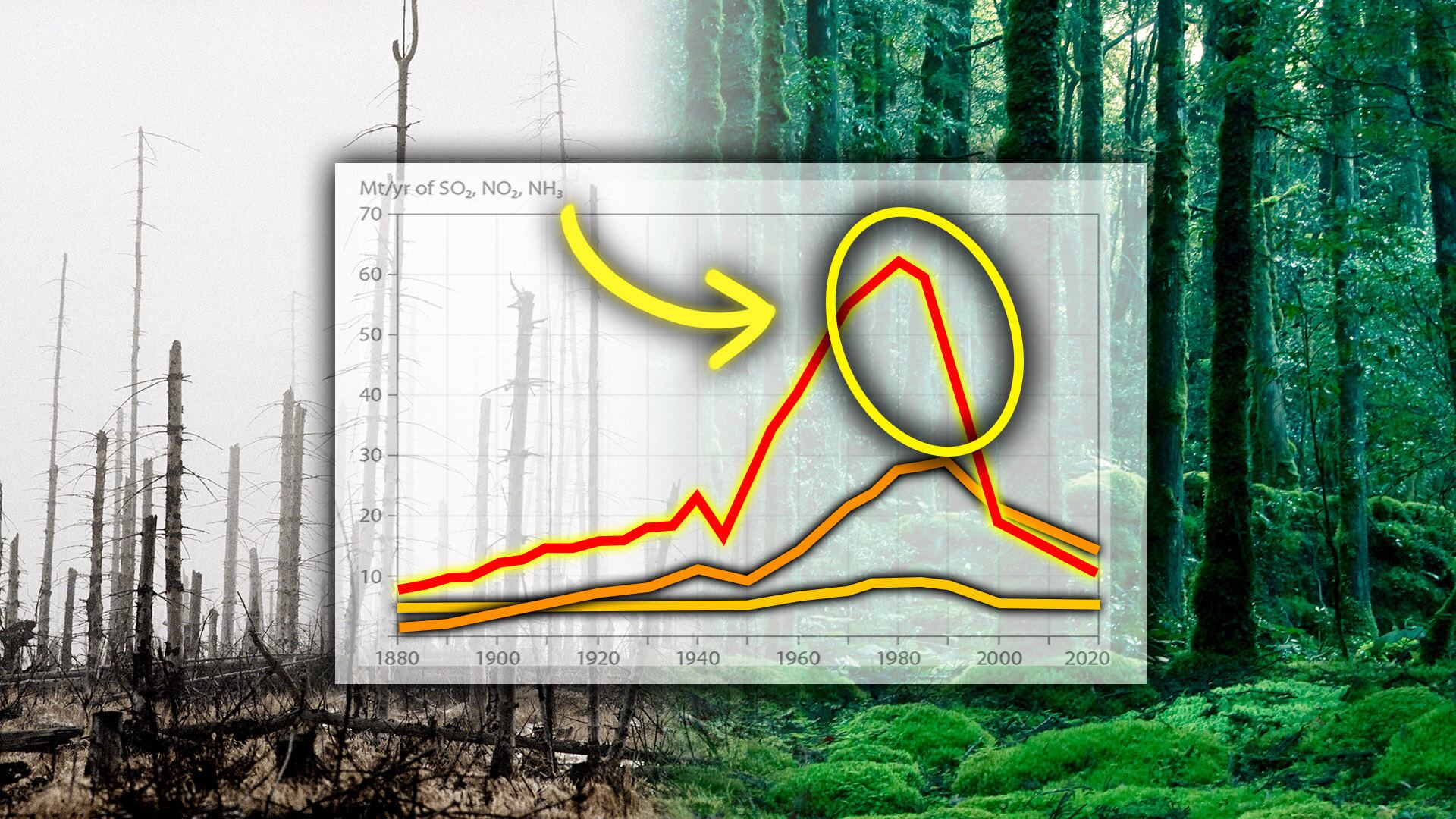
Anyone who remembers the 70s and 80s will probably remember acid rain. Industrial emissions acidified precipitation around the globe, which killed forests and crops, rendered lakes inhospitable, corroded buildings, and exacerbated human health problems.
But anyone who follows environmental news will be surprised to learn this: we solved it! Countries came together to limit acid rain-causing emissions, eliminating the problem altogether.
…kind of. Acidic precipitation may not be a thing of the past after all.
Natalie Ginsberg, Global Impact Officer, MAPS, joins Cheddar Reveals to discuss MAPS organization and its current initiatives and their work to get FDA approval for MDMA to treat PTSD.
Kelsey Ramsden, Co-Founder, President & CEO, Mind Cure Health, joins Cheddar Reveals to break down what 'psychedelic therapy' could look like once it's legalized and how Mind Cure Health is using AI to help treat everything from addiction to depression.
On this episode of Cheddar Reveals, Natalie Ginsberg, Global Impact Officer, MAPS, discusses the MAPS organization and its current initiatives and their work to get FDA approval for MDMA to treat PTSD; Kelsey Ramsden, Co-Founder, President & CEO, Mind Cure Health, breaks down what 'psychedelic therapy' could look like once it's legalized and how Mind Cure Health is using AI to help treat everything from addiction to depression; Cheddar gets a look at Curiosity Stream's 'Pain, Pus and Poison.'