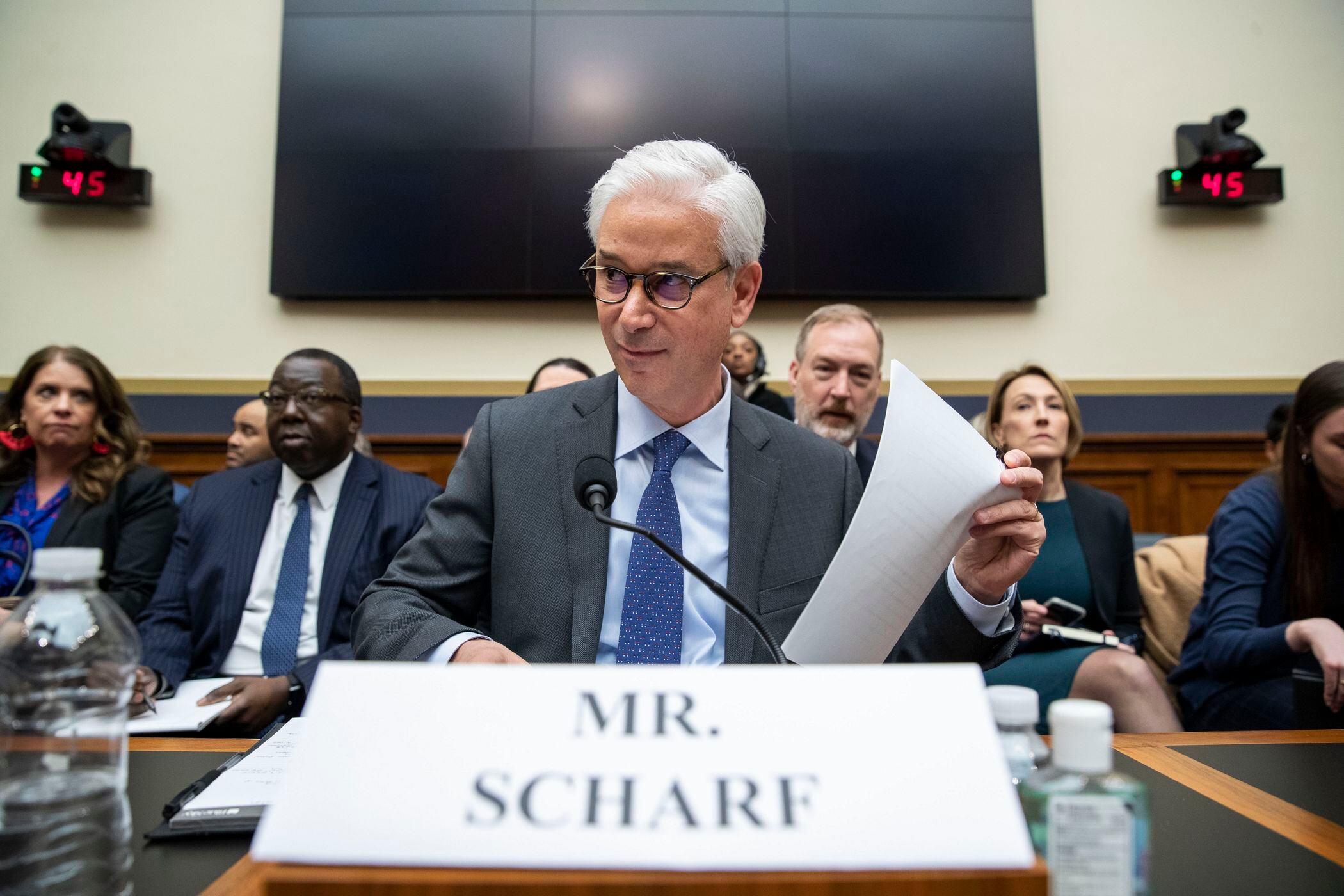
In this March 10, 2020 file photo, Wells Fargo CEO and President Charles Scharf is seated before he testifies during a hearing of the House Financial Services Committee, on Capitol Hill, in Washington. Scharf apologized Wednesday, Sept. 23 for comments he made that dismissed concerns that the banking industry, which has a long history of racist behavior, wasn’t doing enough to promote and retain diverse talent. (AP Photo/Alex Brandon, File)
By Ken Sweet
Wells Fargo CEO Charles Scharf apologized Wednesday for comments he made about the difficulty of finding qualified Black executives.
Scharf said that "there is a very limited pool of black talent to recruit from" in corporate America. The memo to employees was written in June but became public this week.
The comments and similar statements made in a Zoom meeting, reported by Reuters, led to an intense backlash in Washington and on social media.
"Perhaps it is the CEO of Wells Fargo who lacks the talent to recruit Black workers," said Rep. Alexandra Ocasio-Cortez of New York, on Twitter.
Scharf on Wednesday said in a prepared statement that his comments reflected "my own unconscious bias."
"There is no question Wells Fargo has to make meaningful progress to increase diverse representation," he wrote. Wells has pledged to increase the hiring of minority candidates, particularly through Black colleges and universities, as well as new anti-racism training programs at the bank.
American banking is dominated by leadership that is largely white and male. None of the six big Wall Street banks have ever had a Black or female CEO. Citigroup a few weeks ago announced it would promote a woman to CEO next year, the first on Wall Street to do so.
The last prominent African American to serve as CEO at a large financial services company was Kenneth Chenault, the former CEO of American Express. He retired in 2018. In an interview with The Associated Press at the time, Chenault called the lack of a pipeline to recruit and retain diverse talent "embarrassing" to the financial services industry.
Stanley O'Neal, the former CEO Merrill Lynch while it was still an independent company, is also Black. He resigned in 2007 during the firm's collapse.
CEOs of the top U.S. airlines are set to testify in front of a Senate committee Wednesday. Lawmakers will ask airline executives about how they used pandemic-related federal aid, specifically in light of staffing issues and widespread cancellations. Among those expected to participate are the CEOs of American, United, and Southwest Airlines. David Slotnick, Senior Aviation Business Reporter at The Points Guy, joined Cheddar News to discuss.
If 2021 is any indication, 2022 will be a big year for social media. TikTok reached 1 billion users this year and is expected to grow even bigger. We got our first look at the Metaverse, NFTs soared in popularity, and the crypto craze starting hitting its stride - just to name a few fads. Mark Douglas, CEO and Founder of MNTN, joined Cheddar to discuss if these trends could continue, or if we'll see some surprises in the year ahead.
2021 was a big year for big tech, but it was also a wake-up call for the government. Lawmakers are still struggling to figure out how to regulate big tech companies as they grow bigger and get even more powerful. Evan Greer, director of the digital rights organization Fight for the Future, joined Cheddar to discuss key takeaways from the year, as well as what we can expect for big tech and regulation in 2022.
Bumble users are remaining active on the dating app and still linking up with potential matches despite the emergence of the omicron variant of COVID-19. CEO Whitney Wolfe Herd noted that no matter what is happening in the world, people will always need to connect.
Lovesac Founder & CEO Shawn Nelson joined Wake Up With Cheddar to discuss the company's Q3 earnings report and what the future holds, as it continues to combine advanced technology with practical designs.
Google reportedly has announced that its employees must declare their vaccination status by January 18 or face a loss of pay, administrative leave, and eventual termination.
Roger Park, EY Americas Innovation Officer, joins Cheddar to discuss what factors are shaping the future of innovation, the top areas companies are investing in, and what it means to build a culture of innovation.
Carlo and Baker cover the latest data showing the Omicron wave has likely started, Pfizer's Covid pill, Jan. 6 and a box office rescue attempt courtesy of Spider-Man.