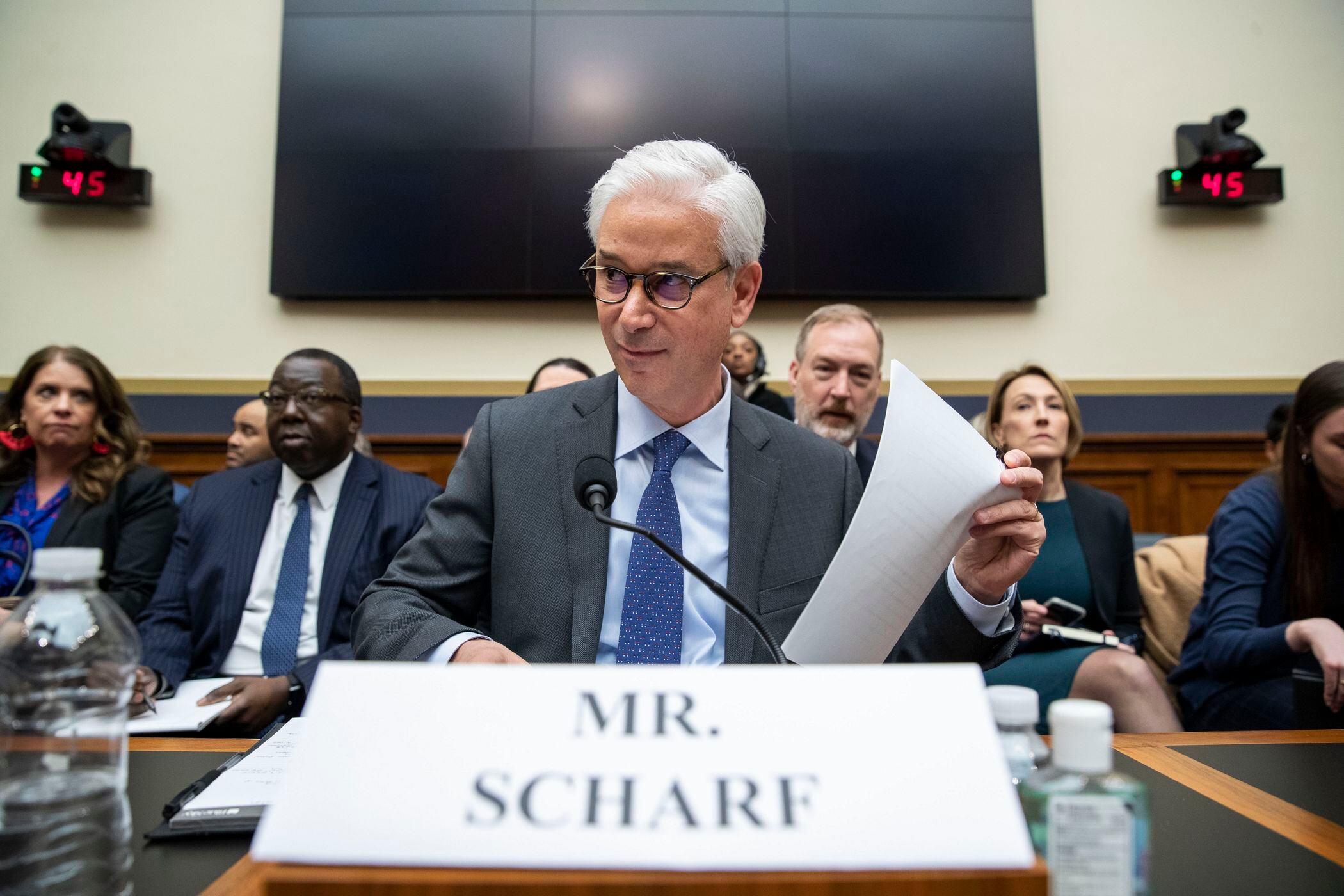
In this March 10, 2020 file photo, Wells Fargo CEO and President Charles Scharf is seated before he testifies during a hearing of the House Financial Services Committee, on Capitol Hill, in Washington. Scharf apologized Wednesday, Sept. 23 for comments he made that dismissed concerns that the banking industry, which has a long history of racist behavior, wasn’t doing enough to promote and retain diverse talent. (AP Photo/Alex Brandon, File)
By Ken Sweet
Wells Fargo CEO Charles Scharf apologized Wednesday for comments he made about the difficulty of finding qualified Black executives.
Scharf said that "there is a very limited pool of black talent to recruit from" in corporate America. The memo to employees was written in June but became public this week.
The comments and similar statements made in a Zoom meeting, reported by Reuters, led to an intense backlash in Washington and on social media.
"Perhaps it is the CEO of Wells Fargo who lacks the talent to recruit Black workers," said Rep. Alexandra Ocasio-Cortez of New York, on Twitter.
Scharf on Wednesday said in a prepared statement that his comments reflected "my own unconscious bias."
"There is no question Wells Fargo has to make meaningful progress to increase diverse representation," he wrote. Wells has pledged to increase the hiring of minority candidates, particularly through Black colleges and universities, as well as new anti-racism training programs at the bank.
American banking is dominated by leadership that is largely white and male. None of the six big Wall Street banks have ever had a Black or female CEO. Citigroup a few weeks ago announced it would promote a woman to CEO next year, the first on Wall Street to do so.
The last prominent African American to serve as CEO at a large financial services company was Kenneth Chenault, the former CEO of American Express. He retired in 2018. In an interview with The Associated Press at the time, Chenault called the lack of a pipeline to recruit and retain diverse talent "embarrassing" to the financial services industry.
Stanley O'Neal, the former CEO Merrill Lynch while it was still an independent company, is also Black. He resigned in 2007 during the firm's collapse.
Electric vehicles are quickly becoming an accessible way for consumers to slash emissions as legacy automakers begin to electrify their fleets and world leaders including President Joe Biden push for broad EV adoption. But consumers have concerns about EV range, the availability of charging stations, and more. What if it were both helpful to consumers — and feasible from a climate change standpoint — to keep hybrid models that run on gas on the market? Gill Pratt, CEO of the Toyota Research Institute & Toyota Motor Corporation's Chief Scientist joins Cheddar Climate to discuss his team's research about 'carbon return on investment,' how Toyota is electrifying its fleet, and more.
Fresh off of a $42 million Series B Fundraise, co-founder and CEO of Chapter, Cobi Blumenfeld-Gantz, joined Cheddar to discuss the company's business model and how it will use the capital going forward. He explained that Chapter is a Medicare advisor that searches savings on medical options in order to help users find the right plan for them. "We want to make sure we can help all of our existing members and as many new Americans find the right Medicare coverage, so we're hiring aggressively for the best talent we can," Blumenfeld-Gantz said.
Apple's iMessage has come under fire after a Google executive accused the fellow tech giant of bullying — Android Users. Hiroshi Lockheimer, Google SVP of Android, said that Apple's lack of RCS adoption is holding the industry back while the company uses peer pressure to bolster iMessage.
Fresh off of receiving an innovation award at ShowStoppers @ CES 2022, Iasha King, co-founder of SOLO Secure joined Cheddar to explain how its platforms, the GoSOLO app and the SOLO Backpackpacker device, helps improve personal safety for users. "People just don't know what's going on around them, so it's very important that you're using smart technology to provide them with what's going on," she said. "For example, if there has been an increase in robberies in a neighborhood, that's something that our technology would inform a user."
The Department of Treasury is warning Americans to expect delays on their tax returns this year as the IRS manages staffing shortages due to the pandemic.
Ellen Fitzsimmons-Craft, assistant professor of psychiatry at Washington University School of Medicine, joins Cheddar News to discuss how chatbots can help prevent eating disorders and the research that uncovered these findings.