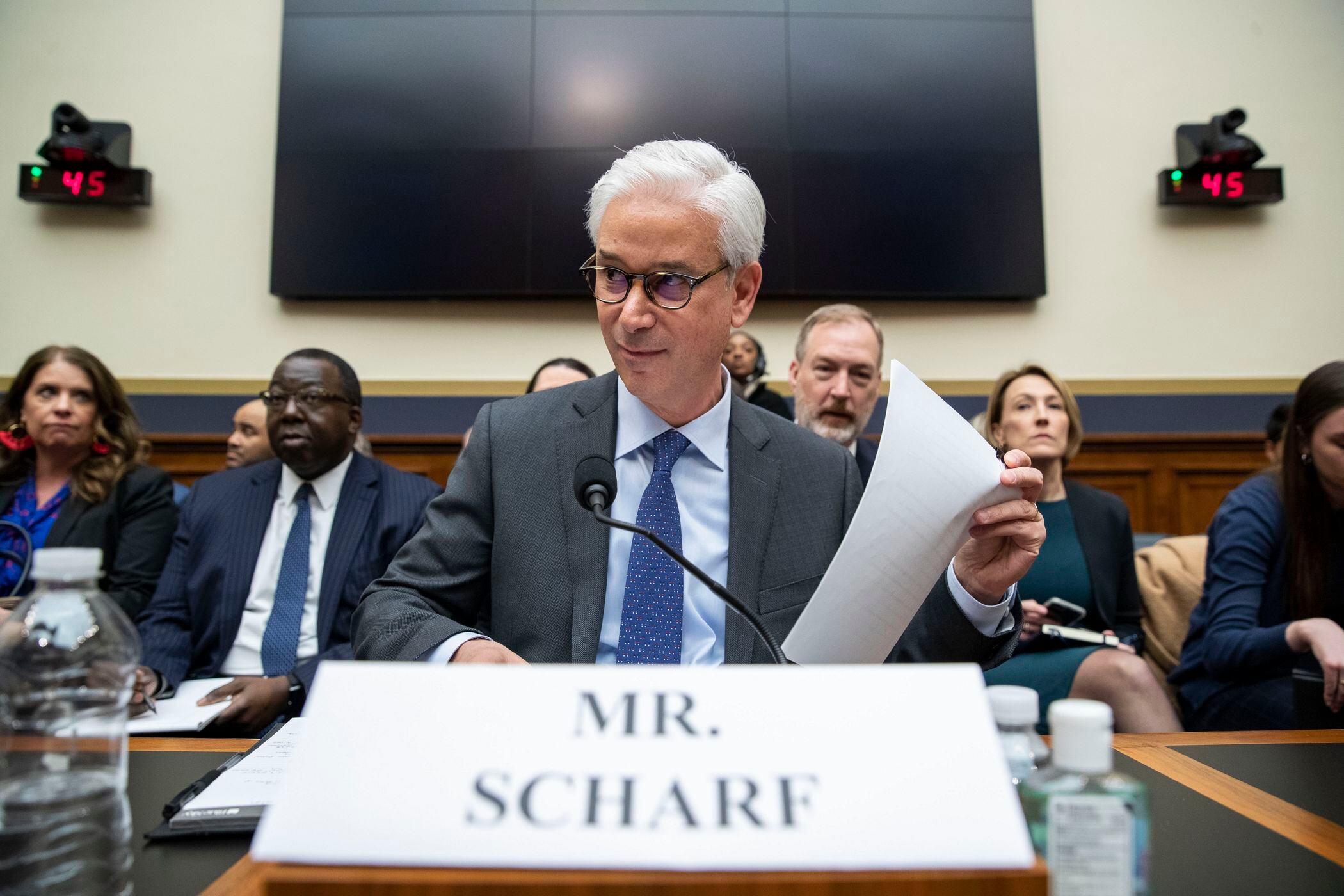
In this March 10, 2020 file photo, Wells Fargo CEO and President Charles Scharf is seated before he testifies during a hearing of the House Financial Services Committee, on Capitol Hill, in Washington. Scharf apologized Wednesday, Sept. 23 for comments he made that dismissed concerns that the banking industry, which has a long history of racist behavior, wasn’t doing enough to promote and retain diverse talent. (AP Photo/Alex Brandon, File)
By Ken Sweet
Wells Fargo CEO Charles Scharf apologized Wednesday for comments he made about the difficulty of finding qualified Black executives.
Scharf said that "there is a very limited pool of black talent to recruit from" in corporate America. The memo to employees was written in June but became public this week.
The comments and similar statements made in a Zoom meeting, reported by Reuters, led to an intense backlash in Washington and on social media.
"Perhaps it is the CEO of Wells Fargo who lacks the talent to recruit Black workers," said Rep. Alexandra Ocasio-Cortez of New York, on Twitter.
Scharf on Wednesday said in a prepared statement that his comments reflected "my own unconscious bias."
"There is no question Wells Fargo has to make meaningful progress to increase diverse representation," he wrote. Wells has pledged to increase the hiring of minority candidates, particularly through Black colleges and universities, as well as new anti-racism training programs at the bank.
American banking is dominated by leadership that is largely white and male. None of the six big Wall Street banks have ever had a Black or female CEO. Citigroup a few weeks ago announced it would promote a woman to CEO next year, the first on Wall Street to do so.
The last prominent African American to serve as CEO at a large financial services company was Kenneth Chenault, the former CEO of American Express. He retired in 2018. In an interview with The Associated Press at the time, Chenault called the lack of a pipeline to recruit and retain diverse talent "embarrassing" to the financial services industry.
Stanley O'Neal, the former CEO Merrill Lynch while it was still an independent company, is also Black. He resigned in 2007 during the firm's collapse.
Fundrise is an investment platform that allows its users to access a diversified portfolio of real estate investments. The company found more than 70 percent of 1,000 Gen Z and Millenial investors surveyed were concerned about inflation and 66 percent were putting their money in real estate, venture capital, and crypto as a safety net. Ben Miller, CEO and co-founder of Fundrise, joined Cheddar to talk about providing retail investors access to the previously difficult-to-access private real estate markets. "I think there's there's an understanding in society that real estate is where you go when there's high inflation," Miller said.
In January alone, the gaming sector has seen three major acquisitions. Yesterday, Sony added to the flurry of M&A activity in the gaming space, snatching up game developer 'Bungie' for $3.6 billion dollars. Renee Gittins, executive director at the International Gaming Developers Association, joins Cheddar News to discuss.
General Motors reported its Q4 earnings Tuesday. While chip shortages impacted sales and revenue last quarter, Paul Jacobson, GM Chief Financial Officer, told Cheddar chip availability has gotten better since Q3. This is crucial as GM has pivoted its focus toward electric vehicles. It recently announced it will be building a new battery plant in Michigan, making $35 billion in EV investments, and producing a million electric vehicles by 2025.
Google’s philanthropy arm, Google.org, recently announced a $10 million grant for the AARP Foundation to aid in teaching digital skills to low income older workers. As the implementation of hybrid work expands, a greater emphasis is being placed on helping workers 50 years old and up — especially among women and people of color — to be digitally literate in order to keep the workplace generationally diverse. Lisa Marsh Ryerson, president of the AARP Foundation, joined Cheddar News to talk about the curriculum of the partnership. "Those of us who are 50 and older are not digital natives, so we do have a learning curve that we have to address," she noted.