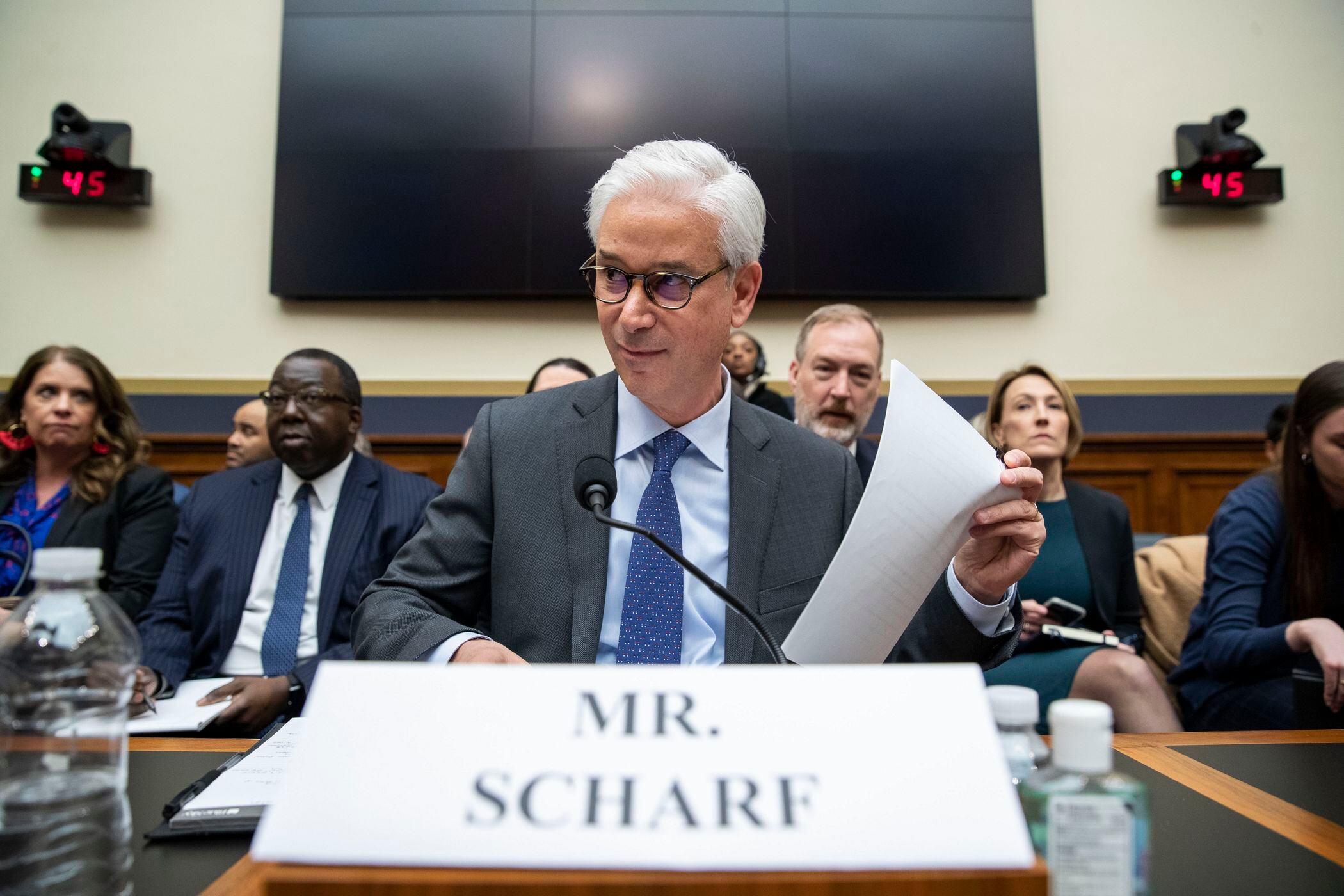
In this March 10, 2020 file photo, Wells Fargo CEO and President Charles Scharf is seated before he testifies during a hearing of the House Financial Services Committee, on Capitol Hill, in Washington. Scharf apologized Wednesday, Sept. 23 for comments he made that dismissed concerns that the banking industry, which has a long history of racist behavior, wasn’t doing enough to promote and retain diverse talent. (AP Photo/Alex Brandon, File)
By Ken Sweet
Wells Fargo CEO Charles Scharf apologized Wednesday for comments he made about the difficulty of finding qualified Black executives.
Scharf said that "there is a very limited pool of black talent to recruit from" in corporate America. The memo to employees was written in June but became public this week.
The comments and similar statements made in a Zoom meeting, reported by Reuters, led to an intense backlash in Washington and on social media.
"Perhaps it is the CEO of Wells Fargo who lacks the talent to recruit Black workers," said Rep. Alexandra Ocasio-Cortez of New York, on Twitter.
Scharf on Wednesday said in a prepared statement that his comments reflected "my own unconscious bias."
"There is no question Wells Fargo has to make meaningful progress to increase diverse representation," he wrote. Wells has pledged to increase the hiring of minority candidates, particularly through Black colleges and universities, as well as new anti-racism training programs at the bank.
American banking is dominated by leadership that is largely white and male. None of the six big Wall Street banks have ever had a Black or female CEO. Citigroup a few weeks ago announced it would promote a woman to CEO next year, the first on Wall Street to do so.
The last prominent African American to serve as CEO at a large financial services company was Kenneth Chenault, the former CEO of American Express. He retired in 2018. In an interview with The Associated Press at the time, Chenault called the lack of a pipeline to recruit and retain diverse talent "embarrassing" to the financial services industry.
Stanley O'Neal, the former CEO Merrill Lynch while it was still an independent company, is also Black. He resigned in 2007 during the firm's collapse.
Aidan McClean, co-founder and CEO of UFODRIVE, joined Cheddar News to discuss how his company plans to shake up the car rental market with a digital experience. "There are no lines, there are no paperwork, there is no key collection ... no pushy insurance or pushy fuel options," he said. "You simply arrive for your electric car, use your smartphone and drive away."
Nearly half of Americans report having to side hustle to make ends meet, according to a survey from LendingTree. Jane Oates, president of WorkingNation, joined Cheddar News to discuss the state of play as families are having a difficult time with inflation and high-interest rates.
Melissa Armo, founder and owner of The Stock Swoosh, joined Cheddar News to discuss this week's markets which were little changed in trading as investors digested the latest corporate earnings results as concerns over a coming recession grow.
Peter Krull, a partner and director of sustainable investing at Prime Capital Investment Advisors company Earth Equity Advisors, joined Cheddar News to give some tips on green investments.
Investment in space was down 53% over the first three months of the year, according to a report from investment fund Space Capital. Chad Anderson, founder and managing partners of Space Capital, joined Cheddar News to discuss the funding downturn that's hit the lowest level in 14 quarters for the space industry.
The Week's Top Stories is a guided tour through the biggest market stories of the week, from winning stocks to brutal dips to the facts and forecasts generating buzz on Wall Street.
Pulitzer Prize winning digital media outlet BuzzFeed News is being shut down as part of a cost-cutting drive by its corporate parent that’s shedding about 15% of its entire staff, adding to layoffs made earlier this year.