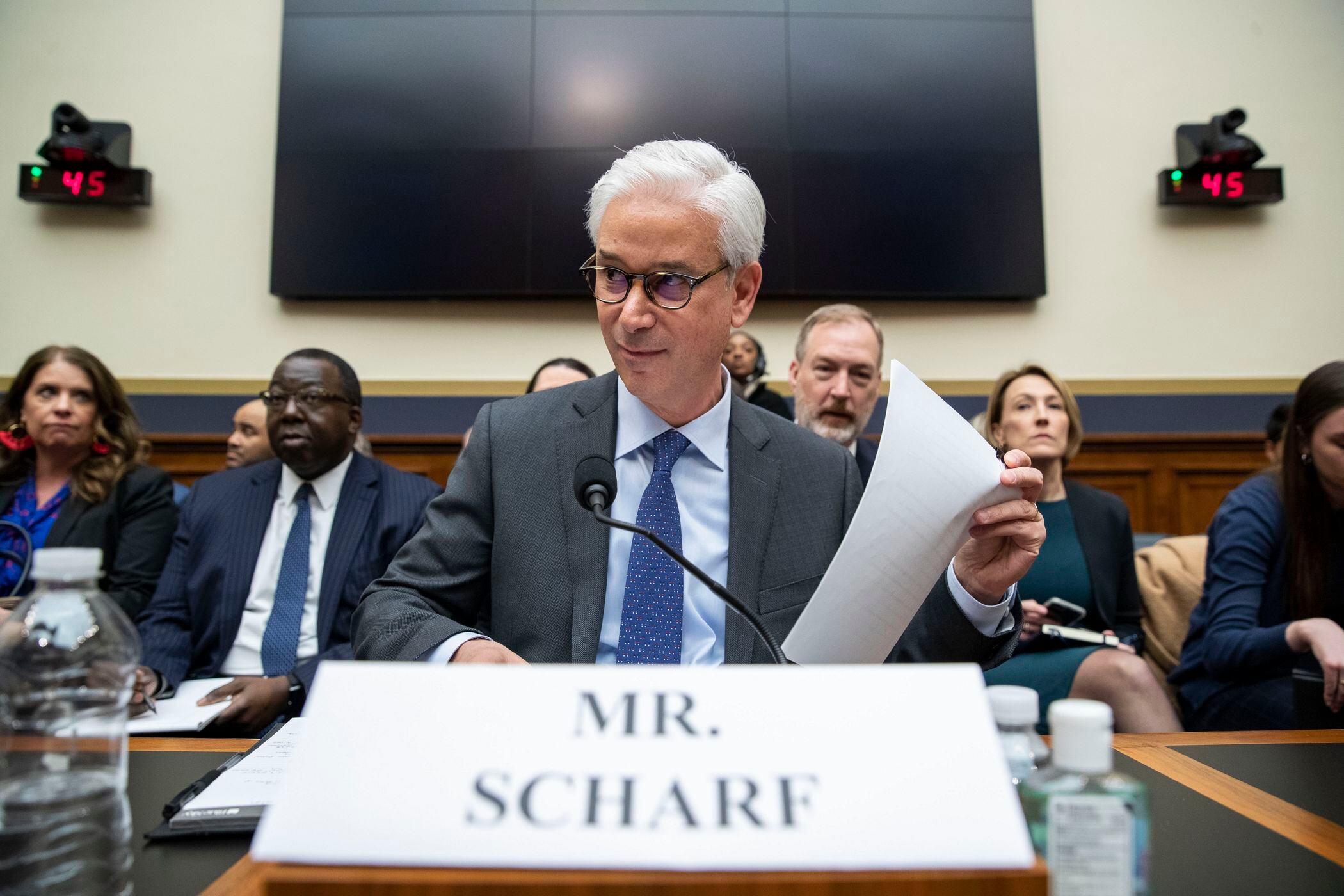
In this March 10, 2020 file photo, Wells Fargo CEO and President Charles Scharf is seated before he testifies during a hearing of the House Financial Services Committee, on Capitol Hill, in Washington. Scharf apologized Wednesday, Sept. 23 for comments he made that dismissed concerns that the banking industry, which has a long history of racist behavior, wasn’t doing enough to promote and retain diverse talent. (AP Photo/Alex Brandon, File)
By Ken Sweet
Wells Fargo CEO Charles Scharf apologized Wednesday for comments he made about the difficulty of finding qualified Black executives.
Scharf said that "there is a very limited pool of black talent to recruit from" in corporate America. The memo to employees was written in June but became public this week.
The comments and similar statements made in a Zoom meeting, reported by Reuters, led to an intense backlash in Washington and on social media.
"Perhaps it is the CEO of Wells Fargo who lacks the talent to recruit Black workers," said Rep. Alexandra Ocasio-Cortez of New York, on Twitter.
Scharf on Wednesday said in a prepared statement that his comments reflected "my own unconscious bias."
"There is no question Wells Fargo has to make meaningful progress to increase diverse representation," he wrote. Wells has pledged to increase the hiring of minority candidates, particularly through Black colleges and universities, as well as new anti-racism training programs at the bank.
American banking is dominated by leadership that is largely white and male. None of the six big Wall Street banks have ever had a Black or female CEO. Citigroup a few weeks ago announced it would promote a woman to CEO next year, the first on Wall Street to do so.
The last prominent African American to serve as CEO at a large financial services company was Kenneth Chenault, the former CEO of American Express. He retired in 2018. In an interview with The Associated Press at the time, Chenault called the lack of a pipeline to recruit and retain diverse talent "embarrassing" to the financial services industry.
Stanley O'Neal, the former CEO Merrill Lynch while it was still an independent company, is also Black. He resigned in 2007 during the firm's collapse.
Danny Taing, founder and CEO of Bokksu, joined Cheddar News to discuss his path on how he became an entrepreneur to launch a company that delivers artisanal Japanese snacks. "When I moved back from Japan to New York, I had this bit of reverse culture shock ... a lot of people had somewhat of a one-dimensional view of Japan ... they saw this country where people ate sushi every day ... none of that is true," he said.
Will Rhind, CEO of GraniteShares, joined Cheddar News to discuss Thursday's trading session amid renewed fears over the regional banking crisis as well as concerns over the debt ceiling debate.
The United Food and Commercial Workers union, one of the country's largest, opposed the planned merger between grocery chains Kroger and Albertson's, according to The Wall Street Journal, citing concerns about lack of information and the potential viability of stores upon closing.
Johnson & Johnson's consumer-health unit Kenvue made its debut on the New York Stock Exchange and jumped about 20% on Thursday. Thibaut Mongon, CEO of Kenvue, joined Cheddar News to discuss business growth goals and what lies ahead for its well-known pipeline of products, including Band-Aid, Neutrogena, Tylenol, among others.
Cheddar News' reporter Angela Miles reports from the Cboe floor with Scott Bauer, CEO of the Prosper Trading Academy, to break down Apple, Moderna, and Datadog earnings for options traders.