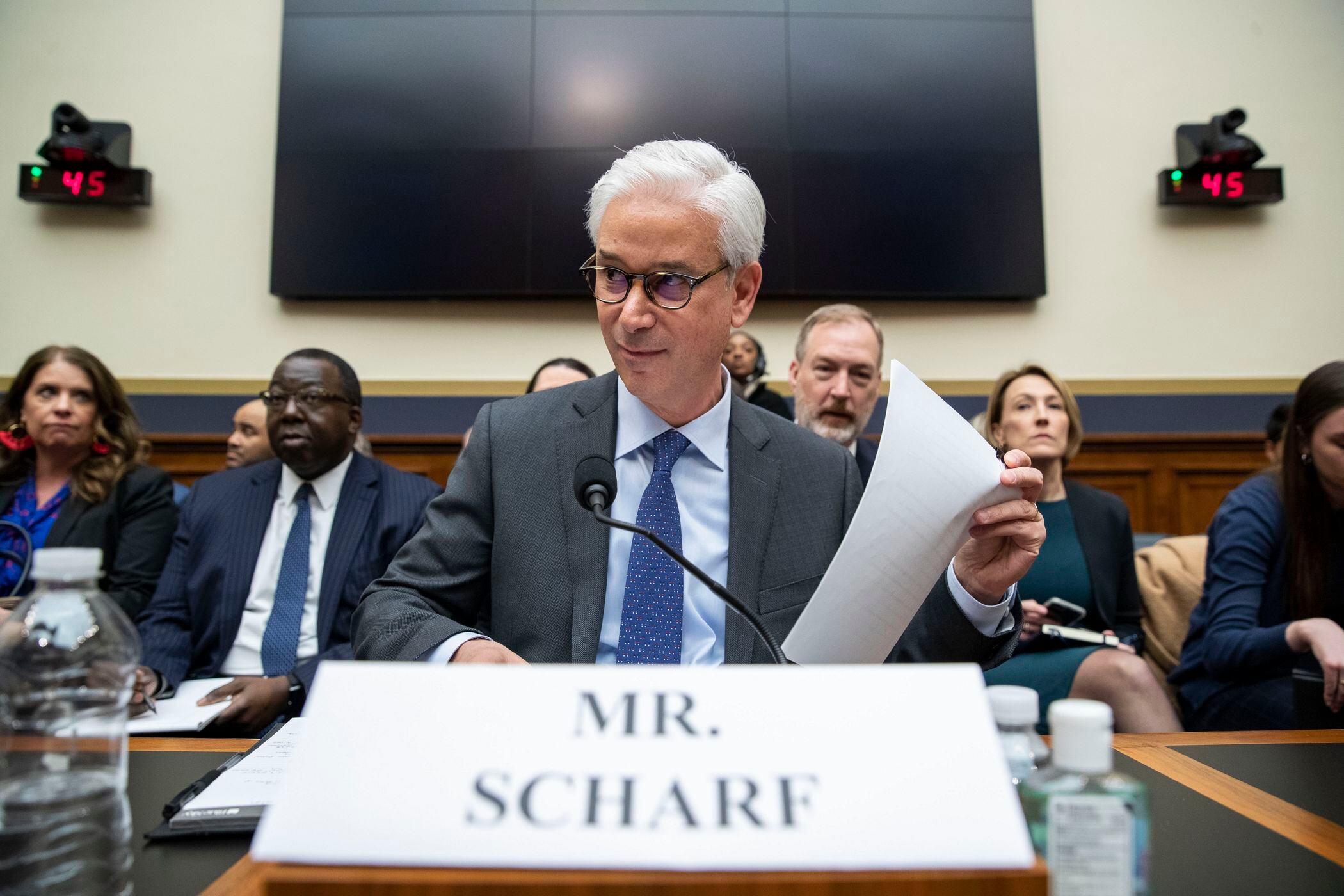
In this March 10, 2020 file photo, Wells Fargo CEO and President Charles Scharf is seated before he testifies during a hearing of the House Financial Services Committee, on Capitol Hill, in Washington. Scharf apologized Wednesday, Sept. 23 for comments he made that dismissed concerns that the banking industry, which has a long history of racist behavior, wasn’t doing enough to promote and retain diverse talent. (AP Photo/Alex Brandon, File)
By Ken Sweet
Wells Fargo CEO Charles Scharf apologized Wednesday for comments he made about the difficulty of finding qualified Black executives.
Scharf said that "there is a very limited pool of black talent to recruit from" in corporate America. The memo to employees was written in June but became public this week.
The comments and similar statements made in a Zoom meeting, reported by Reuters, led to an intense backlash in Washington and on social media.
"Perhaps it is the CEO of Wells Fargo who lacks the talent to recruit Black workers," said Rep. Alexandra Ocasio-Cortez of New York, on Twitter.
Scharf on Wednesday said in a prepared statement that his comments reflected "my own unconscious bias."
"There is no question Wells Fargo has to make meaningful progress to increase diverse representation," he wrote. Wells has pledged to increase the hiring of minority candidates, particularly through Black colleges and universities, as well as new anti-racism training programs at the bank.
American banking is dominated by leadership that is largely white and male. None of the six big Wall Street banks have ever had a Black or female CEO. Citigroup a few weeks ago announced it would promote a woman to CEO next year, the first on Wall Street to do so.
The last prominent African American to serve as CEO at a large financial services company was Kenneth Chenault, the former CEO of American Express. He retired in 2018. In an interview with The Associated Press at the time, Chenault called the lack of a pipeline to recruit and retain diverse talent "embarrassing" to the financial services industry.
Stanley O'Neal, the former CEO Merrill Lynch while it was still an independent company, is also Black. He resigned in 2007 during the firm's collapse.
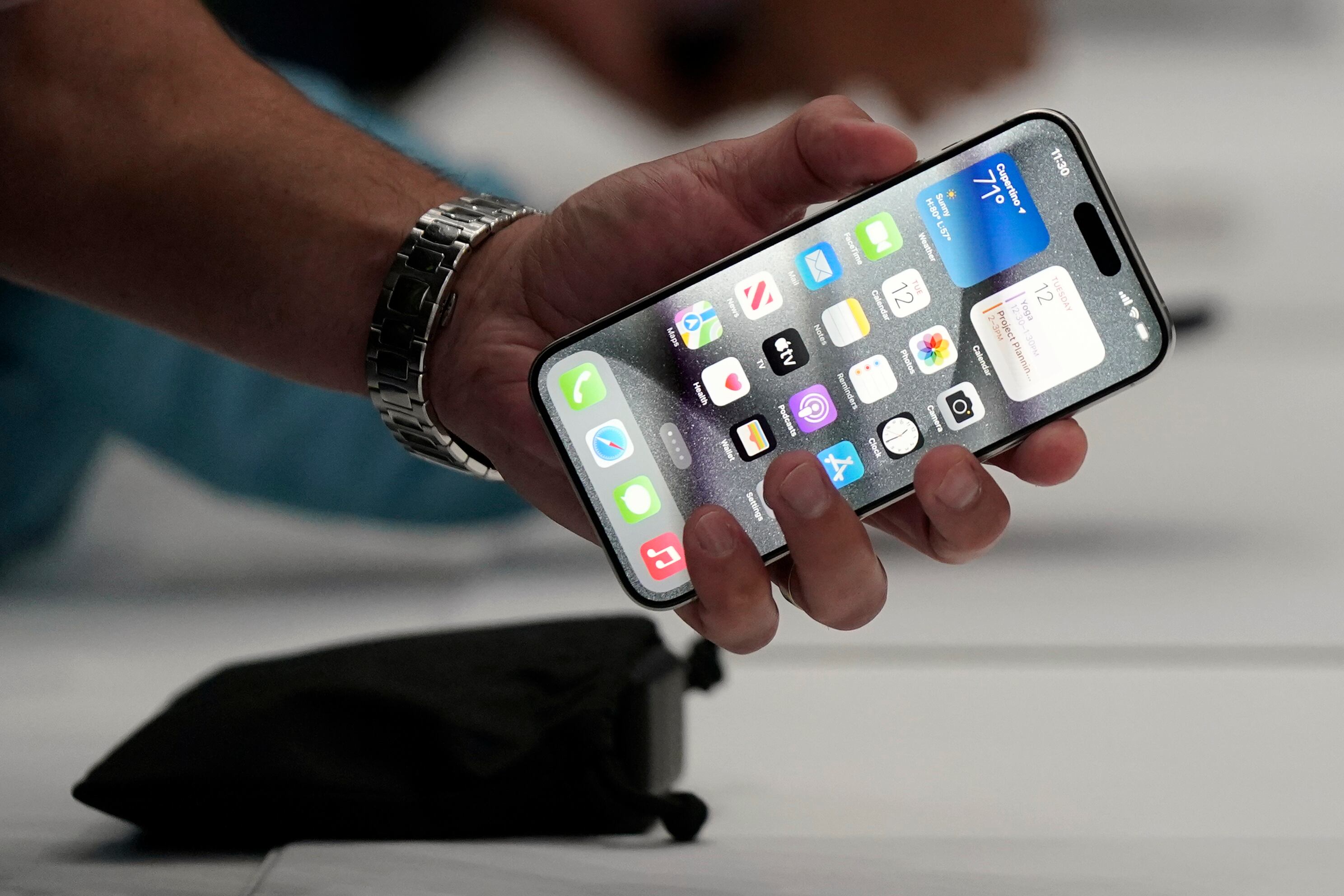
Apple has rolled out an update to its operating system this week with a feature called Stolen Device Protection. It makes it a lot harder for phone thieves to access key functions and settings, and users are being urged to turn it on immediately.
The U.S. economy grew at an unexpectedly brisk 3.3% annual pace from October through December as Americans showed a continued willingness to spend freely despite high interest rates and frustrating price levels.
Alan Becker, CEO and Investment Adviser Representative at Retirement Solutions Group and RSG Investments, shares his thoughts on the latest GDP data plus why he's not sold cryptocurrency as a long-term asset.
The Biden administration wants to ban another type of bank “junk fee," targeting fees that are typically charged by banks when a transaction is declined in real time.
Al Root, senior writer at Barron’s, breaks down everything expected from Tesla’s earnings report, from Elon Musk’s demands from the board to why the market has been looking for affordable EV options.
Online retailer eBay Inc. will cut about 1,000 jobs, or an estimated 9% of its full-time workforce. The announcement follows similar moves by other tech companies that ramped up hiring during the pandemic while people spent more time and money online.
Tony Drake, CFP at Drake and Associates, LLC shares thoughts on whether the record gains in technology will broaden to other sectors, the risks of the Fed keeping interest rates higher for too long, and the health of the U.S. consumer.