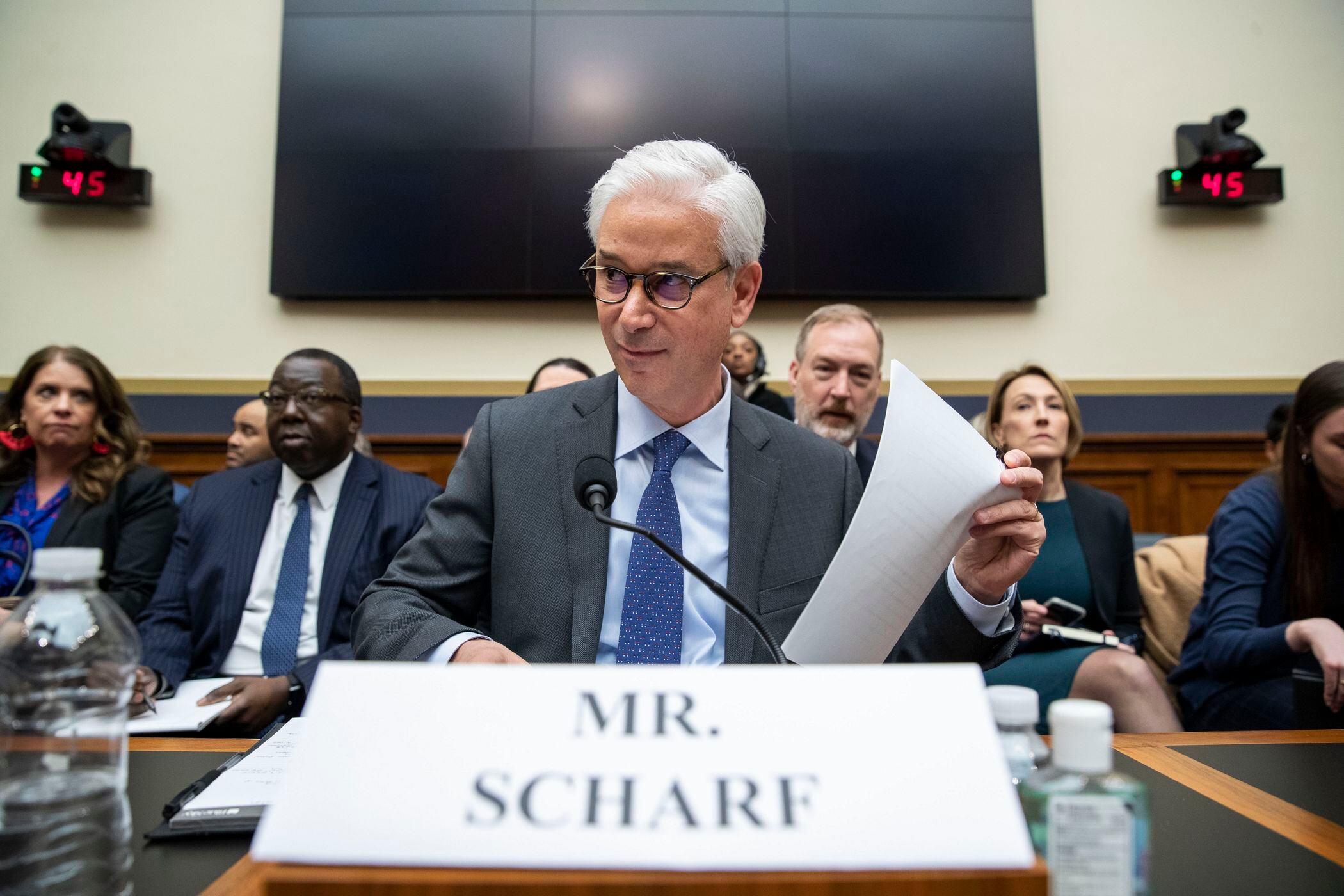
In this March 10, 2020 file photo, Wells Fargo CEO and President Charles Scharf is seated before he testifies during a hearing of the House Financial Services Committee, on Capitol Hill, in Washington. Scharf apologized Wednesday, Sept. 23 for comments he made that dismissed concerns that the banking industry, which has a long history of racist behavior, wasn’t doing enough to promote and retain diverse talent. (AP Photo/Alex Brandon, File)
By Ken Sweet
Wells Fargo CEO Charles Scharf apologized Wednesday for comments he made about the difficulty of finding qualified Black executives.
Scharf said that "there is a very limited pool of black talent to recruit from" in corporate America. The memo to employees was written in June but became public this week.
The comments and similar statements made in a Zoom meeting, reported by Reuters, led to an intense backlash in Washington and on social media.
"Perhaps it is the CEO of Wells Fargo who lacks the talent to recruit Black workers," said Rep. Alexandra Ocasio-Cortez of New York, on Twitter.
Scharf on Wednesday said in a prepared statement that his comments reflected "my own unconscious bias."
"There is no question Wells Fargo has to make meaningful progress to increase diverse representation," he wrote. Wells has pledged to increase the hiring of minority candidates, particularly through Black colleges and universities, as well as new anti-racism training programs at the bank.
American banking is dominated by leadership that is largely white and male. None of the six big Wall Street banks have ever had a Black or female CEO. Citigroup a few weeks ago announced it would promote a woman to CEO next year, the first on Wall Street to do so.
The last prominent African American to serve as CEO at a large financial services company was Kenneth Chenault, the former CEO of American Express. He retired in 2018. In an interview with The Associated Press at the time, Chenault called the lack of a pipeline to recruit and retain diverse talent "embarrassing" to the financial services industry.
Stanley O'Neal, the former CEO Merrill Lynch while it was still an independent company, is also Black. He resigned in 2007 during the firm's collapse.

Just days before the 49ers and Chiefs play in Las Vegas, Joe Pompliano, Investor at Pomp Investments and author of the Huddle Up Newsletter, discusses why he thinks this could be the most-watched Super Bowl in history.
Chris Versace of Tematica Research LLC shares his thoughts on Jerome Powell's latest comments, the timing of those crucial rate cuts, and what semiconductor stocks he's watching closely.
We battle an onslaught of advertising every time we scroll through social media. Deinfluencers propose a less pricey, more honest approach to how we shop online. Could they convince us to spend less?
Scott Gutz, CEO of Monster.com breaks down the company’s Work Watch Report for 2024, including what’s motivating workers to look for new positions and why they should see A.I. as an opportunity.
Tom Graff, Chief Investment Officer, Facet, discusses what the latest jobs report says about this ‘pretty good’ labor market and why the market should worry less about the Fed’s next decision.
Universal Music Group, which represents artists including Taylor Swift, Drake, and Ariana Grande, has removed its music from TikTok and accused the app of bullying and intimidation.
The average rate on a 30-year mortgage fell 0.06% last week. Although the rate is much higher than it was two years ago, the decline could relieve buyers already dealing with low inventory and high prices.