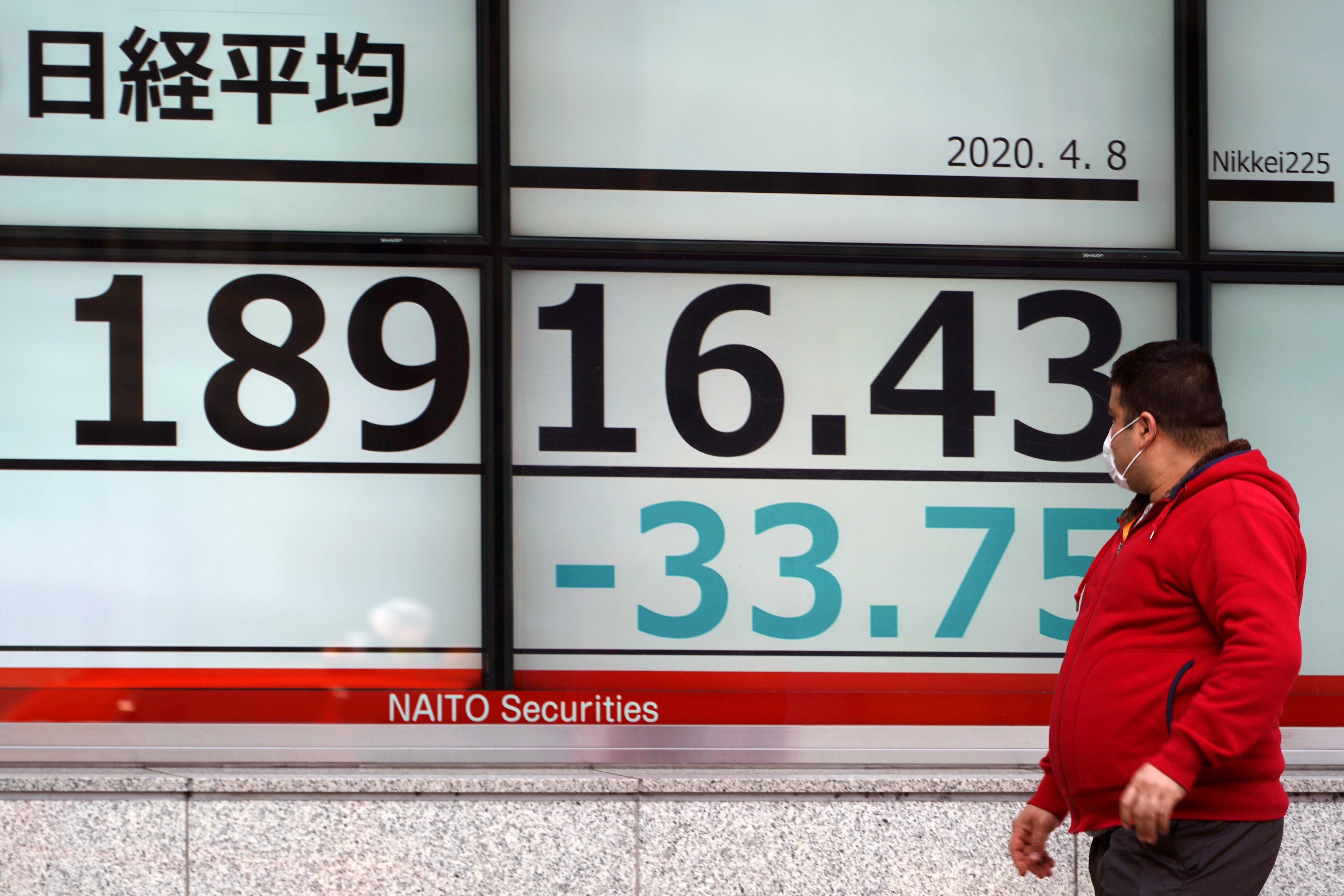
A man looks at an electronic stock board showing Japan's Nikkei 225 index at a securities firm Wednesday, April 8, 2020, in Tokyo. Asian shares were mostly lower after gyrating in early trading amid uncertainty over the coronavirus outbreak.(AP Photo/Eugene Hoshiko)
By Stan Choe
Stocks climbed on Wall Street at the opening of trading Wednesday. Maybe this time it will last.
A big gain for the S&P 500 suddenly vanished the day before, and trading remained unsettled around the world Wednesday. Asian stock markets were mixed and European indexes fell.
The S&P 500 was up 0.6% after the first 20 minutes of trading. The Dow Jones Industrial Average rose 170 points, or 0.7%, to 22,813 and the Nasdaq was up 0.6%.
Markets have been incredibly volatile in recent weeks as investors blindly guess how badly the coronavirus outbreak will hurt corporate profits amid suffocating uncertainty. The economic damage is widespread, and France’s central bank said its economy entered a recession with a 6% drop in the first three months of the year.
Countering that has been unprecedented aid from governments and central banks. Some investors are also pointing to nascent signs that infections and deaths may soon be peaking or plateauing in several hotspots around the world.
Caught between those forces are investors, who have sent the S&P 500 down about 20% from its record set in February. Earlier, it had fallen as much as a third from that mark, reflecting investors’ expectations for a steep, sudden recession and drops in corporate profits. Where stocks go from here depends on how long it takes for the economy to reopen and get closer to what used to be normal.
Stocks that have been beaten down the most since the sell-off began in February were leading the market Wednesday, including energy companies, retailers, airlines and other travel-related companies. That was also the early trend of Tuesday, before the gains vanished.
Kohl's rose 8.5%, Noble Energy rose 8% and American Airlines Group was up 6%, though all three are still down more than 60% for 2020 so far.
Treasury yields, which signaled worries about the economic damage coming from the coronavirus outbreak earlier than the stock market, were relatively steady. The yield on the 10-year Treasury rose to 0.75% from 0.73% late Tuesday.
European stocks dipped as finance ministers clashed over a proposal to borrow as a collective to pay for the health crisis. Countries that have been hardest hit there by COVID-19 are also among those that can least afford to pay for it, such as Italy and Spain. But the outbreak is dragging on economies across the continent. German economists predict its economy will shrink 4.2% this year.
Germany’s DAX slipped 0.2%, and France’s CAC 40 fell 0.6%. The FTSE 100 in London lost 0.7%.
Trading in Asia was more mixed.
Japan’s Nikkei 225 rose 2.1%, while stocks in South Korea fell 0.9% and Hong Kong lost 1.2%.
Benchmark U.S. crude oil rose 82 cents to $24.45 a barrel Wednesday, recovering some of its 9% slide from the prior day. Oil prices have been even more volatile than stocks recently as Russia and Saudi Arabia argue about whether to cut production in the face of withering demand. Oil producers are set to meet on Thursday.
Brent crude, the international standard, gained 20 cents to $32.07.
While many investors are preoccupied with the pandemic, energy remains another major factor driving trading.
Even Thursday’s meeting was in doubt after Iran demanded greater clarity on the scale of U.S. oil production before talks can start.
For “more immediate market stability concerns, all eyes and ears remain trained on the success of the OPEC+ meeting on Thursday,” Stephen Innes of AxiCorp said in a commentary.
The New York Times and President Donald Trump are fighting again. The news outlet said Wednesday it won't be deterred by Trump's “false and inflammatory language” from writing about the 79-year-old president's health. The Times has done a handful of stories on that topic recently, including an opinion column that said Trump is “starting to give President Joe Biden vibes.” In a Truth Social post, Trump said it might be treasonous for outlets like the Times to do “FAKE” reports about his health and "we should do something about it.” The Republican president already has a pending lawsuit against the newspaper for its past reports on his finances.
OpenAI has appointed Slack CEO Denise Dresser as its first chief of revenue. Dresser will oversee global revenue strategy and help businesses integrate AI into daily operations. OpenAI CEO Sam Altman recently emphasized improving ChatGPT, which now has over 800 million weekly users. Despite its success, OpenAI faces competition from companies like Google and concerns about profitability. The company earns money from premium ChatGPT subscriptions but hasn't ventured into advertising. Altman had recently announced delays in developing new products like AI agents and a personal assistant.
President Donald Trump says he will allow Nvidia to sell its H200 computer chip used in the development of artificial intelligence to “approved customers” in China. Trump said Monday on his social media site that he had informed China’s leader Xi Jinping and “President Xi responded positively!” There had been concerns about allowing advanced computer chips into China as it could help them to compete against the U.S. in building out AI capabilities. But there has also been a desire to develop the AI ecosystem with American companies such as chipmaker Nvidia.
U.S. sports betting is booming as NFL and college football fuel massive activity. BetMGM CEO Adam Greenblatt breaks down trends, growth, and what’s next.
President Donald Trump says a deal struck by Netflix last week to buy Warner Bros. Discovery “could be a problem” because of the size of the combined market share. The Republican president says he will be involved in the decision about whether federal regulators should approve the deal. Trump commented Sunday when he was asked about the deal as he walked the red carpet at the Kennedy Center Honors. The $72 billion deal would bring together two of the biggest players in television and film and potentially reshape the entertainment industry.
Disney's changes to a program for disabled visitors are facing challenges in federal court and through a shareholder proposal. The Disability Access Service program, which allows disabled visitors to skip long lines, was overhauled last year. Disney now mostly limits the program to those with developmental disabilities like autism who have difficulty waiting in lines. The changes have sparked criticism from some disability advocates. A shareholder proposal submitted by disability advocates calls for an independent review of Disney's disability policies. Disney plans to block this proposal, claiming it's misleading. It's the latest struggle by Disney to accommodate disabled visitors while stopping past abuses by some theme park guests.
With a merger this big, creators, studios, and theaters all face uncertain futures. Here’s what experts are worried about and what good could come from it.
With disengagement rising and hybrid work shifting, 'Everybody Matters' author Bob Chapman explains why treating people well could define the future of work.
We sat down with Ali Furman, U.S. Consumer Markets Industry Leader at consulting firm PwC to ask what trends she garnered from the initial data this year.