North Carolina's high-tech Research Triangle may get even more advanced in years to come.
The Tar Heel State announced on Friday that it is exploring options to bring Virgin Hyperloop One technology to the Raleigh-Durham-Chapel Hill corridor, which has grown into a hub for technology companies and research universities.
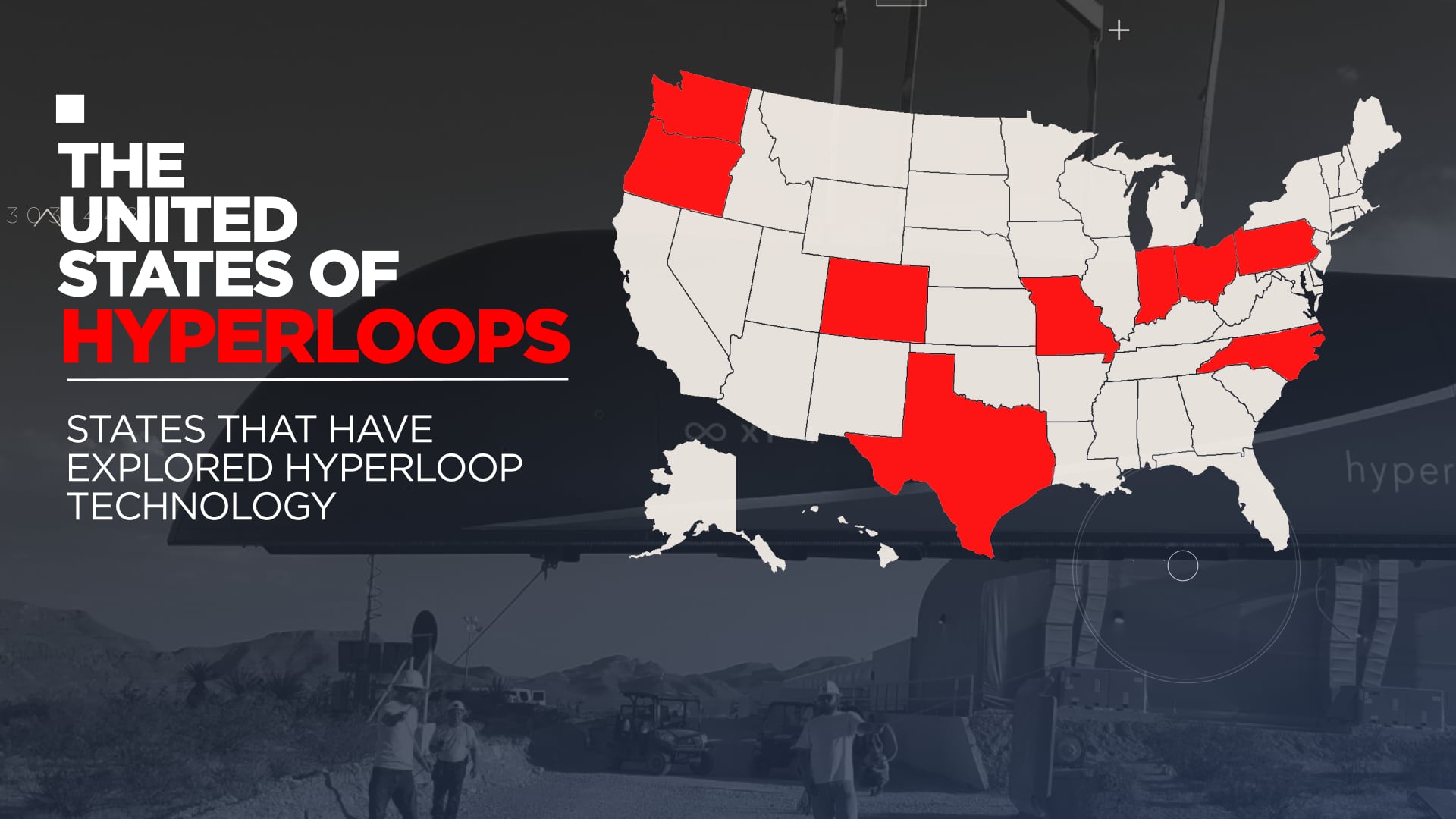
"You can literally begin to start thinking about the cities like they're metro stops," Jay Walder, the CEO of Virgin Hyperloop One, told Cheddar. North Carolina's inquiry makes it the ninth state to explore hyperloop as a potential regional transportation system.
"We have stopped our imagination somewhere around 1956, which is when the interstate highway system was created, and it is time to restart our imagination," Walder said.
Virgin Hyperloop One, which was developed by Virgin founder Richard Branson, is the first company to successfully operate a full-scale hyperloop vehicle system, which uses electric propulsion and electromagnetic levitation in depressurized tubes to propel vehicles at hundreds of miles per hour.
"Imagine being in a super-fast vehicle that is completely smooth, no turbulence moving at airline speed," Walder added.
Although still in its early stages, hyperloop technology is proving to be a far faster, safer, and more environmentally friendly alternative to traditional forms of transportation, according to the company.
"The Research Triangle area is uniquely positioned from a technology focus, spatial layout, and favorable mid-East Coast location to benefit from a hyperloop travel solution that could quickly link America's R&D cities of Raleigh and Durham with each other and with neighboring regions in the southeast and mid-Atlantic," Joe Milazzo II, the executive director of North Carolina's Regional Transportation Alliance, said in a statement.
Trips between Raleigh, Durham, and Chapel Hill are expected to be under 10 minutes, according Virgin Hyperloop One's initial estimates.
"You can take it a step further — Raleigh-Durham to Washington DC it just over 35 minutes," Walder told Cheddar.
A group of crypto enthusiasts pooled over $40 million dollars in an attempt to win a copy of the U.S. Constitution last week. However, their efforts came up short, as hedge fund billionaire Ken Griffin emerged as the victor in a $43.2 million Sotheby's auction. Matt Cutler, CEO & Co-Founder of Blocknative, joins Cheddar News' Closing Bell, where he explains why ConstitutionDAO ultimately came up short.
Gparency, a company that says its mission is to revolutionize the commercial mortgage industry, raised $15 million in its first funding round - representing the largest ever seed round in the commercial real estate space. Gparency's service will allow landlords and real estate developers to receive funding directly from banks, without the need for a mortgage broker. The company says its new approach will give power back to the consumer. Gparency founder and CEO Ira Zlotowitz joins Cheddar News' Closing Bell to discuss.
Rapper and singer T-Pain is teaming up with Google this holiday season to encourage shoppers to support Black-owned businesses on Black Friday. Stephanie Horton, the director of marketing for Google Shopping, joined Cheddar to provide some details about T-Pain's new song, featuring Normani, in a new shoppable interactive film for the promotion. She also explained how Google worked with local artists in various states to create shoppable murals, where products seen in the artwork are discoverable online by simply pointing your camera at it.
Per a request from the UK singing sensation Adele after her new album "30" dropped on Friday, Spotify removed shuffle play as the default for albums. Adele tweeted about her request to the streaming service, arguing that an album's track sequence is intentional and that the songs should be listened to in that order.
Caleb Silver, the Editor-in-Chief for Investopedia, joined Wake Up With Cheddar to break down the latest in the Activision Blizzard sexual misconduct scandal. After 1,700 of the embattled video game maker's employees signed a petition demanding CEO Bobby Kotick step down, Kotick reportedly said he would step down if he can't turn the toxic workplace culture around quickly. Silver noted that the allegations go back years with settlements and lawsuits that indicate Kotick would have to be claiming ignorance of his own business or deliberately obfuscating his knowledge of what happened under his watch.
In 2022, all 3G networks will shutdown permanently. Sprint will be leading the charge as the first network to go dark on New Year's Day, and the rest will follow shortly thereafter. Ryan Johnston of Next Century Cities joins Cheddar News to discuss the importance of the shutdown, and how users who may be affected can act fast before they're left disconnected.