North Carolina's high-tech Research Triangle may get even more advanced in years to come.

The Tar Heel State announced on Friday that it is exploring options to bring Virgin Hyperloop One technology to the Raleigh-Durham-Chapel Hill corridor, which has grown into a hub for technology companies and research universities.

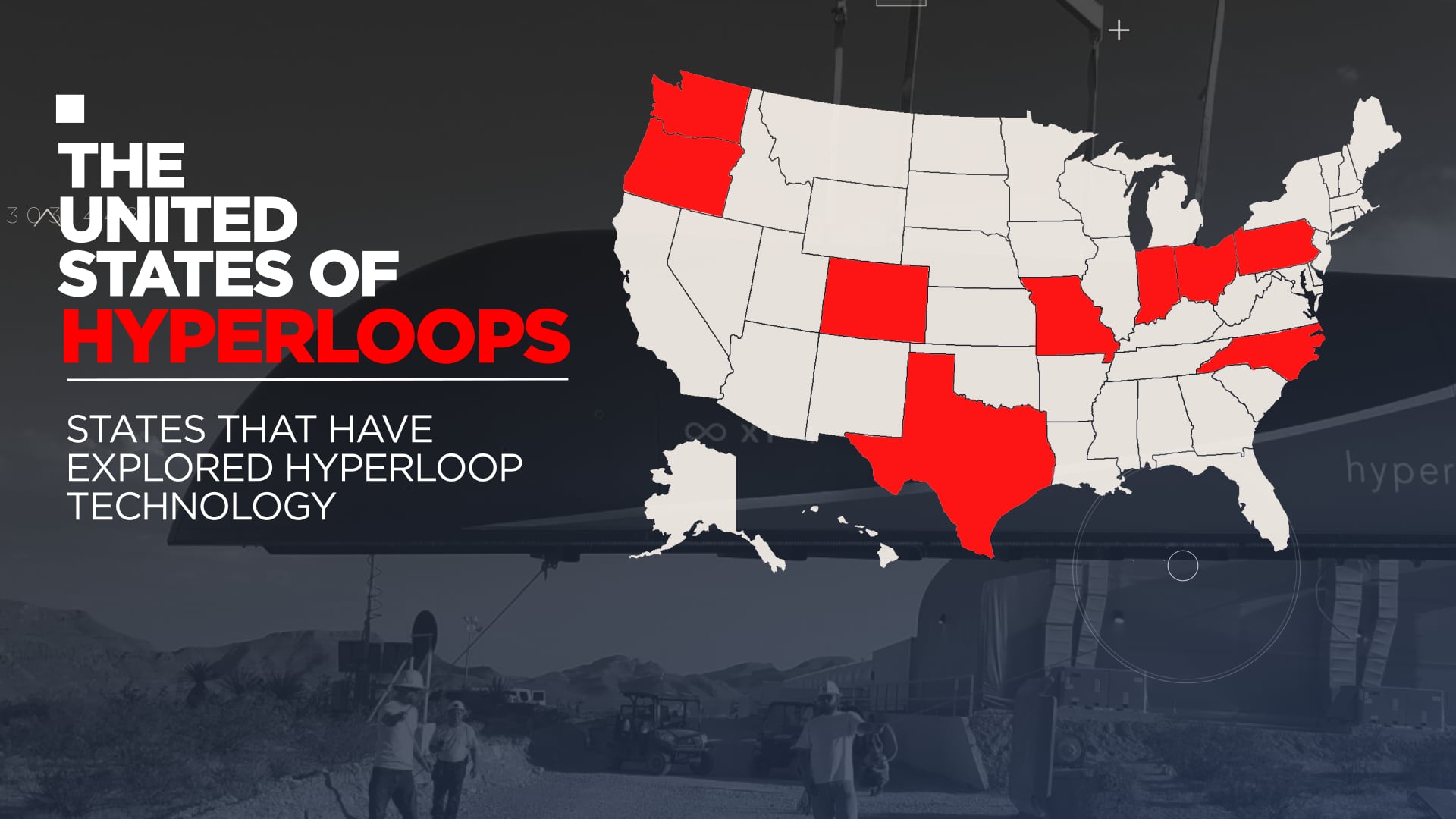
"You can literally begin to start thinking about the cities like they're metro stops," Jay Walder, the CEO of Virgin Hyperloop One, told Cheddar. North Carolina's inquiry makes it the ninth state to explore hyperloop as a potential regional transportation system.

"We have stopped our imagination somewhere around 1956, which is when the interstate highway system was created, and it is time to restart our imagination," Walder said.

Virgin Hyperloop One, which was developed by Virgin founder Richard Branson, is the first company to successfully operate a full-scale hyperloop vehicle system, which uses electric propulsion and electromagnetic levitation in depressurized tubes to propel vehicles at hundreds of miles per hour.

"Imagine being in a super-fast vehicle that is completely smooth, no turbulence moving at airline speed," Walder added.

Although still in its early stages, hyperloop technology is proving to be a far faster, safer, and more environmentally friendly alternative to traditional forms of transportation, according to the company.

"The Research Triangle area is uniquely positioned from a technology focus, spatial layout, and favorable mid-East Coast location to benefit from a hyperloop travel solution that could quickly link America's R&D cities of Raleigh and Durham with each other and with neighboring regions in the southeast and mid-Atlantic," Joe Milazzo II, the executive director of North Carolina's Regional Transportation Alliance, said in a statement.

Trips between Raleigh, Durham, and Chapel Hill are expected to be under 10 minutes, according Virgin Hyperloop One's initial estimates.

"You can take it a step further — Raleigh-Durham to Washington DC it just over 35 minutes," Walder told Cheddar.

<i>Cheddar</i>
Share:
More In Technology
Pfizer, BioNTech to Develop mRNA Shingles Vaccine
Pfizer and BioNTech are working to develop an mRNA-based shingles vaccine following the success of the COVID-19 shot. This latest collaboration will mark the third time the pharmaceutical companies have worked together on a vaccine.
SGH Reports Solid Q1 Results
SGH, formerly known as Smart Global Holdings, reported Q1 earnings after the bell on Tuesday. The holdings company reported solid net sales, up a whopping 60 percent from the same period last year, marking its seventh consecutive quarter of year-over-year revenue growth. SGH also announced a two-for-one share split in the form of a share dividend of one ordinary share for every one ordinary share owned. Mark Adams, CEO, SGH and Former President, Micron, joined Wake Up with Cheddar to discuss.
LG Annouces New Appliances and Recipe Service
LG announced its latest cooking appliances including its ThinQ Recipe service. The app allows people to choose from up to 10,000 recipes and have the ingredients delivered to their doorstep. LG Electronics executive Brandt Varner joins Cheddar News to talk about the products.
Elizabeth Holmes Fraud Conviction Might Yield Five to Seven Years in Prison
The six-month trial of Theranos founder Elizabeth Holmes has come to an end with the former tech startup star found guilty of four out of 11 counts of fraud. Michael S. Weinstein, Esq, chair of the white collar criminal defense practice at Cole Schotz, and former Department of Justice trial attorney, joined Cheddar News Wrap to discuss what happens next for the former mogul. "Do I think it's going to be more than five or seven years? Probably yes. I think that's probably a fair range at this point," he said about her potential prison sentence.
Elon Musk Sets Big Goals Towards Starship and Starlink
Elon Musk continues on his path to make a reusable rocket with his starship project, but it's not going to be easy. If successful, the rocket would heavily reduce launch costs, in addition to further developing Starlink, Musk’s satellite-based internet service. Rick Tumlinson, founding partner at Space Fund, spoke to Cheddar News about the future of SpaceX.
Load More