North Carolina's high-tech Research Triangle may get even more advanced in years to come.
The Tar Heel State announced on Friday that it is exploring options to bring Virgin Hyperloop One technology to the Raleigh-Durham-Chapel Hill corridor, which has grown into a hub for technology companies and research universities.
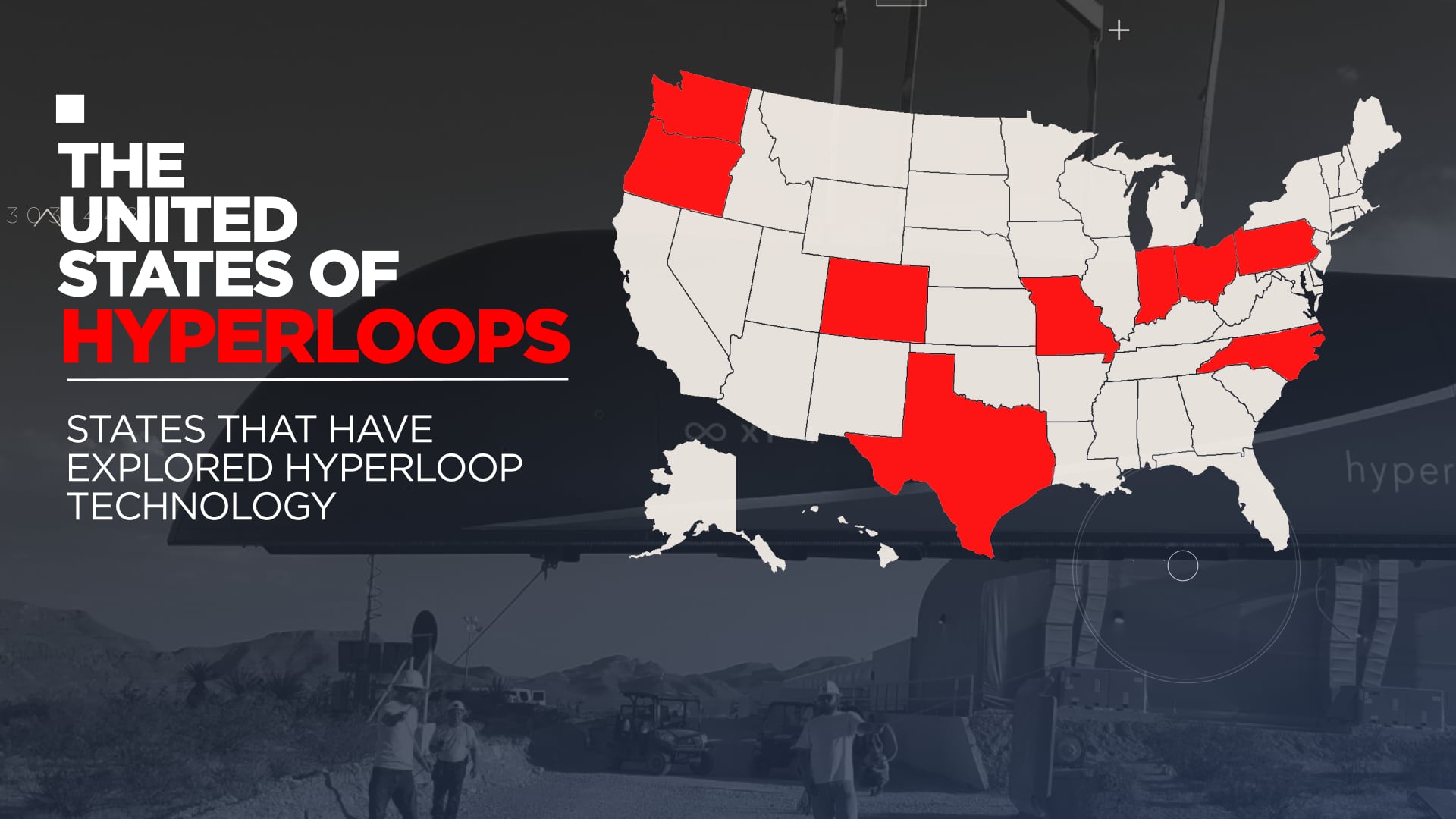
"You can literally begin to start thinking about the cities like they're metro stops," Jay Walder, the CEO of Virgin Hyperloop One, told Cheddar. North Carolina's inquiry makes it the ninth state to explore hyperloop as a potential regional transportation system.
"We have stopped our imagination somewhere around 1956, which is when the interstate highway system was created, and it is time to restart our imagination," Walder said.
Virgin Hyperloop One, which was developed by Virgin founder Richard Branson, is the first company to successfully operate a full-scale hyperloop vehicle system, which uses electric propulsion and electromagnetic levitation in depressurized tubes to propel vehicles at hundreds of miles per hour.
"Imagine being in a super-fast vehicle that is completely smooth, no turbulence moving at airline speed," Walder added.
Although still in its early stages, hyperloop technology is proving to be a far faster, safer, and more environmentally friendly alternative to traditional forms of transportation, according to the company.
"The Research Triangle area is uniquely positioned from a technology focus, spatial layout, and favorable mid-East Coast location to benefit from a hyperloop travel solution that could quickly link America's R&D cities of Raleigh and Durham with each other and with neighboring regions in the southeast and mid-Atlantic," Joe Milazzo II, the executive director of North Carolina's Regional Transportation Alliance, said in a statement.
Trips between Raleigh, Durham, and Chapel Hill are expected to be under 10 minutes, according Virgin Hyperloop One's initial estimates.
"You can take it a step further — Raleigh-Durham to Washington DC it just over 35 minutes," Walder told Cheddar.
Chris Vecchio, senior analyst at DailyFX, joins Cheddar News to discuss what investors should watch as the three major indexes see wild swings all week.
Although the auto industry is faced with chip shortages and supply chain woes, Tesla was still expected to report record earnings, and Elon Musk did not disappoint. Jon Rettinger, President of JFL Network, joins Cheddar News to discuss the company, the electric vehicle competition, and growth for the auto industry.
Rita Brooks, Co-Founder of Palmly, joins ChedHER to discuss how she's creating a social networking app for Christians, and her experience being a female founder in the tech industry.
A year after the r/WallStreetBets community on Reddit drove GameStop and other meme stocks to unprecedented heights, the subreddit seems to be losing its luster among retail investors. Caitlin McCabe, markets and retail trading reporter from The Wall Street Journal, joined Cheddar to talk about the waning popularity of the group “Users are going on to find the next GameStop, and instead, they're seeing many of the new users who have joined the subreddit still talking about GameStop and AMC," McCabe noted. "And, they've become frustrated as they're ready to move on from those original meme stocks."
Tech titan Microsoft reported its second fiscal quarter of 2022 earnings on Tuesday, its first earnings report since announcing its plans to acquire gaming company Activision Blizzard in a multibillion dollar deal. Steve Larsen, co-founder of PlannerDAO, explains the role that cloud services played for Microsoft in the quarter and what the future may hold for Microsoft in the midst of the new acquisition.
Microsoft is expected to report financial results for its second fiscal quarter of 2022. It comes after the company beat on its top and bottom line in its previous four quarters. John Freeman of CFRA Research explains what investors will be keeping an eye out for as Microsoft continues to expand its domain.