North Carolina's high-tech Research Triangle may get even more advanced in years to come.
The Tar Heel State announced on Friday that it is exploring options to bring Virgin Hyperloop One technology to the Raleigh-Durham-Chapel Hill corridor, which has grown into a hub for technology companies and research universities.
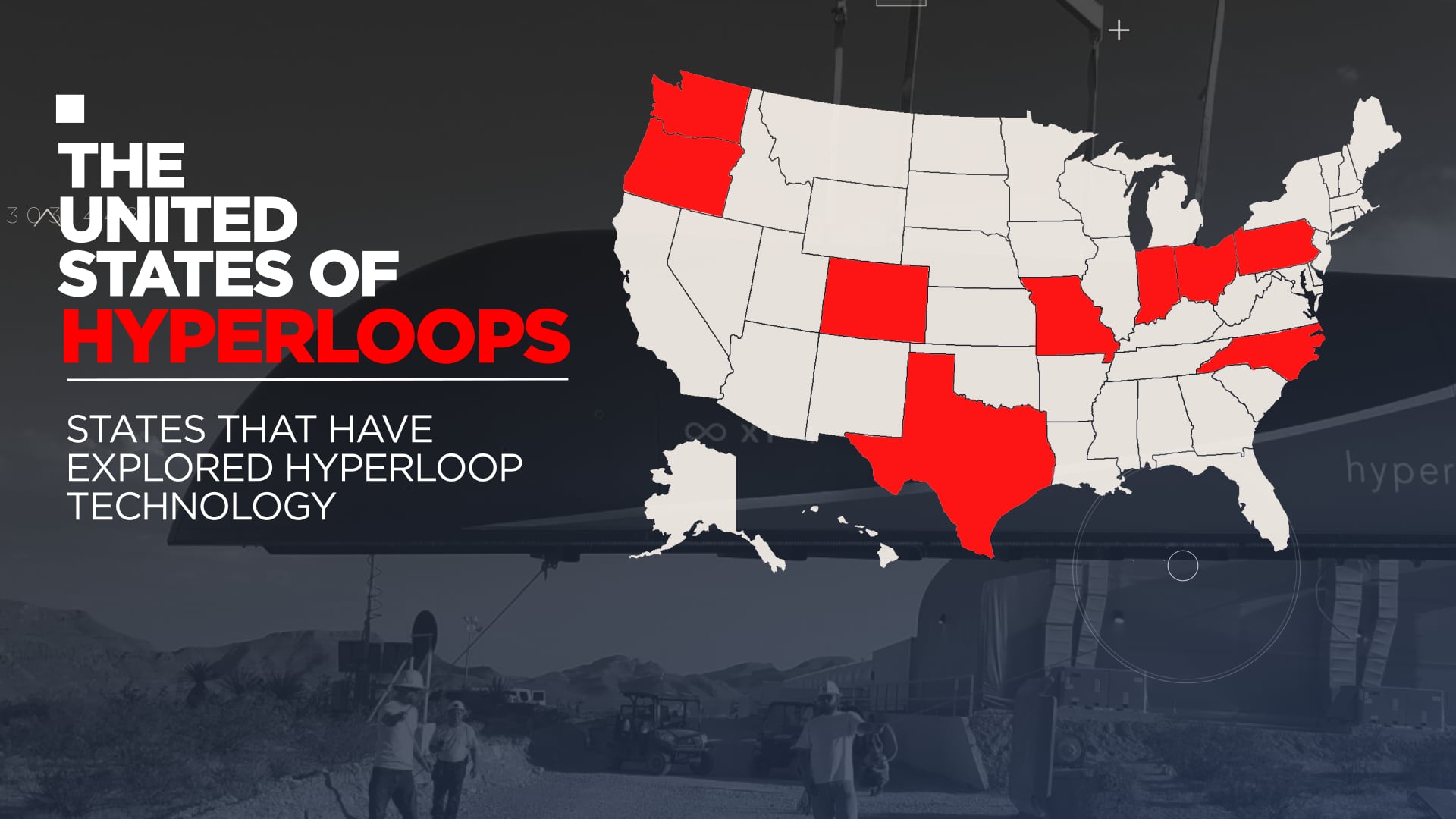
"You can literally begin to start thinking about the cities like they're metro stops," Jay Walder, the CEO of Virgin Hyperloop One, told Cheddar. North Carolina's inquiry makes it the ninth state to explore hyperloop as a potential regional transportation system.
"We have stopped our imagination somewhere around 1956, which is when the interstate highway system was created, and it is time to restart our imagination," Walder said.
Virgin Hyperloop One, which was developed by Virgin founder Richard Branson, is the first company to successfully operate a full-scale hyperloop vehicle system, which uses electric propulsion and electromagnetic levitation in depressurized tubes to propel vehicles at hundreds of miles per hour.
"Imagine being in a super-fast vehicle that is completely smooth, no turbulence moving at airline speed," Walder added.
Although still in its early stages, hyperloop technology is proving to be a far faster, safer, and more environmentally friendly alternative to traditional forms of transportation, according to the company.
"The Research Triangle area is uniquely positioned from a technology focus, spatial layout, and favorable mid-East Coast location to benefit from a hyperloop travel solution that could quickly link America's R&D cities of Raleigh and Durham with each other and with neighboring regions in the southeast and mid-Atlantic," Joe Milazzo II, the executive director of North Carolina's Regional Transportation Alliance, said in a statement.
Trips between Raleigh, Durham, and Chapel Hill are expected to be under 10 minutes, according Virgin Hyperloop One's initial estimates.
"You can take it a step further — Raleigh-Durham to Washington DC it just over 35 minutes," Walder told Cheddar.
Stocks closed at session lows Thursday, mostly due to a larger tech selloff after Facebook parent company Meta reported weak earnings results one day before. The Nasdaq closed down nearly 4% for its worst day since September 2020. Erin Gibbs, Chief Investment Officer at Main Street Asset Management, joins Closing Bell to discuss today's close, Meta earnings, Amazon earnings, and more
Spotify beat fourth quarter earnings expectations, and also reported a jump in monthly active users and in paid subscribers. The report comes as the company grapples with a new question: is it simply a streaming platform, or is it a media company responsible for the content it posts, like Joe Rogan's controversial podcast? Greg Martin, Co-Founder of Rainmaker Securities, joins Closing Bell to discuss why the stock took a hit even though earnings results were positive, how the company can move forward through the Rogan controversy, and more.
Chen Arad, Chief Operating Officer for Solidus Labs, joins Cheddar News' Closing Bell, where he explains why Wormhole was particularly vulnerable to a $320+ million crypto hack and discusses what new investors need to do in order to protect their assets.
E-commerce platform for construction and building materials RenoRun has raised $142 million in a Series B round, which the company says is the fourth largest Series B round in Canadian history. RenoRun’s platform offers same-day delivery of construction materials to job sites in Canada and the United States. The company aims to revolutionize the construction industry by maximizing productivity and efficiency. RenoRun co-founder and CEO Eamonn O’Rourke joins Cheddar News' Closing Bell to discuss.
Facebook parent company Meta reported weaker-than-expected fourth quarter earnings, and also issued disappointing guidance for Q1 2022. The tech giant is also under pressure due to Apple's iOS privacy change, as well as continued multi-billion dollar losses for its metaverse focused business unit. Angelo Zino, Tech Analyst at CFRA Research, joins Closing Bell to discuss the earnings results, how Apple's iOS privacy change will impact revenue, whether the metaverse is an underrated investment opportunity, and more.
The video game industry has seen monumental growth the past few years - with an increasing amount of companies jumping head first into the space. In January alone, Microsoft announced its plan to acquire Activision Blizzard, game publisher Take-Two agreed to buy Zynga, and most recently, Sony announced it has agreed to buy game developer Bungie for $3.6 billion. Tobias Batton, CEO and founder of Ex Populus, joined Cheddar Movers to discuss the surge in M&A activity in the gaming space.
Facebook parent Meta reported disappointing results in its first quarterly earnings report since rebranding to focus on the metaverse. The tech giant delivered mixed results with quarterly profit falling well below Wall Street expectations. Shares plunged more than 20 percent in after hours trading as a result. Martin Garner, COO of CCS Insight, joined Cheddar Movers to break down the company's results.