By Susan Montoya Bryan and Marcia Dunn

Virgin Galactic is taking its first space tourists on a long-delayed rocket ship ride, including a former British Olympian who bought his ticket 18 years ago and a mother-daughter duo from the Caribbean.

The rocket-powered plane was carried aloft Thursday morning from Spaceport America in the New Mexico desert. The flight plan called for the plane to be released about an hour later and fire its rocket to reach the edge of space.

If all goes well, Richard Branson's company will begin offering monthly trips to customers on its winged space plane, joining Jeff Bezos' Blue Origin and Elon Musk's SpaceX in the space tourism business.

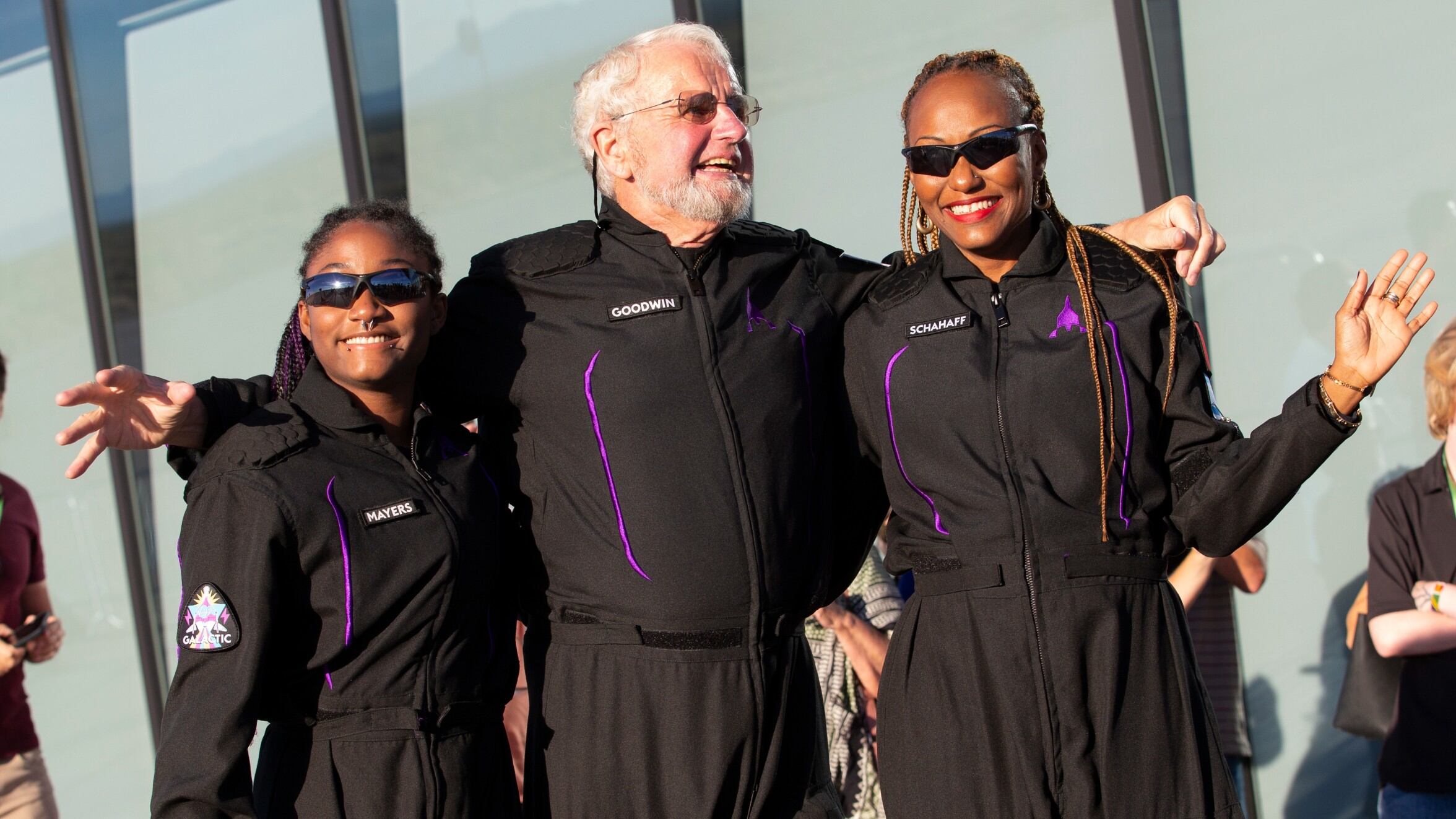
Virgin Galactic passenger Jon Goodwin, who was among the first to buy a ticket in 2005, said he had faith that he would someday make the trip. The 80-year-old athlete — he competed in canoeing in the 1972 Olympics — has Parkinson's disease and wants to be an inspiration to others.

“I hope it shows them that these obstacles can be the start rather than the end to new adventures," he said in a statement.

Ticket prices were $200,000 when Goodwin signed up. The cost is now $450,000.

He was joined by sweepstakes winner Keisha Schahaff, 46, a health coach from Antigua, and her daughter, Anastatia Mayers, 18, a student at Scotland's University of Aberdeen. Also aboard the plane-launched craft, which glides to a space shuttle-like landing: two pilots and the company's astronaut trainer.

It will be Virgin Galactic's seventh trip to space since 2018, but the first with a ticket-holder. Branson, the company's founder, hopped on board for the first full-size crew ride in 2021. Italian military and government researchers soared in June on the first commercial flight. About 800 people are currently on Virgin Galactic’s waiting list, according to the company.

Virgin Galactic’s rocket ship launches from the belly of an airplane, not from the ground, and requires two pilots in the cockpit. Once the mothership reaches about 50,000 feet (10 miles or 15 kilometers), the space plane is released and fires its rocket motor to make the final push to just over 50 miles (80 kilometers) up. Passengers can unstrap from their seats, float around the cabin for a few minutes and take in the sweeping views of Earth, before the space plane glides back home and lands on a runway.

In contrast, the capsules used by SpaceX and Blue Origin are fully automated and parachute back down.

People have been taking on adventure travel for decades, the risks underscored by the recent implosion of the Titan submersible that killed five passengers on their way down to view the Titanic wreckage. Virgin Galactic suffered its own casualty in 2014 when its rocket plane broke apart during a test flight, killing one pilot. Yet space tourists are still lining up, ever since the first one rocketed into orbit in 2001 with the Russians

Dunn reported from Cape Canaveral, Florida.

The Associated Press Health and Science Department receives support from the Howard Hughes Medical Institute’s Science and Educational Media Group. The AP is solely responsible for all content.

Share:
More In Technology
Spain fines Airbnb $75 million for unlicensed tourist rentals
Spain's government has fined Airbnb 64 million euros or $75 million for advertising unlicensed tourist rentals. The consumer rights ministry announced the fine on Monday. The ministry stated that many listings lacked proper license numbers or included incorrect information. The move is part of Spain's ongoing efforts to regulate short-term rental companies amid a housing affordability crisis especially in popular urban areas. The ministry ordered Airbnb in May to remove around 65,000 listings for similar violations. The government's consumer rights minister emphasized the impact on families struggling with housing. Airbnb said it plans to challenge the fine in court.
Militant groups are experimenting with AI, and the risks are expected to grow
The Islamic State group and other militant organizations are experimenting with artificial intelligence as a tool to boost recruitment and refine their operations. National security experts say that just as businesses, governments and individuals have embraced AI, extremist groups also will look to harness the power of AI. That means aiming to improve their cyberattacks, breaking into sensitive networks and creating deepfakes that spread confusion and fear. Leaders in Washington have responded with calls to investigate how militant groups are using AI and seek ways to encourage tech companies to share more about how their products are being potentially misused.
Trump signs executive order to block state AI regulations
President Donald Trump has signed an executive order to block states from regulating artificial intelligence. He argues that heavy regulations could stifle the industry, especially given competition from China. Trump says the U.S. needs a unified approach to AI regulation to avoid complications from state-by-state rules. The order directs the administration to draw up a list of problematic regulations for the Attorney General to challenge. States with laws could lose access to broadband funding, according to the text of the order. Some states have already passed AI laws focusing on transparency and limiting data collection.
San Francisco woman gives birth in a Waymo self-driving taxi
Waymo's self-driving taxis have been in the spotlight for both negative and positive reasons. This week, the automated ride-hailing taxis went viral after a San Francisco woman gave birth inside a Waymo taxi while on her way to the hospital. A Waymo spokesperson on Wednesday confirmed the unusual delivery. It said the company's rider support team detected unusual activity inside the vehicle and alerted 911. The taxi arrived safely at the hospital before emergency services. Waymo's popularity is growing despite heightened scrutiny following an illegal U-turn and the death of a San Francisco cat. The company, owned by Alphabet, says it is proud to serve riders of all ages.
OpenAI names Slack CEO Dresser as first chief of revenue
OpenAI has appointed Slack CEO Denise Dresser as its first chief of revenue. Dresser will oversee global revenue strategy and help businesses integrate AI into daily operations. OpenAI CEO Sam Altman recently emphasized improving ChatGPT, which now has over 800 million weekly users. Despite its success, OpenAI faces competition from companies like Google and concerns about profitability. The company earns money from premium ChatGPT subscriptions but hasn't ventured into advertising. Altman had recently announced delays in developing new products like AI agents and a personal assistant.
Trump approves sale of more advanced Nvidia computer chips used in AI to China
President Donald Trump says he will allow Nvidia to sell its H200 computer chip used in the development of artificial intelligence to “approved customers” in China. Trump said Monday on his social media site that he had informed China’s leader Xi Jinping and “President Xi responded positively!” There had been concerns about allowing advanced computer chips into China as it could help them to compete against the U.S. in building out AI capabilities. But there has also been a desire to develop the AI ecosystem with American companies such as chipmaker Nvidia.
Load More