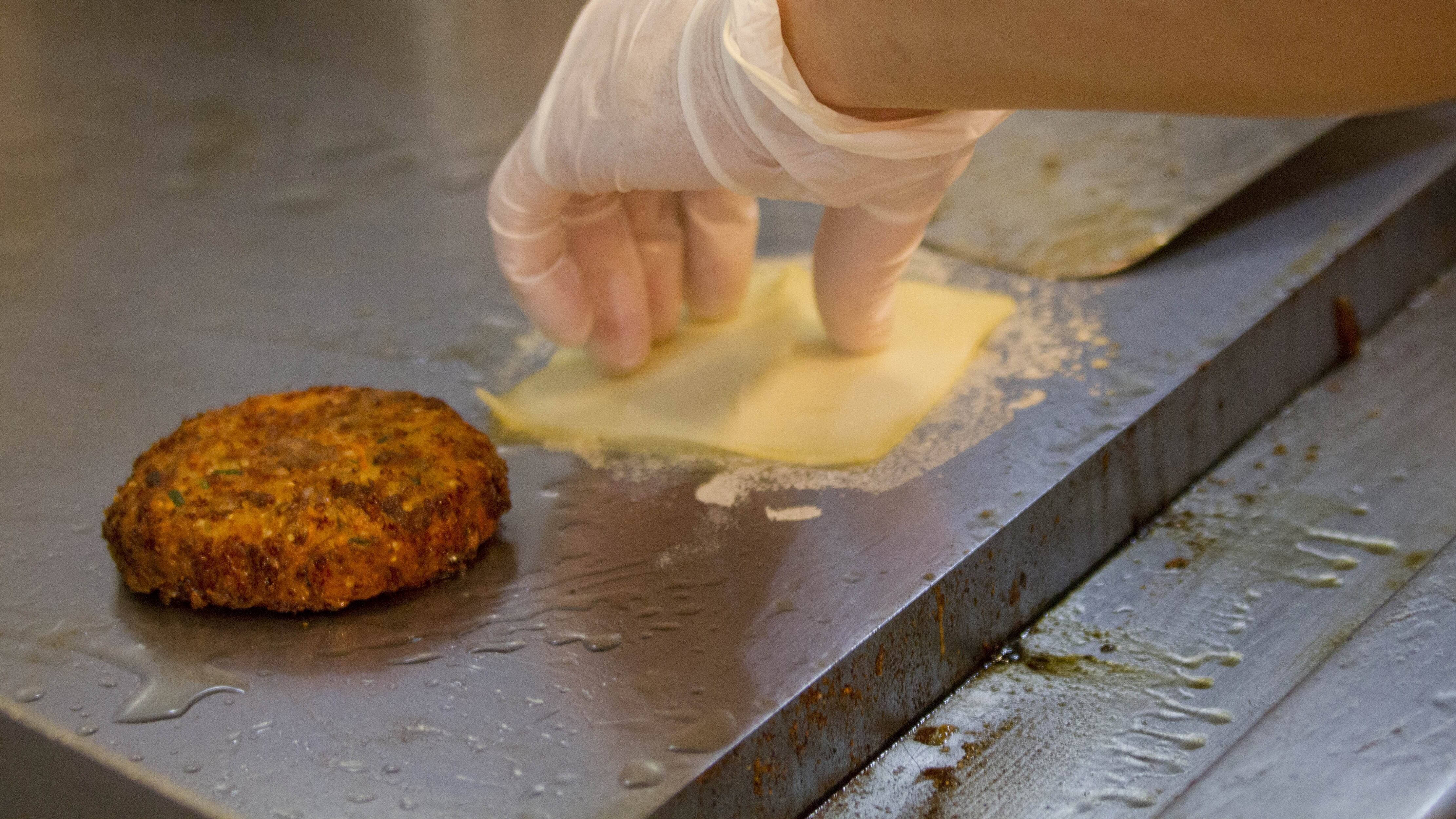
In this file photo from Tuesday, Jan. 27, 2015, a BurgerFi restaurant employee prepares to add cheese to a veggie burger as she grills an order at the Aventura, Fla., restaurant. (AP Photo/Wilfredo Lee)
Plant-based products that do not contain meat can continue to be labeled “sausages” or “burgers,” European lawmakers said Friday, when they rejected a proposal back by the meat industry to ban the terms.
In votes on issues relating to agricultural products, the European Parliament said that so-called veggie burgers, soy steaks and vegan sausages can continue to be sold as such in restaurants and shops across the union.
Europe’s largest farmers' association, Copa-Cogeca, had supported a ban, arguing that labeling vegetarian substitutes with designations bringing meat to mind was misleading for consumers.
On the opposite side of the debate, a group of 13 organizations including Greenpeace and WWF urged lawmakers to reject the proposed amendments, arguing that a ban would have not only exposed the EU “to ridicule," but also damaged its environmental credibility.
They said promoting a shift toward more plant-based diet is in line with the EU Commission's ambition to tackle global warming. Losing the ability to use the terms steak or sausage might make those plant-based products more obscure for consumers.
After the vote, the European Consumer Organization, an umbrella group bringing together consumers' associations, praised the MEPs for their “common sense."
“Consumers are in no way confused by a soy steak or chickpea-based sausage, so long as it is clearly labeled as vegetarian or vegan," the group said in a statement. “Terms such as ‘burger’ or ‘steak’ on plant-based items simply make it much easier for consumers to know how to integrate these products within a meal."
Together with Greenpeace, the group regretted that lawmakers accepted further restrictions on the naming of alternative products containing no dairy. Terms like ‘almond milk’ and ‘soy yogurt’ are already banned in Europe after the bloc's top court ruled in 2017 that purely plant-based products can't be marketed using terms such as milk, butter or cheese, which are reserved for animal products.
Meta announced its plans to join the Cannes Lions International Festival of Creativity. This is leaving businesses and customers wondering what the tech giant has in store for the event. Nicola Mendelsohn, the vice president of the global business group at Meta, joined Cheddar News to preview what the tech giant will discuss at this year's festival. "We're going to be showcasing more about reels. We're going to be talking about our commerce solutions, are messaging solutions, and of course, the method of us speaking of new ways to kind of connect with customers," she said.
On today's episode of On The Job: Cheddar gets a look at how the salon and beauty industry has pivoted throughout the pandemic; Mark Brim, President of Aquent's Recruiting Division Vitamin T, breaks down how remote work has transformed hiring and recruiting process across the board;
Julie Bauke, President & Chief Career Strategist at The Bauke Group, breaks down why companies are being 'ghosted' by new hires, and what repercussions can come from this.
Mark Brim, President of Aquent's Recruiting Division Vitamin T, joins On The Job to discuss how remote work has transformed hiring and recruiting process across the board, and the latest trends surrounding remote hiring across the globe.
Julie Bauke, President & Chief Career Strategist, The Bauke Group, joins Cheddar to discuss the phenomenon of new hires accepting jobs and quitting before their first day of work, and how ghosting one company may come back to bite you when you find a job you really want.
Miami's real estate market has boomed since early 2020, thanks to an overall strong housing market, remote work, and no income tax as incentives. The city is preparing to welcome even more residents as people relocate to warmer climates to work from home. Garrett Derderian, director of market intelligence at SERHANT, joined Cheddar to discuss the Magic City's red hot market.
Paul Tracey, Founder & CEO of Innovative Technologies, and author of 'Delete The Hacker Playbook' and 'Cyber Storm', joins Cheddar to discuss the most effective ways to protect small businesses from cyber attacks, the labor shortage's effects on cybercrime, and how businesses and employees can stay cyber secure while working from home.
A lot has changed since the pandemic began back in march 2020. COVID-19 caused a huge disruption in the U.S. labor force that is just beginning to normalize. As of last month, about 96% of jobs lost in the pandemic have returned. Still, where people work now looks very different from two years ago. Cheddar's Shannon Lanier looks at where the jobs are now and where they aren't.